
Skip to content
The Encyclopedia of Horology

Clock · Bracket clock

Caramer, Kuss & Co. carved oak bracket clock

Partially verified

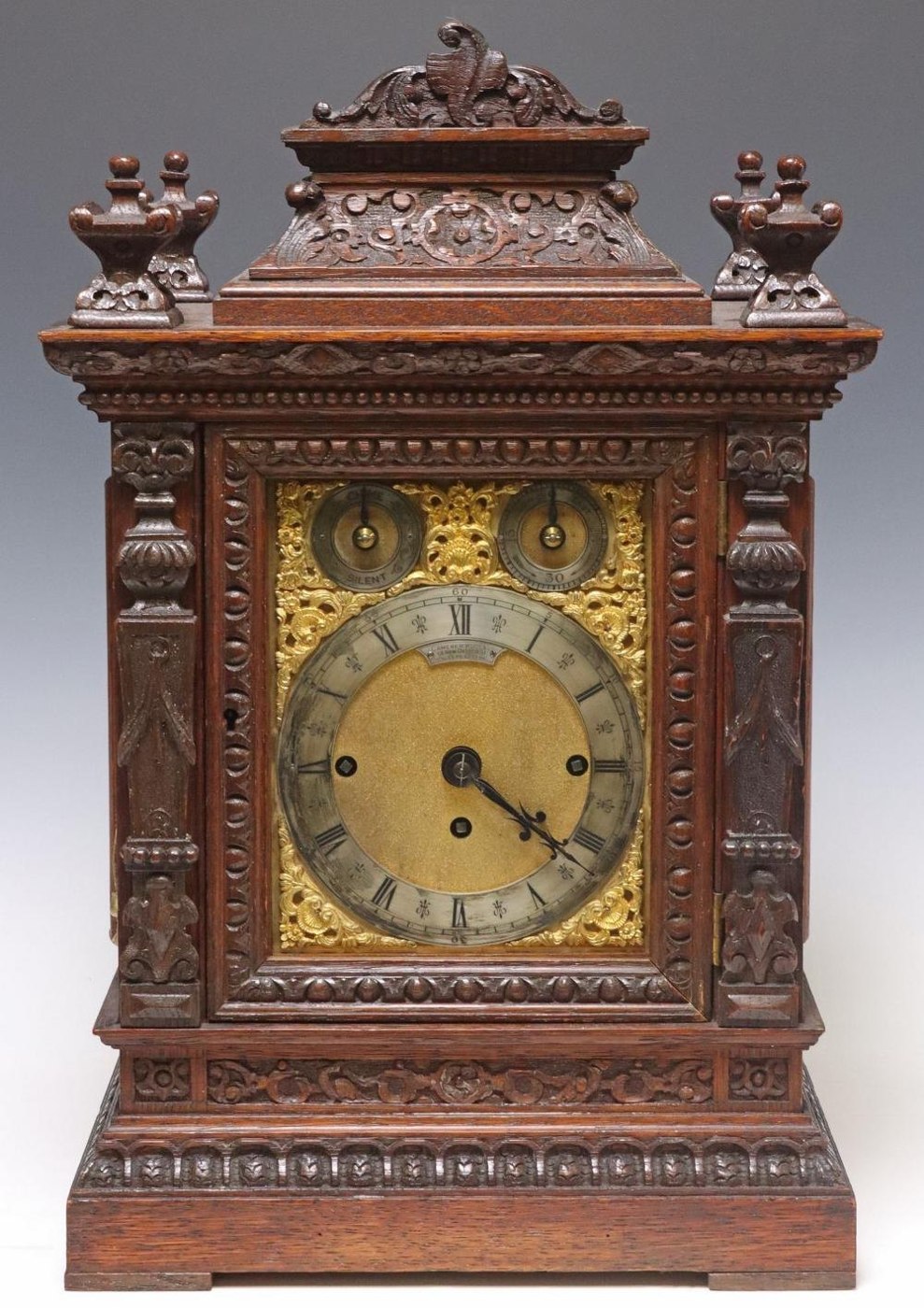
This late 19th to early 20th-century English bracket clock is housed in a substantial oak case with architectural features. The woodwork is decorated with carved scrollwork and running ornamentation, with pointed finials positioned at the top corners of the case. The clock sits on a stepped base. Centrally positioned is a gilt metal dial displaying Roman numeral hour markers, and the maker's signature, Caramer, Kuss, & Co., 56 New Oxford St., London, is inscribed on the dial. The timepiece is powered by a three-train chain-driven fusee movement, which also bears the maker's signature. The clock performs time, strike, and chime functions. The ensemble includes a pendulum and a winding key. The clock stands 17.5 inches high, 11 inches wide, and 9 inches deep, weighing approximately 26 pounds.

Front view of the Caramer, Kuss & Co. bracket clock in an oak case, showing the gilt metal dial, Roman numerals, and decorative carvings.
Front view of the Caramer, Kuss & Co. bracket clock in an oak case, showing the gilt metal dial, Roman numerals, and decorative carvings. — Austin Auction Gallery. Rights pending — permission not yet requested. Original source

Catalogue identity

Source
orbiscollectibles.com
Category
Clock · Bracket clock
Maker / attribution
Caramer, Kuss & Co.
Reference
Not recorded
Catalogue / lot identifier
Source URL identifies the listing
Source-reported date
late 19th/ early 20th c.
Source-reported place
England

Source-reported attribution and specifications are not independent authentication. A listing does not establish present ownership, current display, availability or permission to reproduce.

Object description

Case and Dial Construction

The clock is enclosed within a substantial squared oak case, characterized by a design that utilizes both carved scrollwork and running ornamentation. The upper section of the case is framed by prominent pointed finials situated at the corners, while the structure rests upon a stepped base designed for stability.

The dial is constructed from gilt metal and features Roman numeral markers for the hours. The maker's inscription is clearly applied to the face of the dial, indicating the firm's address at 56 New Oxford Street, London.

Evidence for this section
  • “substantial squared oak case”
  • “intricate carved scrollwork, running ornamentation, and prominent pointed finials”
  • “gilt metal dial adorned with Roman numeral hour markers”
  • “Caramer, Kuss, & Co., 56 New Oxford St., London”

Movement and Functionality

The internal mechanism is a three-train movement. The movement is signed by the makers, confirming their involvement in the timepiece's production.

The clock is designed to perform timekeeping, striking, and chiming functions. Necessary components for its operation, specifically the pendulum and winding key, are provided as part of the ensemble.

Evidence for this section
  • “time-strike-and-chime three-train chain-driven fusee movement”
  • “bearing the maker's signature”
  • “includes a pendulum and winding key”

Attribution and Physical Specifications

The object is identified as an English bracket clock, attributed by the source to the late 19th to early 20th century. While the classification is described as probable, the clock is presented as an example of the London clockmaking trade from the turn of the century.

The clock has significant physical presence, weighing 26 pounds. Its dimensions are 17.5 inches in height, 11 inches in width, and 9 inches in depth, reflecting the scale associated with its three-train fusee mechanism.

Evidence for this section
  • “late 19th to early 20th-century English bracket clock”
  • “weighs 26 pounds”
  • “17.5 inches in height, 11 inches in width, and 9 inches in depth”

Open research questions

  • Does any archival record exist for the firm Caramer, Kuss & Co. at the 56 New Oxford Street address to verify the active dates of the partnership?
  • Are there records of specific numbering on the movement that could distinguish the production year within the late 19th or early 20th-century window?

Source evidence

Recorded claims and source quotations for Caramer, Kuss & Co. carved oak bracket clock
FieldSource-reported valueSource quotation
MakerCaramer, Kuss & Co.“Caramer, Kuss & Co.”
Location56 New Oxford St., London“56 New Oxford St., London”
MovementThree-train chain-driven fusee“three-train chain-driven fusee movement”
MaterialOak and gilt metal“substantial squared oak case”
Height17.5 inches“17.5 inches in height”
Weight26 pounds“weighs 26 pounds”
FunctionsTime, strike, and chime“time-strike-and-chime”

Visible details

  • Gilt metal dial with Roman numerals
  • Pointed finials at the top corners of the case
  • Carved scrollwork and running ornamentation on the oak housing
  • Stepped base supporting the clock body

Research qualifications

  • Classification is described as probable rather than fully established
  • Specific production date range remains a broad estimate rather than verified documentation

Photograph identity and source facts were screened before import; rights clearance remains pending.

Consulted source

English carved oak bracket clock, Caramer, Kuss & Co., London

Reviewed 2026-11-02 · Record 6356e87603

Terms in this record

Glossary explanations for terms named in this object’s record.