
Skip to content
The Encyclopedia of Horology

Tool · Sundial and perpetual calendar

Byzantine sundial-calendar

Partially verified

This device is a combined sundial and mechanical perpetual calendar, attributed to the Byzantine Empire and dated to 400-600. The object is composed of four surviving elements, including a front sundial plate, a suspension arm, a Moon disc with integral gearing, and an arbor fitted with a ratchet and two gear wheels. The circular main plate features inscriptions in Greek detailing sixteen distinct locations spanning the ancient world, including Constantinople, Alexandria, Rome, and Antioch, indicating its function as a timekeeping instrument across these regions. The inclusion of a geared mechanism enables the prediction of lunar phases and the tracking of solar and lunar positions within the zodiac. It serves as an instrument for measuring time and astronomical cycles.

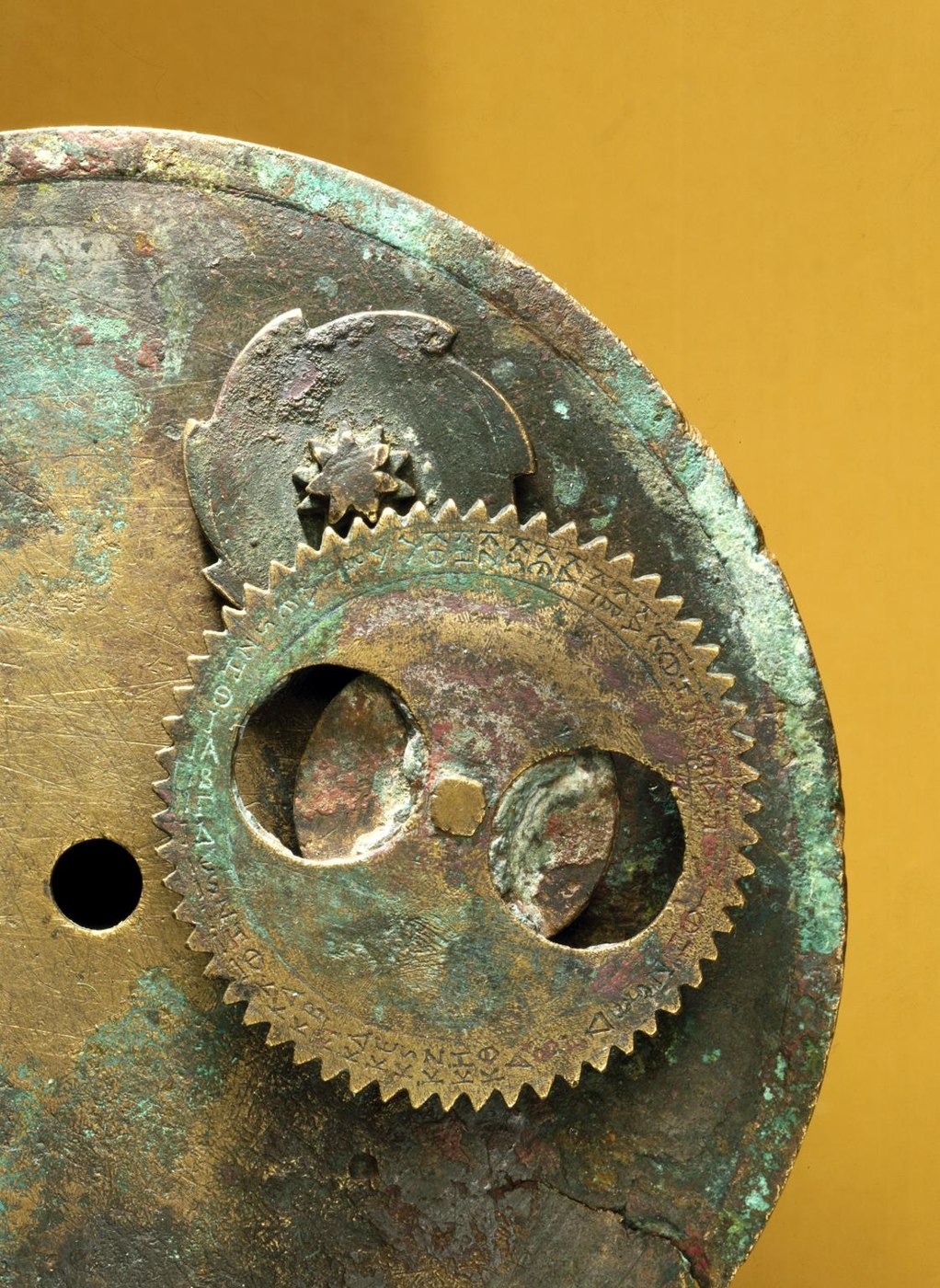
Detailed view of the geared mechanism and inscribed gear wheel of the Byzantine sundial-calendar.
Detailed view of the geared mechanism and inscribed gear wheel of the Byzantine sundial-calendar. — Science Museum Group. Rights pending — permission not yet requested. Original source

Catalogue identity

Source
collection.sciencemuseumgroup.org.uk
Category
Tool · Sundial and perpetual calendar
Maker / attribution
Not established
Reference
Not recorded
Catalogue / lot identifier
1983-1393
Source-reported date
400-600
Source-reported place
Byzantine Empire

Source-reported attribution and specifications are not independent authentication. A listing does not establish present ownership, current display, availability or permission to reproduce.

Object description

Construction and Composition

The object is constructed as a modular instrument composed of four distinct surviving components. The assembly includes a main front sundial plate, a suspension arm designed for carrying the device, and a complex geared mechanism. The gearing includes a Moon disc connected to an arbor which features a ratchet and two gear wheels. These components are integrated to facilitate the mechanical functions of the device beyond simple solar timekeeping.

Visible examination reveals metallic surfaces consistent with historical aging and surface oxidation. The gear wheels are cut with teeth that engage with the central arbor, and the overall design demonstrates an integration of manual sundial measurements with mechanical calculation capabilities.

Evidence for this section
  • “Sundial-calendar consisting of four surviving parts (including front sundial plate, suspension arm, Moon disc with gear, and arbor with ratchet and two gear wheels).”

Inscriptions and Geographical Scope

The front sundial plate contains engraved inscriptions in the Greek language. These inscriptions specify sixteen geographical locations across the ancient world. The list of locations includes Constantinople, Syene, Thebaid, Africa, Alexandria, Antioch, Rhodes, Athens, Sicily, Thessalonika, Rome, Dalmatia, Doclea, Caesarea Sratonis, Palestine, and Ascalon.

These place names indicate the intended reach of the sundial's function, allowing the owner to adapt the instrument for timekeeping across these various regional points. The precision of the engraving reflects the intended utility of the plate in determining solar time based on the user's location.

Evidence for this section
  • “16 locations are inscribed in Greek on the sundial plate, translated as: Constantinople, Syene, Thebaid, Africa, Alexandria, Antioch, Rhodes, Athens, Sicily, Thessalonika, Rome, Dalmatia, Doclea, Caesarea Sratonis, Palestine, and Ascalon.”

Functional Capabilities

The device functions simultaneously as a sundial and a geared mechanical calendar. Beyond its primary utility as a timekeeping tool, the device is capable of predicting lunar phases. It also serves to track the positions of the Sun and the Moon within the zodiac.

The combination of the sundial with the geared mechanical internal components represents a specialized instrument for ancient astronomical observation.

Evidence for this section
  • “The owner of this device would have been able to use it as a sundial to tell the time in 16 locations across the ancient world and would have been able to predict the positions of the Sun and Moon in the zodiac and the lunar phases.”

Open research questions

  • What is the specific mechanical sequence of operations required to calibrate the lunar disc?
  • To what extent are the sixteen listed locations intended to represent varied latitudes for the sundial calibration?
  • How do the gear ratios compare to other known late antique astronomical instruments?

Source evidence

Recorded claims and source quotations for Byzantine sundial-calendar
FieldSource-reported valueSource quotation
Object namesundial; perpetual calendar; sundial; perpetual calendar“Object name: sundial; perpetual calendar; sundial; perpetual calendar”
Accession number1983-1393“Accession number: 1983-1393”
Date400-600“Date: 400-600”
Place of manufactureByzantine Empire“Made in the Byzantine Empire”
Material partsFour surviving parts“Sundial-calendar consisting of four surviving parts (including front sundial plate, suspension arm, Moon disc with gear, and arbor with ratchet and two gear wheels).”
Inscriptions16 locations in Greek“16 locations are inscribed in Greek on the sundial plate”
Historical statusSecond oldest known“This device, consisting of a sundial and geared mechanical calendar, is the second oldest known of its kind.”

Visible details

  • Surface exhibits signs of oxidation and metallic corrosion
  • Greek characters are incised along the perimeter of the gear
  • The mechanism includes a central arbor and a ratchet wheel system

Research qualifications

  • The exact original configuration of the four surviving parts is not fully documented
  • The full functional interaction between the gears and the sundial plate is limited by existing damage

Photograph identity and source facts were screened before import; rights clearance remains pending.

Consulted source

Byzantine sundial-calendar

Reviewed 2026-10-26 · Record 37a25261da

Terms in this record

Glossary explanations for terms named in this object’s record.