
Skip to content
The Encyclopedia of Horology

Clock · Electric mantel clock

Bulle Art Deco oak-cased mantel clock

Partially verified

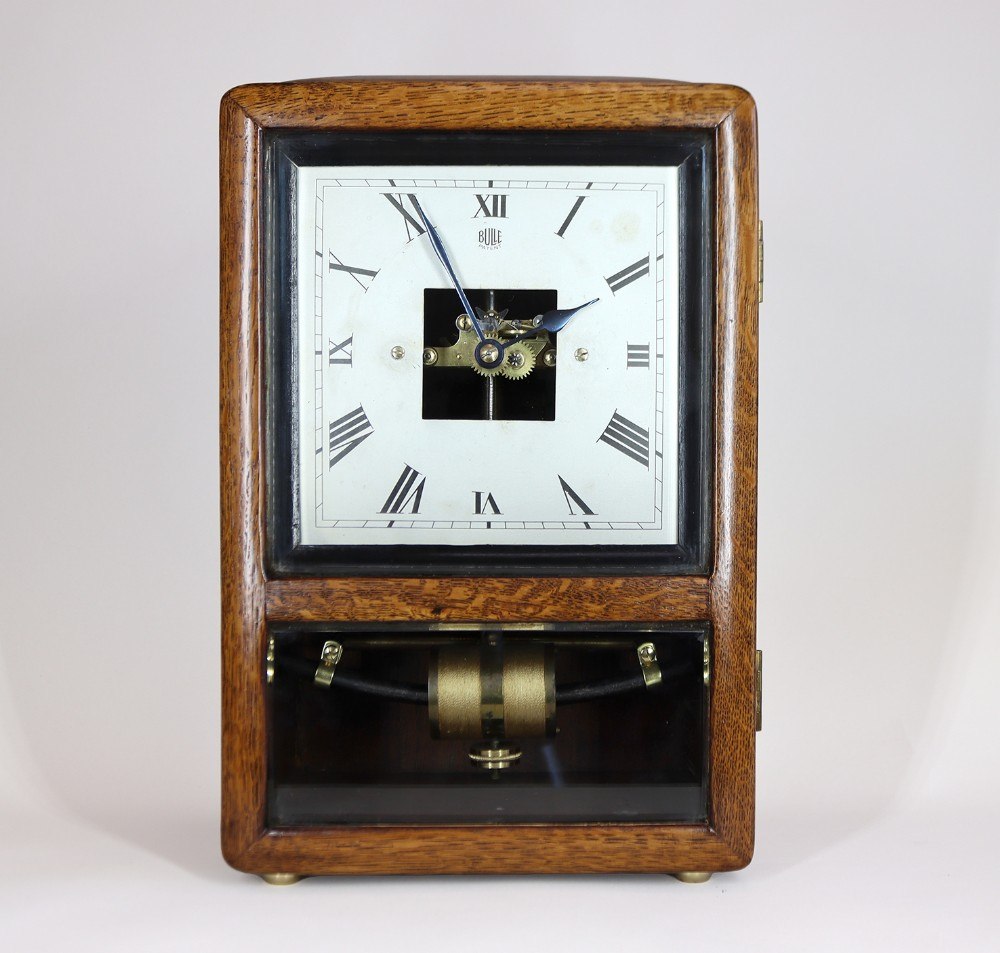
This Art Deco electric mantel clock is reported by the dealer to date from circa 1922, representing the second year of production by the Compagnie Générale des Appareils Horo-Electriques. It is housed in a pale oak case with rounded corners measuring 32 cm in height by 20.5 cm in width. The facade is divided into two glazed apertures: the upper window displays a square silvered dial with black Roman numerals, blued steel hands, and a central cut-out showing the brass wheelwork; the lower window exposes the cylindrical pendulum bob and curved horizontal magnetic bar. The source notes that dial motion is driven via a pawl and ratchet arrangement.

Front view of the Bulle Art Deco oak-cased electric mantel clock showing the exposed movement and magnetic pendulum
Front view of the Bulle Art Deco oak-cased electric mantel clock showing the exposed movement and magnetic pendulum — Chalfont Clocks / Sellingantiques. Rights pending — permission not yet requested. Original source

Catalogue identity

Source
www.sellingantiques.co.uk
Category
Clock · Electric mantel clock
Maker / attribution
Compagnie Générale des Appareils Horo-Electriques (Bulle)
Reference
SA1230012
Catalogue / lot identifier
314
Source-reported date
circa 1922
Country
France

Source-reported attribution and specifications are not independent authentication. A listing does not establish present ownership, current display, availability or permission to reproduce.

Object description

Case Construction

The clock is housed in a pale oak case featuring rounded corners and a push-button mechanism to facilitate access to the front. The structure is supported by small, rounded brass feet.

The facade contains two glazed apertures: the upper window displays the dial, while the lower window exposes the internal pendulum mechanism.

Evidence for this section
  • “Housed in a very attractive pale coloured Oak case with a push button mechanism to open the front.”
  • “32cm H x 20.5cm W x 14cm D”
  • “With a silvered dial and exposed movement and two panels of beveled glass.”

Dial and Appointments

The upper section houses a silvered dial featuring black Roman numerals. The dial includes a central cut-out that reveals the internal brass gearing.

The 'Bulle Patent' trademark is printed on the dial. The assembly utilizes blued steel hands.

Evidence for this section
  • “With a silvered dial and exposed movement”
  • “The Bulle Clock was manufactured by the Compagnee Generale des Appareils Horo-Electrique.”

Mechanism

The clock is powered by a battery and operates via a pendulum that swings along a curved horizontal bar magnet. The magnet features a north-seeking pole at the center and south poles at the ends.

Contacts close at every alternate swing to energize the pendulum solenoid. Motion is transferred to the dial via a pawl and ratchet arrangement.

Evidence for this section
  • “Powered by a battery the pendulum swings along a bar magnet which has a north seeking pole at the centre and south poles at each end.”
  • “As the pendulum swings contacts close at every alternate swing and the pendulum is energised and attracted to the centre of the magnetic bar.”
  • “Motion to the dial is supplied by a pawl and ratchet mechanism.”

Open research questions

  • Is there a serial number present on the movement or case back that was not documented in the provided source?
  • What specific electrical components were replaced or maintained during the reported 'sympathetic restoration'?

Source evidence

Recorded claims and source quotations for Bulle Art Deco oak-cased mantel clock
FieldSource-reported valueSource quotation
MakerCompagnie Générale des Appareils Horo-Electriques“The Bulle Clock was manufactured by the Compagnee Generale des Appareils Horo-Electrique.”
Production DateCirca 1922“dating from the second year of the company’s production in 1922.”
Case MaterialPale coloured oak“Housed in a very attractive pale coloured Oak case with a push button mechanism to open the front.”
Dimensions32cm H x 20.5cm W x 14cm D“32cm H x 20.5cm W x 14cm D”
Dial and AperturesSilvered dial with exposed movement and bevelled glass panels“With a silvered dial and exposed movement and two panels of beveled glass.”
Dealers Internal Reference314“Dealers Internal Reference 314”
Dealer Reference314“Dealers Internal Reference 314”

Visible details

  • Square silvered dial features black Roman numerals, an outer rail minute track, and an open central square revealing brass gearing.
  • Bulle Patent trademark is printed below the XII numeral.
  • Lower glazed aperture exposes a cylindrical brass pendulum bob sliding along a curved horizontal bar magnet.
  • Pale oak case features rounded exterior edges, right-side door hinges, and rests on small rounded brass feet.

Research qualifications

  • The internal battery compartment and rear case view are not shown in the primary photograph.
  • Electromagnetic contact mechanisms and full restoration state are source-reported and not directly visible.

Photograph identity and source facts were screened before import; rights clearance remains pending.

Consulted source

Art Deco Oak Cased Bulle Clock Circa 1922 1900 - 1920 | Sellingantiques

Reviewed 2026-10-22 · Record c2242cbf88

Terms in this record

Glossary explanations for terms named in this object’s record.