
Skip to content
The Encyclopedia of Horology

Clock · Electric mantel clock

Léon Hatot ATO Electrique Art Deco Mantel Clock

Partially verified

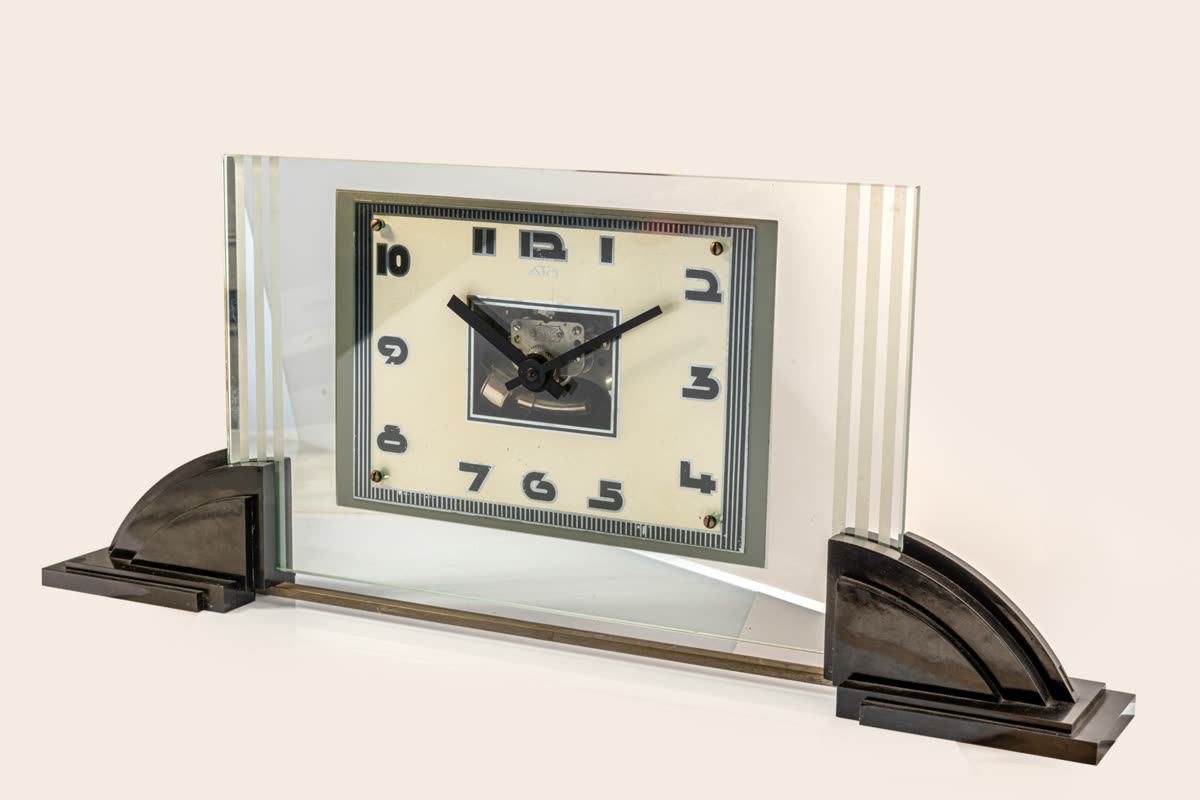
This Art Deco electric mantel clock by Léon Hatot, model 'ATO Electrique', dates to circa 1930–1935 and features movement number 79 920. Constructed from etched glass, Bakelite, and chromium-plated metal, the clock rests on stepped geometric Bakelite side supports. The rectangular dial features stylized Art Deco Arabic numerals, framed by etched striped borders on the glass panel, and contains a central aperture displaying portions of the battery-powered electromagnetic pendulum mechanism. Measuring 210 mm in height, 520 mm in width, and 105 mm in thickness, both the dial and movement bear signatures from the maker.

Front three-quarter view of the Léon Hatot ATO Electrique mantel clock on dark Bakelite base supports
Front three-quarter view of the Léon Hatot ATO Electrique mantel clock on dark Bakelite base supports — Antiquorum. Rights pending — permission not yet requested. Original source

Catalogue identity

Source
catalog.antiquorum.swiss
Category
Clock · Electric mantel clock
Maker / attribution
Léon Hatot
Reference
Not recorded
Catalogue / lot identifier
7
Source-reported date
circa 1930-1935
Country
France
Source-reported serial
79 920

Source-reported attribution and specifications are not independent authentication. A listing does not establish present ownership, current display, availability or permission to reproduce.

Object description

Identity and Form

Catalogued as an "ATO Electrique" electric mantel table clock by Léon Hatot, Paris, this piece is dated by the cataloguer to circa 1930–1935. The auction entry records materials of etched glass, Bakelite, and chromium-plated metal, with dimensions of 210 mm in height, 520 mm in width, and 105 mm in thickness.

Visual observation indicates stepped semi-circular dark Bakelite bracket feet holding the lower structure, supporting a wide clear glass panel.

Evidence for this section
  • “Model “ATO Electrique””
  • “Year circa 1930-1935”
  • “Material glass, Bakelite and chromium-plated”
  • “Height 210 mm. Width 520 mm. Thickness 105 mm.”
  • “Stepped semi-circular dark Bakelite bracket feet holding the lower structure.”

Dial and Case Detailing

The front displays a rectangular clear glass body etched with vertical flanking stripes. The hour markers are stylized blocky Art Deco numerals accompanied by matching dark baton hands, which the cataloguer lists under hands as "Original".

The cataloguer notes signatures on both the dial and movement. In direct observation, a central cut-out in the rectangular dial reveals internal movement components, corresponding to the catalog description of a visible movement.

Evidence for this section
  • “Rectangular clear glass body etched with vertical flanking stripes.”
  • “Stylized blocky Art Deco numerals for the hours with matching dark baton hands.”
  • “HANDS Original”
  • “Signature dial and movement”
  • “A central cut-out in the rectangular dial revealing internal movement components.”
  • “Etched glass, Bakelite and chromium-plated, electric, mantel table clock, with visible movement.”

Movement and Technical Condition

The clock is catalogued with an unnumbered case housing movement number 79 920. The source lists the mechanism as caliber 93 mm with an electromagnetic pendulum, battery-powered operation, and a patent regulator.

The cataloguer graded the movement condition as poor, indicating that it lacks elements and requires repair at the buyer's expense. The rear side, battery compartment, and internal movement details are not visible in the provided reference photograph.

Evidence for this section
  • “Case No. unnumbered”
  • “Movement No. 79 920”
  • “Caliber 93 mm., electromagnetic pendulum, battery powered”
  • “ATO - Léon Hatot Art Deco, electric mantel clock, with patent regulator; glass, Bakelite and chromium-plated”
  • “Movement: 5-29** Poor Lacking elements Repair required, at buyer's expense”

Open research questions

  • Which specific movement components or contacts are missing from caliber 79 920 to account for the cataloguer's note of lacking elements?
  • Does the unnumbered case or Bakelite foot assembly bear internal workshop stamps, mold numbers, or patent date markings consistent with Léon Hatot production?
  • What specific battery voltage and cell housing format does this 93 mm caliber variant require for electromagnetic pendulum operation?

Source evidence

Recorded claims and source quotations for Léon Hatot ATO Electrique Art Deco Mantel Clock
FieldSource-reported valueSource quotation
BrandLéon Hatot, Paris“Brand Léon Hatot, Paris”
ModelATO Electrique“Model “ATO Electrique””
Movement Number79 920“Movement No. 79 920”
Datecirca 1930-1935“Year circa 1930-1935”
MaterialsGlass, Bakelite and chromium-plated“Material glass, Bakelite and chromium-plated”
Dimensions210 mm x 520 mm x 105 mm“Height 210 mm. Width 520 mm. Thickness 105 mm.”
Caliber Description93 mm., electromagnetic pendulum, battery powered“Caliber 93 mm., electromagnetic pendulum, battery powered”
Case NumberUnnumbered“Case No. unnumbered”
HandsReported as original“HANDS Original”

Visible details

  • Rectangular clear glass body etched with vertical flanking stripes.
  • Stepped semi-circular dark Bakelite bracket feet holding the lower structure.
  • A central cut-out in the rectangular dial revealing internal movement components.
  • Stylized blocky Art Deco numerals for the hours with matching dark baton hands.

Research qualifications

  • The source notes the movement condition as poor, lacking elements and requiring repair.
  • The rear side, battery compartment, and internal movement details are not visible in this view.

Photograph identity and source facts were screened before import; rights clearance remains pending.

Terms in this record

Glossary explanations for terms named in this object’s record.