
Skip to content
The Encyclopedia of Horology

Clock · Electric mantel clock

ATO - Léon Hatot Art Deco Electric Mantel Clock

Partially verified

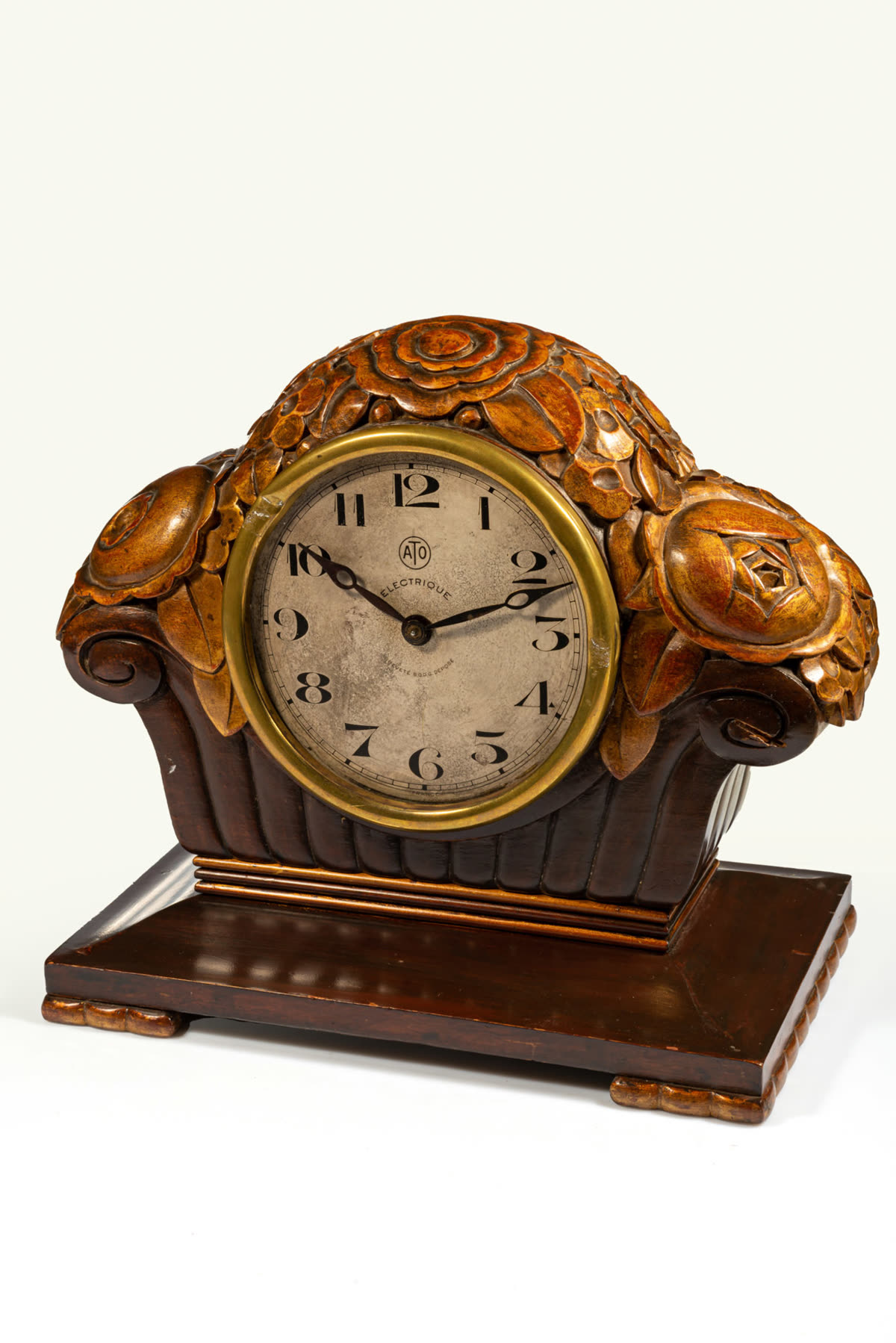
This Art Deco electric mantel clock by Léon Hatot, Paris, is dated circa 1925-1930. The case, sculpted in the form of a basket of flowers from gilded wood and metal, is source-attributed to the French design partnership Sue & Mare, Paris. It measures 230 mm high, 220 mm wide, and 150 mm deep. The circular silvered dial features stylized Arabic hour numerals and the 'ATO ELECTRIQUE' emblem. The clock is powered by an unnumbered 120 mm caliber battery-driven movement with an electromagnetic pendulum, catalogued with movement number 3 022.

Front view of the Léon Hatot ATO electric mantel clock in a carved flower-basket wooden case
Front view of the Léon Hatot ATO electric mantel clock in a carved flower-basket wooden case — Antiquorum. Rights pending — permission not yet requested. Original source

Catalogue identity

Source
catalog.antiquorum.swiss
Category
Clock · Electric mantel clock
Maker / attribution
Léon Hatot, Paris
Reference
Not recorded
Catalogue / lot identifier
8
Source-reported date
circa 1925-1930
Country
France
Source-reported serial
3 022

Source-reported attribution and specifications are not independent authentication. A listing does not establish present ownership, current display, availability or permission to reproduce.

Object description

Object Identity and Case Form

Catalogued under the maker Léon Hatot, Paris, this Art Deco electric mantel clock is dated to circa 1925-1930. The case is constructed from gilded wood and metal in the form of a basket of flowers, resting on a fluted lower section set upon a tiered rectangular plinth with molded feet. The auction listing reports the dimensions as 230 mm in height, 220 mm in width, and 150 mm in thickness.

The auction cataloguer attributes the case design to the Parisian firm Sue & Mare, Paris. The auction entry lists the case number as unnumbered, and no physical signature for Sue & Mare is noted on the exterior in the available record.

Evidence for this section
  • “Gilded wood and metal, electric, mantel table clock in the shape of a basket of flowers; case attributed to Sue & Mare, Paris.”
  • “Height 230 mm. Width 220 mm. Thickness 150 mm.”
  • “Case No. unnumbered”
  • “Fluted lower body resting on a tiered rectangular wooden plinth supported by molded feet.”

Dial and Hands

The clock features a circular dial framed within the lower portion of the carved floral basket structure. The dial displays stylized Arabic numerals and is inscribed with the ATO logo alongside 'ELECTRIQUE'.

According to the auction listing, the clock carries a signature on both the dial and movement, and the hands are reported as original. The seller's grading system records the dial condition as 'Fair', noting it as slightly oxidized and slightly scratched.

Evidence for this section
  • “Circular dial features stylized Arabic numerals and is inscribed with the ATO logo and 'ELECTRIQUE'.”
  • “HANDS Original”
  • “Signature dial and movement”
  • “Dial: 4-6-8-01 Fair Slightly oxidized Slightly scratched”

Movement Details and Seller Evaluation

The movement is catalogued as caliber 120 mm, operating via an electromagnetic pendulum powered by a battery, and recorded under Movement No. 3 022. The title description also lists a patent regulator.

The internal mechanism is not visible in the front photograph. In its condition assessment, the auction house grades the movement as '5** Poor' and notes 'Repair required, at buyer's expense'.

Evidence for this section
  • “Movement No. 3 022”
  • “Caliber 120 mm., electromagnetic pendulum, battery powered”
  • “Art Deco, electric mantel clock, with patent regulator; gilded wood and metal”
  • “Movement: 5** Poor Repair required, at buyer's expense”

Open research questions

  • Does the reverse or interior of the wooden case bear stamped marks, labels, or inventory numbers from the Compagnie des Arts Français confirming the Sue & Mare attribution?
  • What specific electrical or mechanical components account for the cataloguer's 'Poor' rating on movement number 3 022?
  • Does the movement backplate carry Léon Hatot patent markings or serial stamps consistent with other 120 mm electromagnetic pendulum clocks of this period?

Source evidence

Recorded claims and source quotations for ATO - Léon Hatot Art Deco Electric Mantel Clock
FieldSource-reported valueSource quotation
MakerLéon Hatot, Paris“Brand Léon Hatot, Paris”
Movement Number3 022“Movement No. 3 022”
Caliber120 mm., electromagnetic pendulum, battery powered“Caliber 120 mm., electromagnetic pendulum, battery powered”
DimensionsHeight 230 mm. Width 220 mm. Thickness 150 mm.“Height 230 mm. Width 220 mm. Thickness 150 mm.”
Case DesignAttributed to Sue & Mare, Paris“in the shape of a basket of flowers; case attributed to Sue & Mare, Paris.”
Case NumberUnnumbered“Case No. unnumbered”
Hands ConditionOriginal“HANDS Original”
Dial ConditionFair, slightly oxidized, slightly scratched“Dial: 4-6-8-01 Fair Slightly oxidized Slightly scratched”
Movement ConditionPoor, repair required at buyer's expense“Movement: 5** Poor Repair required, at buyer's expense”

Visible details

  • Carved floral and foliage motifs in a gilded finish arch over and flank the upper dial.
  • Circular dial features stylized Arabic numerals and is inscribed with the ATO logo and 'ELECTRIQUE'.
  • Fluted lower body resting on a tiered rectangular wooden plinth supported by molded feet.

Research qualifications

  • Case attribution to Sue & Mare is source-reported and not physically signed on the case exterior.
  • Internal battery-powered movement and case back are not visible in the photograph.

Photograph identity and source facts were screened before import; rights clearance remains pending.

Terms in this record

Glossary explanations for terms named in this object’s record.