
Skip to content
The Encyclopedia of Horology

Wristwatch · Chronograph

Breitling Cosmonaute Ref. 809

Partially verified

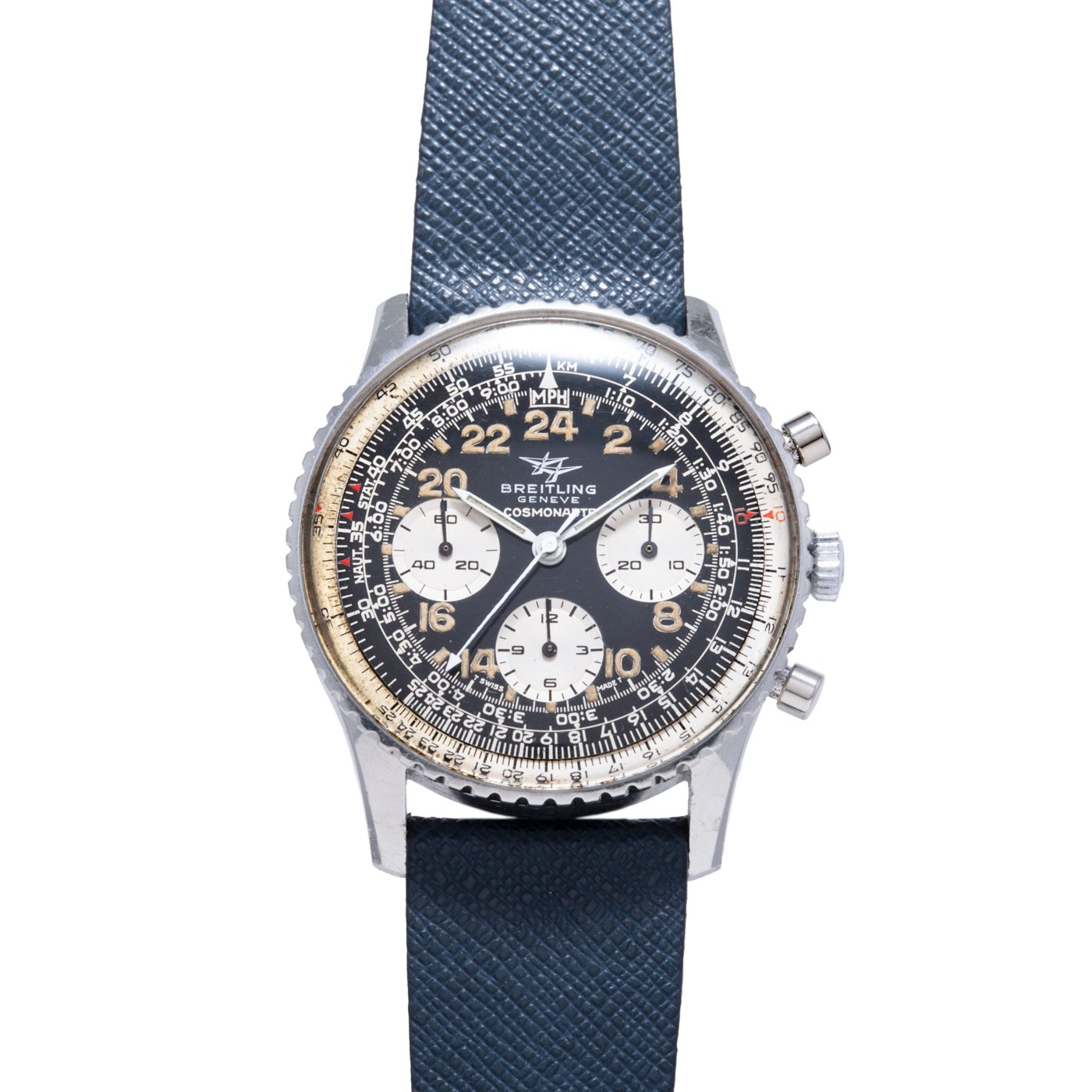
This Breitling Cosmonaute is a manually wound chronograph watch featuring a 24-hour dial scale, which ensures the hour hand completes a full rotation once every 24 hours. The watch is housed in a 41mm stainless steel case and is powered by the Venus 178 column-wheel chronograph movement. The black dial includes three contrasting chronograph registers and a circular slide rule, designed as a professional instrument. The watch features luminous Arabic numerals and markers that have aged to a warm tone. A gilt "Cosmonaute" signature and Breitling’s twin-plane emblem are located on the dial. The watch is presented with a Plexiglass crystal. This reference was developed following the requirements of astronaut Malcolm Scott Carpenter for the Aurora 7 mission in May 1962, intended for environments where traditional day and night rhythms are not applicable.

Front view of the Breitling Cosmonaute showing the 24-hour dial, sub-registers, and circular slide rule.
Front view of the Breitling Cosmonaute showing the 24-hour dial, sub-registers, and circular slide rule. — Analog Shift. Rights pending — permission not yet requested. Original source

Catalogue identity

Source
analogshift.com
Category
Wristwatch · Chronograph
Maker / attribution
Breitling
Reference
809
Catalogue / lot identifier
Source URL identifies the listing
Source-reported date
1960s
Source-reported place
Not established

Source-reported attribution and specifications are not independent authentication. A listing does not establish present ownership, current display, availability or permission to reproduce.

Object description

Design and Dial Configuration

The Breitling Cosmonaute is distinguished by its 24-hour dial layout, a departure from standard 12-hour watch displays. This configuration requires the hour hand to travel the circumference of the dial only once every twenty-four hours. The dial is black and incorporates three contrasting chronograph registers.

Included on the dial is a circular slide rule, a component carried over from the Navitimer model. The dial elements include Arabic numerals and markers that have acquired a warm patina over time. A gilt "Cosmonaute" signature and the Breitling twin-plane emblem are present on the dial surface. The entire assembly is protected by a Plexiglass crystal.

Evidence for this section
  • “the black dial is reorganized around a full 24-hour scale”
  • “The familiar circular slide rule remains, as do the three contrasting chronograph registers”
  • “A gilt “Cosmonaute” signature and Breitling’s twin-plane emblem provide two particularly charming period details.”

Case and Movement

The watch is constructed with a 41mm stainless steel case, noted as a large dimension for the era in which it was produced. The case includes standard chronograph pushers and a crown on the side for manual operation.

Internally, the timepiece is powered by the Venus 178 movement. This is a manually wound, column-wheel chronograph caliber, which served as the mechanical basis for several of the manufacturer's chronographs during this period.

Evidence for this section
  • “At 41mm, the stainless steel case was enormous by 1960s standards”
  • “Beneath the Plexiglass crystal sits the manually wound Venus 178, the column-wheel chronograph caliber”

Historical Context

The Cosmonaute model emerged from the early development of American spaceflight programs. Its specific layout was developed after consultation with astronaut Malcolm Scott Carpenter, who sought a watch adapted for environments where traditional day and night cycles were not present.

A specialized version of this watch was worn during the Aurora 7 mission in May 1962. The design intended to serve as a professional instrument, reflected in the density of information provided on the dial and the specific movement choice.

Evidence for this section
  • “The Cosmonaute grew out of the early years of American spaceflight”
  • “Carpenter ultimately wore a specially prepared version during the Aurora 7 mission in May 1962”
  • “all tied to the idea of a professional instrument”

Open research questions

  • What is the specific serial number of this unit to verify the production year within the 1960s?
  • Are the luminous materials on the hands and indices original to the piece or a result of later restoration?

Source evidence

Recorded claims and source quotations for Breitling Cosmonaute Ref. 809
FieldSource-reported valueSource quotation
MakerBreitling“Breitling”
ModelCosmonaute“Breitling Cosmonaute”
Reference809“The Ref. 809 that followed is essentially a Navitimer from an alternate universe.”
MovementVenus 178“Beneath the Plexiglass crystal sits the manually wound Venus 178, the column-wheel chronograph caliber”
Case diameter41mm“At 41mm, the stainless steel case was enormous by 1960s standards”
Dial feature24-hour scale“the black dial is reorganized around a full 24-hour scale.”
Associated missionAurora 7“Carpenter ultimately wore a specially prepared version during the Aurora 7 mission in May 1962”

Visible details

  • 24-hour dial scale with Arabic numerals
  • Contrasting chronograph registers at 3, 6, and 9 o'clock
  • Circular slide rule integrated into the dial bezel
  • Stainless steel case with manual winding pushers

Research qualifications

  • The exact year of manufacture is not provided, only a general 1960s attribution.
  • Specific serial numbers are not disclosed in the provided source.

Photograph identity and source facts were screened before import; rights clearance remains pending.

Consulted source

ساعت Breitling Cosmonaute

Reviewed 2026-11-02 · Record 2033f7c906

Terms in this record

Glossary explanations for terms named in this object’s record.