
Skip to content
The Encyclopedia of Horology

Marine chronometer · Box marine chronometer with independent seconds

Breguet & Fils Marine Chronometer No. 2741

Partially verified

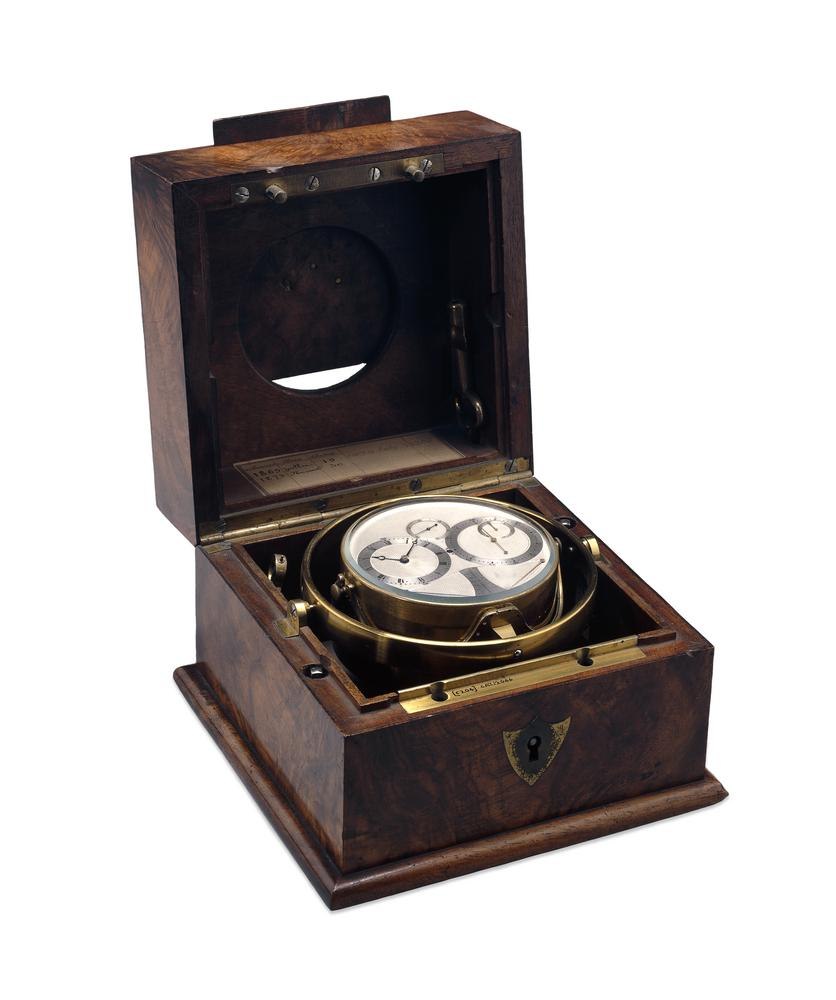
Completed in Paris in 1813 by Breguet & Fils, this spring-driven thirty-hour marine chronometer served as an experimental workshop test-bed before being presented to Monseigneur Louis Belmas in 1822. Source documentation records that it incorporates a specialised club-tooth lever escapement designed to eliminate impulse sliding friction using a helical tooth on a gold roller, alongside an independent seconds train. The solid silver engine-turned dial features separate indications for standard time, recorded minutes and seconds, and two reserve-of-going sectors. The chronometer is gimballed inside a fitted wooden box equipped with retractable spring-loaded fixing screws.

Breguet & Fils marine chronometer No. 2741 suspended in gimbals inside its fitted wooden box
Breguet & Fils marine chronometer No. 2741 suspended in gimbals inside its fitted wooden box — British Museum. Rights pending — permission not yet requested. Original source

Catalogue identity

Source
www.britishmuseum.org
Category
Marine chronometer · Box marine chronometer with independent seconds
Maker / attribution
Breguet & Fils
Reference
Not recorded
Catalogue / lot identifier
1958,1006.2066
Source-reported date
1813
Country
France
Source-reported serial
2741

Source-reported attribution and specifications are not independent authentication. A listing does not establish present ownership, current display, availability or permission to reproduce.

Object description

Identity and Provenance

Identified as No. 2741, this marine chronometer was manufactured in Paris by Breguet & Fils in 1813. Records indicate it functioned as an experimental workshop timekeeper until 1822, rather than serving in maritime navigation.

The timepiece was presented to Monseigneur Louis Belmas, Bishop of Cambrai, and bears an internal inscription regarding its friction-reducing experimental design. It was later part of the Ilbert Collection before being presented to the British Museum in 1958.

Evidence for this section
  • “When completed in 1813 Breguet used it himself as an experimental workshop piece until 1822.”
  • “Premiere Piece ou la Comunication du Rouage au Régulateur S'Opère Sans Frotement. Exécutée en 1813 par Breguet Pour Mr Belmas ami de l'auteur N02741”
  • “Formerly in the Ilbert Collection.”
  • “Presented by Gilbert Edgar CBE in 1958.”

Construction and Housing

The movement is contained within an open-ended gilded brass drum suspended in a gimbal cradle. This assembly is housed in a box featuring a locking system and a shield-shaped escutcheon.

The box includes retractable, spring-loaded wood screws designed to secure the instrument to a surface. Source documentation provides conflicting descriptions of the box's primary material, referring to it both as walnut and mahogany.

Evidence for this section
  • “The movement is contained in an open-ended brass drum”
  • “suspended in gimbals within walnut box”
  • “The box is made from mahogany with gimbal mounts”
  • “The box can be screwed to a wooden surface by two spring loaded wood screws lodged in the side of the box.”
  • “The box also has a lock with a shield shaped escutcheon plate”

Dial and Mechanism

The engine-turned solid silver dial displays chapter rings for the going train, independent seconds and minutes, and two lower reserve-of-going indicators. The independent train is powered by a secondary barrel and can be operated via a push-piece on the drum.

The movement utilizes a club-tooth lever escapement designed with a gold helical tooth on the balance roller to achieve rolling impulse contact. The going train features an 8-turn fusee with Harrison’s maintaining power.

Evidence for this section
  • “Solid silver engine turned dial”
  • “central upper seconds dial and left hand central and lower sector dials are for the going train and the reserve of going (up-and-down) of the going mainspring respectively.”
  • “This train can be stopped or started at will, without affecting the going train, by a push-piece in the side of the drum.”
  • “A club tooth lever escapement with divided lift.”
  • “the transmission of impulse being by perfect rolling contact on the centre line.”
  • “Fusee: 8-turn fusee with Harrison's maintaining power”

Open research questions

  • What is the definitive material composition of the housing, given conflicting references to walnut and mahogany in the source text?
  • Are there surviving primary documents detailing the specific performance challenges caused by the inertia of the fork and platinum counterpoise assembly?

Source evidence

Recorded claims and source quotations for Breguet & Fils Marine Chronometer No. 2741
FieldSource-reported valueSource quotation
EscapementClub-tooth lever“Escapement club-tooth lever”
Museum Number1958,1006.2066“Museum number 1958,1006.2066”
Production PlaceParis (France)“Made in: Paris (France)”
Movement Serial2741“On the back plate 'Breguet et fils No 2741'.”
Dedication InscriptionPour Mr Belmas ami de l'auteur“Pour Mr Belmas ami de l'auteur N02741”
Beat Rate14,400 beats per hour“Beat per hour: 14,400”
Independent Seconds Mechanism OriginInvented by Moyse Pouzait in 1777“The independent seconds mechanism was invented by Moyse Pouzait in 1777.”

Visible details

  • Fitted wooden box open on brass hinges showing a circular aperture with a sliding cover inside the upper lid.
  • A key clipped inside the lid next to the circular aperture.
  • Shield-shaped brass keyhole escutcheon mounted on the front face of the wooden box.
  • Circular brass movement drum gimbal-mounted within an outer brass ring.
  • Engine-turned silver dial displaying two large circular subsidiary dials flanked by upper and lower indicators.

Research qualifications

  • Source metadata and Richard Good's text identify the box as walnut, whereas David Thompson's comments identify it as mahogany.
  • Internal escapement components, helical roller tooth, and inscriptions on the back plates are enclosed and not visible from the exterior view.

Photograph identity and source facts were screened before import; rights clearance remains pending.

Terms in this record

Glossary explanations for terms named in this object’s record.