
Skip to content
The Encyclopedia of Horology

Tool · Persian-inscribed astrolabe, Iran

Brass Indo-Persian Astrolabe

Partially verified

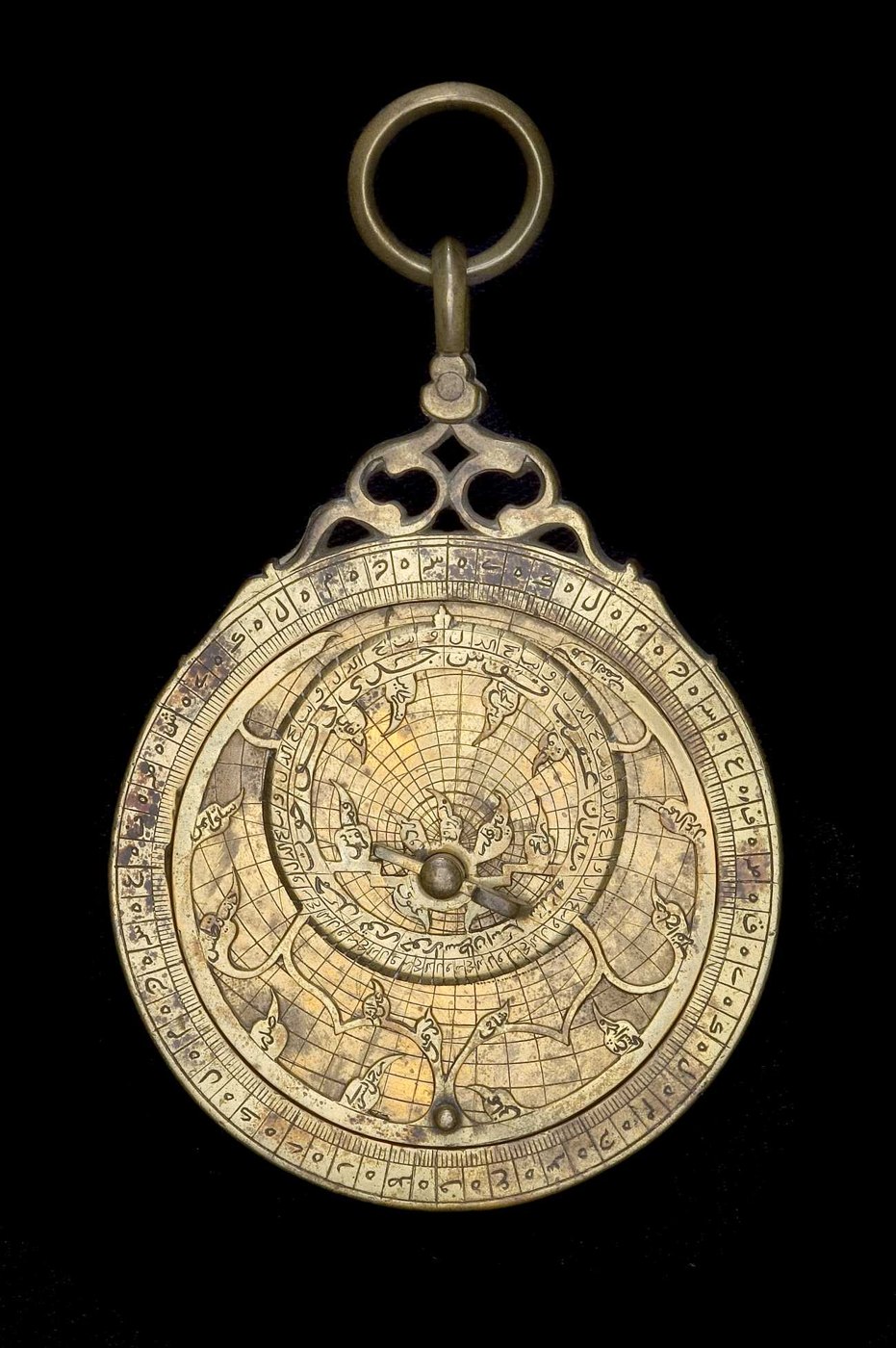
This brass astrolabe, designated inventory number 49300, is attributed to 18th-century (?) Persia. The instrument features a pierced Indo-Persian style throne topped with a trefoil tab, connected via a flat, cello-shaped tab to an omega-shaped shackle and a simple, squared cross-section ring. The mater and limb are constructed in one piece, with a plate-retaining tab located 180 degrees from the throne. The limb displays a degree scale from 0 to 360 in 5-degree increments. The rete, identified as a replacement, is of the foliate single-knob type and lacks star pointers. The instrument includes a double-ended alidade, also possibly a replacement. A gazetteer located in the womb provides coordinate data for 17 cities. The object was acquired by the History of Science Museum, University of Oxford, through a presentation by Lewis Evans in 1924, who had previously acquired it from the S. Waters collection.

View of the brass astrolabe (inventory 49300).
View of the brass astrolabe (inventory 49300). — History of Science Museum, University of Oxford. Rights pending — permission not yet requested. Original source

Catalogue identity

Source
www.mhs.ox.ac.uk
Category
Tool · Persian-inscribed astrolabe, Iran
Maker / attribution
Not established
Reference
Not recorded
Catalogue / lot identifier
49300
Source-reported date
18th century (?)
Source-reported place
Persia

Source-reported attribution and specifications are not independent authentication. A listing does not establish present ownership, current display, availability or permission to reproduce.

Object description

Construction and Assembly

The astrolabe is crafted primarily from brass. Its structural integrity relies on a one-piece construction of the mater and the limb. A specific tab positioned 180 degrees from the throne ensures the stability of the plates during use.

The instrument is suspended by a ring featuring a simple, squared cross-section. This is joined to an omega-shaped shackle, which connects to the main body via a flat, cello-shaped tab. The throne, characterized by its pierced Indo-Persian design, is integrated into the base and finished with a trefoil-shaped tab.

Evidence for this section
  • “The mater and limb are of one-piece construction.”
  • “The throne is of the indo-persian, pierced type”
  • “Shackle of the omega type (i.e. Ω-shaped shackle). A flat, cello-shaped tab connects the shackle to the throne .”

Components and Inscriptions

The rete, which functions as a replacement, lacks star pointers and features a foliate single-knob design. The zodiac sequence is inscribed on the rete using Arabic terminology for signs such as Aries (Hamal), Taurus (Thawr), and Gemini (Jawza).

The womb houses an incomplete gazetteer containing coordinate data for 17 cities, including Mecca, Baghdad, and Isfahan, detailing longitude, latitude, and Inhiraf. The limb provides a circular degree scale marked every five degrees, spanning 0 to 360 degrees.

Evidence for this section
  • “The rete contains 0 stars. The rete is a replacement.”
  • “The zodiac on the rete is labelled: حمل , ثور , جوزا , سرطان , اسد , سنبله , ميزان , عقرب , قوس , جدي , دلو , حوت .”
  • “The table has been engraved for 48 cities. The womb contains a gazetteer with coordinates for 17 cities”

Provenance and History

Accessioned by the History of Science Museum in 1924, this instrument bears the inventory number 49300. The acquisition was facilitated by the donation of Lewis Evans.

Prior to the museum's stewardship, the astrolabe was part of the collection held by S. Waters. Evans secured this collection between 1900 and 1910 before transferring it to the current institution.

Evidence for this section
  • “Presented by Lewis Evans in 1924”
  • “Evans acquired it with the collection of S. Waters, which he bought between 1900 and 1910.”

Open research questions

  • What specific historical evidence confirms the classification of the rete as a replacement?
  • Could the gazetteer's inclusion of Inhiraf values suggest a particular intended use or user region?

Source evidence

Recorded claims and source quotations for Brass Indo-Persian Astrolabe
FieldSource-reported valueSource quotation
Inventory number49300“Inventory no. 49300”
Place of manufacturePersia“Place Persia”
Date18th century (?)“Date 18th century (?)”
MaterialBrass“Material Brass”
ProvenancePresented by Lewis Evans in 1924“Presented by Lewis Evans in 1924”
Throne styleIndo-Persian, pierced“The throne is of the indo-persian, pierced type”
Rete statusReplacement“The rete is a replacement.”

Visible details

  • Pierced Indo-Persian throne with trefoil tab
  • Omega-shaped shackle with flat, cello-shaped connector
  • One-piece construction of mater and limb
  • Rete features zodiac labels in Arabic script

Research qualifications

  • Rete is documented as a replacement
  • Alidade is suspected to be a replacement

Photograph identity and source facts were screened before import; rights clearance remains pending.

Consulted source

Astrolabe, inventory 49300 (Persia, 18th century (?))

Reviewed 2026-10-26 · Record a7a14b86ac

Terms in this record

Glossary explanations for terms named in this object’s record.

Other persian-inscribed astrolabe, iran records