
Skip to content
The Encyclopedia of Horology

Tool · Persian-inscribed astrolabe, Iran

Brass Astrolabe by Faḍl ‘Alī

Partially verified

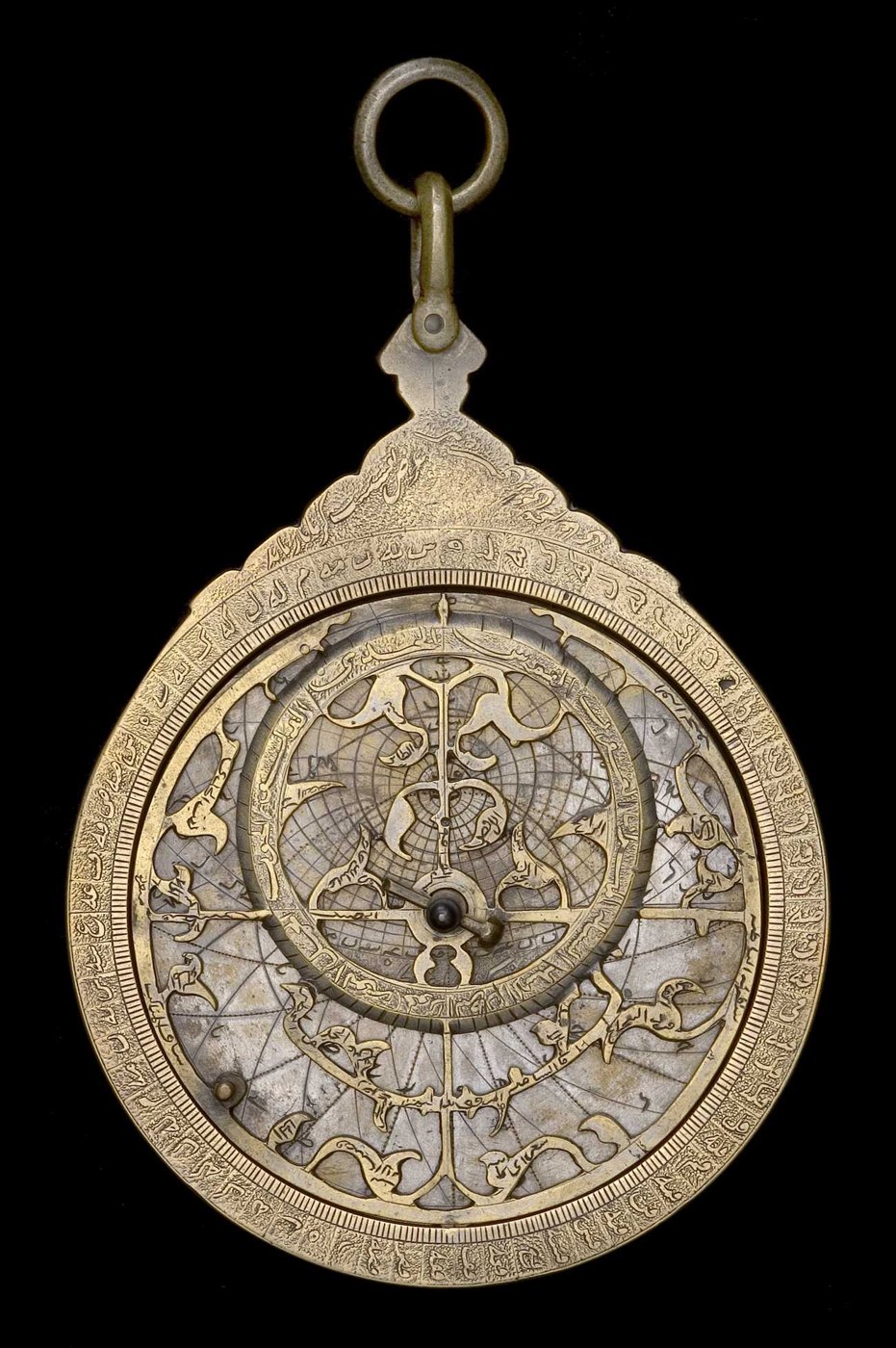
This brass astrolabe is attributed to the maker Faḍl ‘Alī and dated to the early 18th century. The instrument features a broad, Indo-Persian type throne attached to an integrated base, with a simple round-section ring and an omega-shaped shackle. The mater and limb are constructed from a single piece of brass, and the womb shows evidence of being silvered. The rete is of the foliate single-knob type, featuring 29 stars marked with foliate pointers and a zodiac labeled in Arabic. The back of the instrument is engraved with 11 scales, including altitude, equal hours, zodiacal signs, lunar mansions, and a shadow square. It includes four plates with latitudes ranging from 29° to 40°. The double-ended alidade is original to the instrument. This object was presented to the collection by Lewis Evans in 1924, having previously been acquired at the 1911 Roussel collection auction.

Front view of the astrolabe showing the rete, throne, and Arabic inscriptions on the limb.
Front view of the astrolabe showing the rete, throne, and Arabic inscriptions on the limb. — History of Science Museum, University of Oxford. Rights pending — permission not yet requested. Original source

Catalogue identity

Source
www.mhs.ox.ac.uk
Category
Tool · Persian-inscribed astrolabe, Iran
Maker / attribution
Faḍl ‘Alī
Reference
Not recorded
Catalogue / lot identifier
1924-0/2012
Source-reported date
early 18th century (?)
Source-reported place
Persia
Source-reported serial
38235

Source-reported attribution and specifications are not independent authentication. A listing does not establish present ownership, current display, availability or permission to reproduce.

Object description

Construction and Design

The astrolabe is constructed primarily of brass. The instrument features a broad, Indo-Persian style throne which is attached via an integrated base. This throne is embossed with inscriptions on both the front and the back sides, which include the signature of the maker, Faḍl ‘Alī, and a poetic sentiment regarding the continuity of existence.

The mater and the limb are formed from a single-piece construction. A notch is provided in the limb to accept the tabs of the tympan plates. The womb surface shows signs of having been silvered and contains a detailed gazetteer listing coordinates, including longitudes and latitudes for 56 specific cities.

Evidence for this section
  • “The throne is of the indo-persian, broad type made of brass attached with integrated base”
  • “The mater and limb are of one-piece construction.”
  • “The womb seems to have been silvered.”
  • “عمل كمترين فضل علي The work of the most humble Faẓl-e ʿAlī.”

Rete and Calibrated Scales

The rete is of the foliate, single-knob design and contains 29 stars, each indicated by a foliate pointer. The zodiacal signs are identified in Arabic on the rete. The rete is secured to the instrument using a pin and wedge system.

The back of the astrolabe is densely packed with 11 distinct scales. These include circular, concentric scales for altitude, zodiacal signs, and various astrological divisions such as terms, lunar mansions, and faces. Additionally, a shadow square with both feet and finger calibrations is situated in the lower quadrants of the instrument's reverse.

Evidence for this section
  • “The rete is of the foliate (single knob) type.”
  • “There are 29 stars on the rete marked with foliate pointers.”
  • “The back contains 11 scales of the following types: Altitude; Equal hours; Dastūr Circle; Zodiacal signs; Terms; Lunar Mansions; Faces; Shadow square.”

Provenance and Acquisition

The instrument was added to the present collection in 1924, when it was presented by Lewis Evans. Prior to this, the astrolabe was part of the Roussel collection based in Paris.

The record confirms that the object was purchased at the Roussel collection auction sale on 14 March 1911, specifically identified as lot 205 in the auction catalogue.

Evidence for this section
  • “Presented by Lewis Evans in 1924”
  • “Evans bought it at the auction sale of the Roussel collection in Paris on 14 March 1911 (lot 205).”

Open research questions

  • What specific purpose did the 'additional coordinate' regarding hours of daylight serve in the gazetteer?
  • Are there stylistic variations in the 56 cities listed that might indicate the intended geographic usage of the instrument?

Source evidence

Recorded claims and source quotations for Brass Astrolabe by Faḍl ‘Alī
FieldSource-reported valueSource quotation
MakerFaḍl ‘Alī“Maker Faḍl ‘Alī”
Dateearly 18th century“Date early 18th century”
Inventory number38235“Inventory no. 38235”
Place of manufacturePersia“Place Persia”
ProvenanceEvans collection, acquired at Roussel sale 1911“Evans bought it at the auction sale of the Roussel collection in Paris on 14 March 1911 (lot 205).”
AcquisitionPresented by Lewis Evans in 1924“Presented by Lewis Evans in 1924”
Throne typeIndo-Persian, broad“The throne is of the indo-persian, broad type”
Rete star count29“The rete contains 29 stars.”

Visible details

  • Broad Indo-Persian style throne embossed with Persian inscriptions
  • Womb contains a gazetteer with coordinates for 56 cities
  • Rete features a zodiac inscribed in Arabic script
  • Alidade is double-ended with single sights and pinholes

Research qualifications

  • The dating to the early 18th century is provided with a question mark in the source
  • The claim that the womb was silvered is reported as a possibility rather than a confirmed state
  • The source acknowledges the alidade is rather crude in comparison to the rest of the instrument

Photograph identity and source facts were screened before import; rights clearance remains pending.

Consulted source

Astrolabe, inventory 38235 (Persia, early 18th century)

Reviewed 2026-10-26 · Record f318221b7d

Terms in this record

Glossary explanations for terms named in this object’s record.

Other persian-inscribed astrolabe, iran records