
Skip to content
The Encyclopedia of Horology

Tool · Latin-inscribed astrolabe

Brass Astrolabe, Inventory 41468

Partially verified

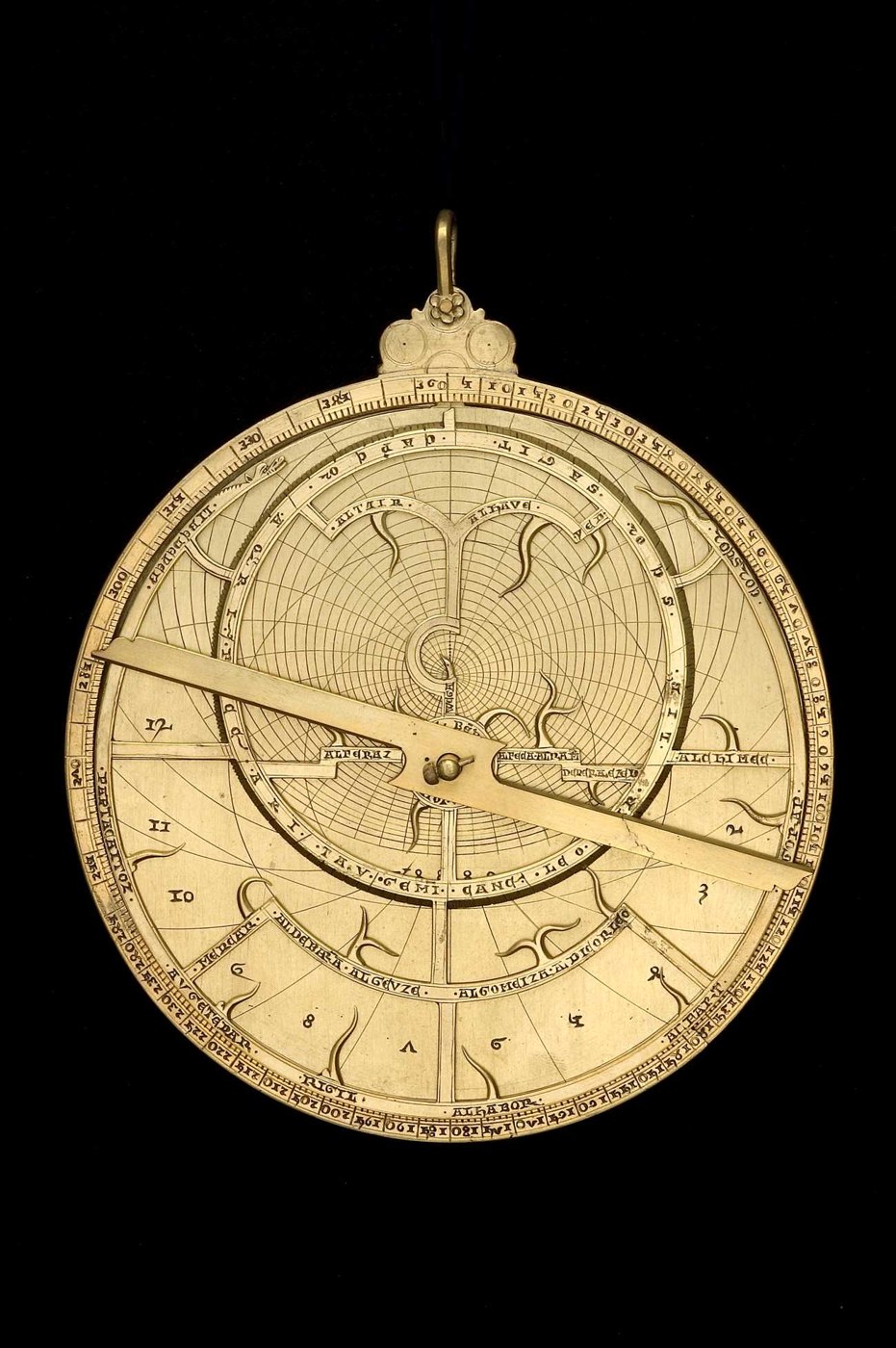
This brass astrolabe, designated inventory number 41468, is attributed to Paris with an approximate date of 1400. It was presented to the History of Science Museum by Lewis Evans in 1924. The instrument features a simple, engraved throne with integrated supports and an omega-shaped shackle, the latter decorated with a six-petalled flower at the pin point. The mater and limb are constructed from two soldered pieces, with the limb featuring a circular degree scale. The rete is of the full indicator-line type and includes 28 stars marked with flamant pointers and a dragon's head on the Tropic of Capricorn. The instrument is equipped with four plates covering latitudes from 41° to 52°. The back displays four scales—degree, zodiacal, calendar, and shadow square—alongside construction marks including circles and angles.

The rete and mater of the brass astrolabe (inventory 41468), displaying the ecliptic scale, flamant star pointers, and modern replacement rule.
The rete and mater of the brass astrolabe (inventory 41468), displaying the ecliptic scale, flamant star pointers, and modern replacement rule. — History of Science Museum, University of Oxford. Rights pending — permission not yet requested. Original source

Catalogue identity

Source
www.mhs.ox.ac.uk
Category
Tool · Latin-inscribed astrolabe
Maker / attribution
Not established
Reference
41468
Catalogue / lot identifier
1924-0/2063
Source-reported date
ca. 1400
Source-reported place
Paris (?)

Source-reported attribution and specifications are not independent authentication. A listing does not establish present ownership, current display, availability or permission to reproduce.

Object description

General Construction and Throne

The astrolabe is fabricated from brass and consists of a mater and limb formed by two soldered pieces. The instrument is designed with a simple, engraved throne featuring integrated supports. A distinct structural element is the omega-shaped shackle, which incorporates a six-petalled flower decoration at the point where the pin extends through the assembly.

Construction marks remain visible on the back of the instrument, specifically consisting of circles and angles used to layout the shadow square. The upper half of the rear surface is left blank, while the remainder is occupied by four distinct scales: degree, zodiacal, calendar, and shadow square, the latter marked in fingers.

Evidence for this section
  • “The mater and limb are of two pieces, soldered construction.”
  • “The throne is of the simple, engraved type with integrated support(s).”
  • “Shackle of the omega type (i.e. Ω-shaped shackle). simple Ω-shaped, with a 6-petalled flower where the pin extends through.”
  • “Construction marks on the back include the circle and angles used to construct the shadow square.”

Rete and Astronomical Features

The rete is categorized as an indicator-line full type, containing 28 stars marked with flamant pointers. The zodiacal signs are labeled individually along the ecliptic, including abbreviations such as 'ARI', 'TAV', 'GEMI', 'CANC', 'LEO', 'VIR', 'LIB', 'SCOR', 'SAGIT', 'CAP’COR', 'AQU”RI', and 'PISCC'.

Modern replacement parts include the pin, wedge, rule, and alidade, with the latter being a double-ended, counter-changed, rigid component.

Evidence for this section
  • “The rete is of the indicator-line (full) type.”
  • “The rete contains 28 stars.”
  • “Dragon’s head on Tropic of Capricorn”
  • “The rule is not original.”

Provenance and Historical Context

The instrument was accessioned in 1924 following its presentation by Lewis Evans, though formal acquisition records do not specify the source from which Evans obtained the piece. The cataloguing body notes that Evans' donation is assigned the inventory number 41468.

Although the exact origin remains tentative, the inclusion of a plate specifically calibrated for the latitude of 48° 49' provides evidence that the astrolabe was originally intended for use in Paris. This association with the Parisian latitude is the primary basis for the attributed place of manufacture.

Evidence for this section
  • “Presented by Lewis Evans in 1924”
  • “A plate for the specific latitude of 48° 49' suggests that it was originally made for use in Paris.”

Open research questions

  • What specific archival evidence or stylistic analysis links this instrument to the Paris workshop hinted at in the catalogue?
  • Are there extant records of Lewis Evans' correspondence that might clarify the acquisition history of this item prior to 1924?

Source evidence

Recorded claims and source quotations for Brass Astrolabe, Inventory 41468
FieldSource-reported valueSource quotation
Inventory number41468“Inventory number: 41468”
Dateca. 1400“Date ca. 1400”
Place of manufactureParis (?)“Place Paris (?)”
MaterialBrass“Material Brass”
AcquisitionPresented by Lewis Evans in 1924“Presented by Lewis Evans in 1924”
Rete star count28“The rete contains 28 stars.”
Plates4“There are 4 plates”

Visible details

  • The rete features a dragon’s head located on the Tropic of Capricorn.
  • The shackle is omega-shaped with a flower-like detail.
  • The back side includes a central shadow square and various concentric circular scales.

Research qualifications

  • The rule and alidade are identified as modern replacements.
  • The manufacture location is provided with a question mark as 'Paris (?)'.

Photograph identity and source facts were screened before import; rights clearance remains pending.

Consulted source

Astrolabe, inventory 41468 (Paris (?), ca. 1400)

Reviewed 2026-10-26 · Record ade2a14eed

Terms in this record

Glossary explanations for terms named in this object’s record.