
Skip to content
The Encyclopedia of Horology

Tool · Planispheric astrolabe

Brass Astrolabe for Horoscopes

Partially verified

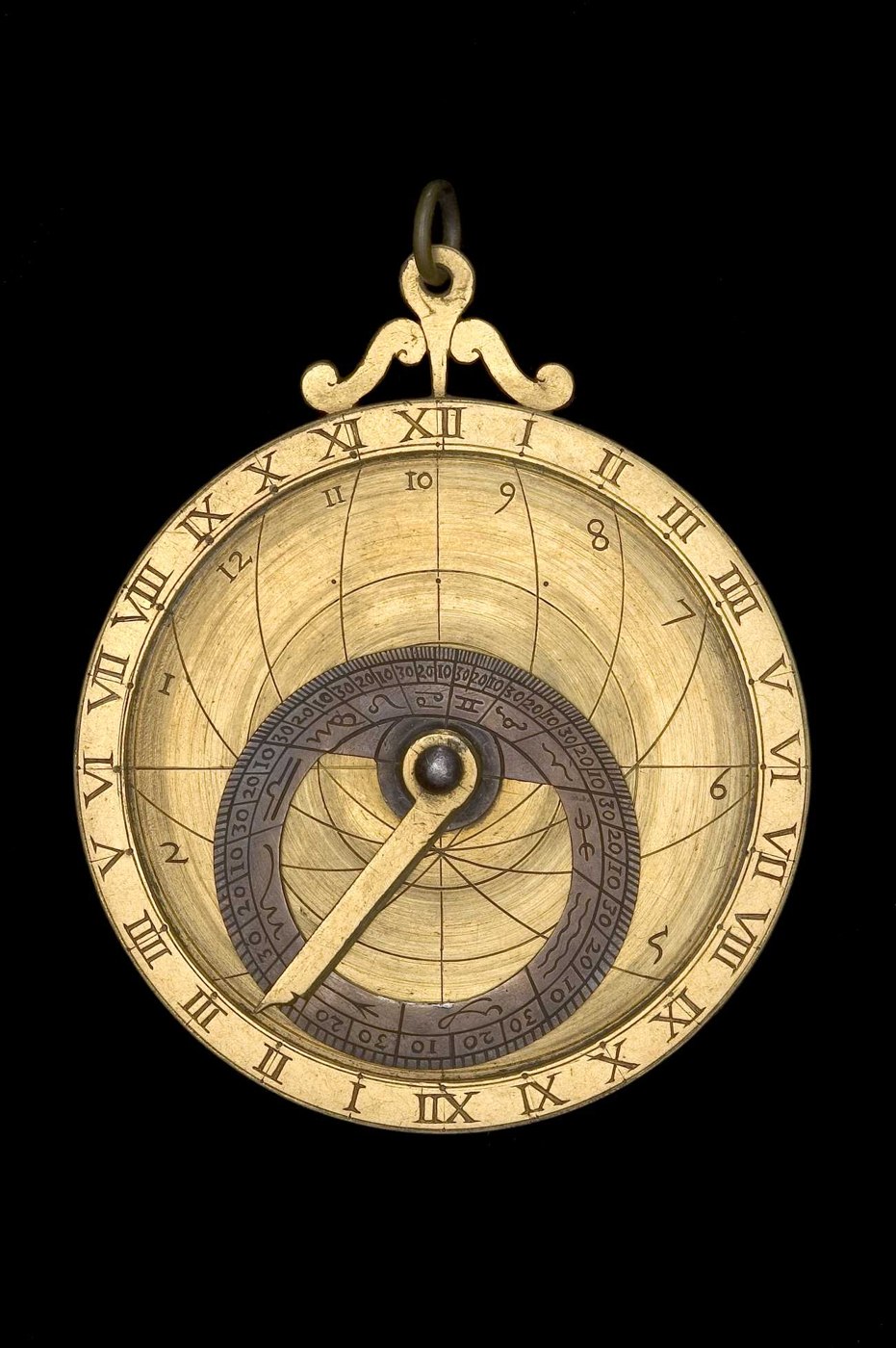
This brass astrolabe, inventory number 41951, is attributed to 16th-century Europe. The instrument was designed to assist in casting horoscopes. Its construction features a mater and limb made of two pieces in soldered brass, accompanied by a throne of a simple type with s-shaped scrollwork supports and a round cross-section ring. The womb of the mater is engraved with horoscopic houses, while a simplified rete, comprising only an ecliptic band, rotates over these lines. The back of the instrument displays a set of radial scales used to indicate the time of sunset at six-day intervals throughout the year. The device includes a single-ended pointer, and the rete is secured by a rivet.

Front view of the brass astrolabe (inventory 41951) showing the simplified rete and the horoscopic house lines on the mater.
Front view of the brass astrolabe (inventory 41951) showing the simplified rete and the horoscopic house lines on the mater. — History of Science Museum, University of Oxford. Rights pending — permission not yet requested. Original source

Catalogue identity

Source
www.mhs.ox.ac.uk
Category
Tool · Planispheric astrolabe
Maker / attribution
Not established
Reference
Not recorded
Catalogue / lot identifier
41951
Source-reported date
16th century (?)
Source-reported place
Europe

Source-reported attribution and specifications are not independent authentication. A listing does not establish present ownership, current display, availability or permission to reproduce.

Object description

Construction and Design

The astrolabe is fabricated from brass, utilizing a two-piece, soldered construction for the mater and the limb. The external appearance is defined by a simple throne featuring s-shaped scrollwork supports and an integrated base, attached to a ring with a plain, round cross-section. The design emphasizes portability, as the small, simple architecture suggests the tool was meant to be carried.

The front of the mater is engraved with horoscopic houses, which are numbered using engraved digits. The rete is minimal in its design, lacking star pointers and consisting primarily of an ecliptic band that pivots over the womb of the mater, allowing the user to align a single pointer to specific points on the zodiac.

Evidence for this section
  • “The mater and limb are of two pieces, soldered construction.”
  • “The throne is of the simple type with s-shaped scroll work support(s) made of brass”
  • “The simple design and small size suggest that the instrument was intended to be carried about and used frequently.”

Functionality and Scales

Designed specifically for horoscopic calculation, the instrument requires the user to set a pointer at the sun's position on the ecliptic. By rotating the assembly, the user can determine the time for casting a horoscope and read the house cusps where the ecliptic intersects the horoscopic lines in the womb. The limb is graduated with a scale for equal hours, arranged in a circular, concentric layout numbering 1 through 12.

The back of the astrolabe is heavily detailed with radial scales. These scales provide the time of sunset at six-day intervals for each month of the year, facilitating the time-keeping requirements of the user.

Evidence for this section
  • “The womb of the mater has been engraved with a set of horoscopic houses.”
  • “Scales on the limb: equal hours scale.”
  • “The back is covered with a set of radial scales listing the time of sunset at six-day intervals, one for each month of the year.”

Provenance and Identification

The instrument is recorded in the Astrolabe Catalogue of the History of Science Museum at the University of Oxford under inventory number 41951. Regarding its history, the museum reports that no acquisition details have been found.

Nothing is known regarding its provenance prior to its entry into the collection.

Evidence for this section
  • “Inventory no. 41951”
  • “No acquisition details have been found”
  • “Nothing is known of its earlier provenance.”
  • “16th century (?)”

Open research questions

  • What specific historical or mathematical evidence supports the 16th-century dating?
  • Are there similar horoscopic-focused astrolabes that provide a basis for the attribution to Europe?

Source evidence

Recorded claims and source quotations for Brass Astrolabe for Horoscopes
FieldSource-reported valueSource quotation
Inventory Number41951“Inventory no. 41951”
MaterialBrass“Material Brass”
Date16th century (?)“Date 16th century (?)”
Place of ManufactureEurope“Place Europe”
ConstructionTwo-piece soldered mater and limb“The mater and limb are of two pieces, soldered construction.”
Intended UseCasting horoscopes“This astrolabe was constructed to assist in casting horoscopes.”
Rete ConfigurationSimplified ecliptic band“The simplified rete, consisting of just the ecliptic band, rotates over these lines.”
Throne TypeSimple type with s-shaped scroll work“The throne is of the simple type with s-shaped scroll work support(s)”

Visible details

  • The limb features a circular, concentric scale for equal hours numbered 1-12.
  • The rete includes a zodiac band marked with symbols for the twelve signs.
  • The back is engraved with radial scales and numeric data for sunset times.
  • The throne is designed with s-shaped scrollwork.

Research qualifications

  • The exact date of manufacture is uncertain and recorded as '16th century (?)'.
  • The geographical origin is broadly attributed to Europe, with no specific maker or workshop identified.

Photograph identity and source facts were screened before import; rights clearance remains pending.

Consulted source

Astrolabe, inventory 41951 (Europe, 16th century (?))

Reviewed 2026-10-26 · Record 2925870773

Terms in this record

Glossary explanations for terms named in this object’s record.