
Skip to content
The Encyclopedia of Horology

Clock · Bracket clock

Bracket night clock

Partially verified

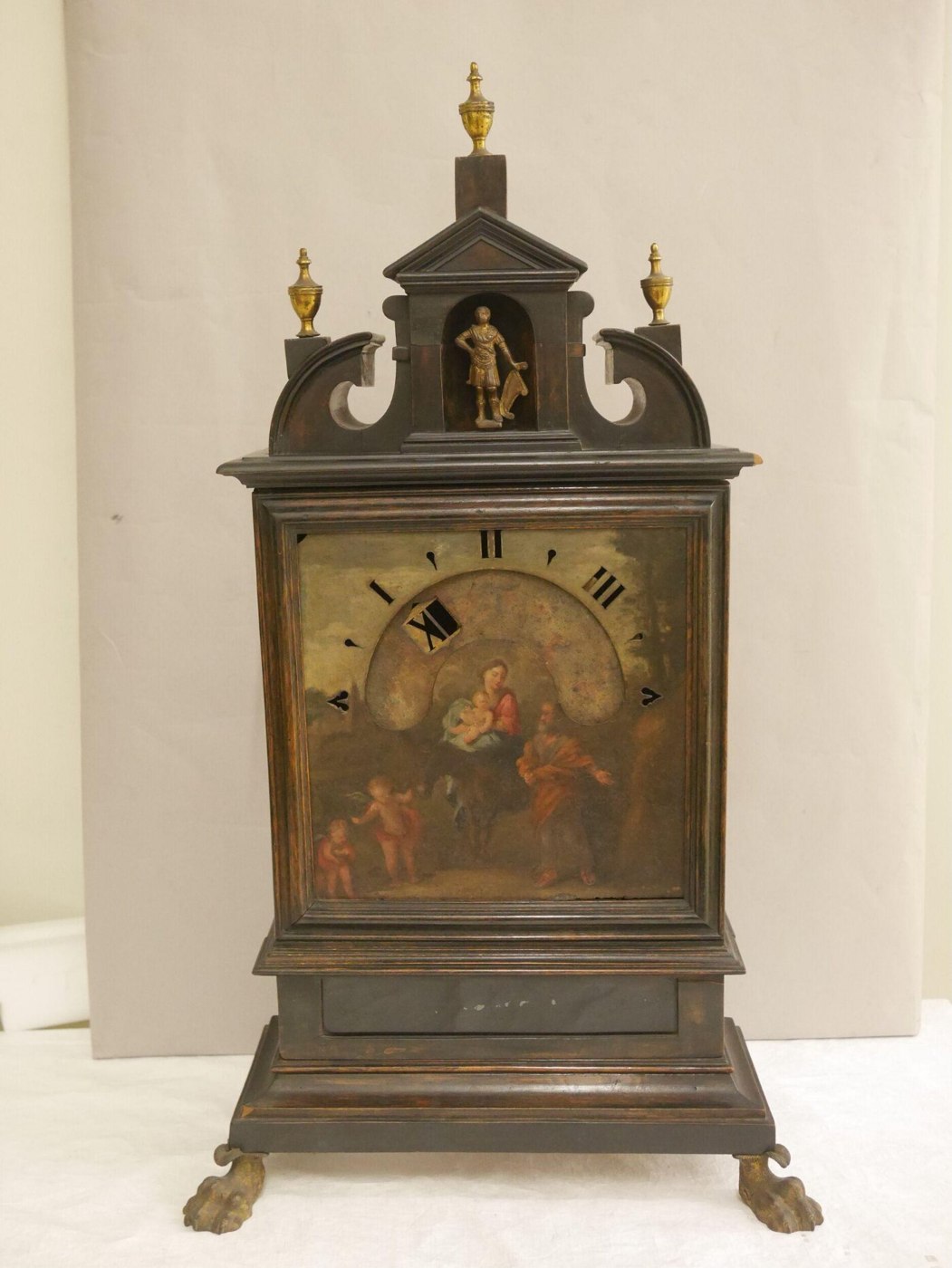
The dial is unglazed, metal, and pierced, painted with a scene representing the Flight into Egypt. The clock mechanism is mounted on a two-part circular metal plate. The base includes a rectangular window originally intended to show the pendulum, which has since been painted black. The clock was designed as a night clock, intended to allow the time to be read through the placement of a lamp or candle behind the dial, emitting light through the pierced apertures. The object was bequeathed by Colonel G. B. Croft Lyons to the museum and remains a recorded example of the night clock genre.

The front view of the Campani bracket night clock showing the ebonised case and the painted Flight into Egypt dial.
The front view of the Campani bracket night clock showing the ebonised case and the painted Flight into Egypt dial. — Victoria and Albert Museum. Rights pending — permission not yet requested. Original source

Catalogue identity

Source
collections.vam.ac.uk
Category
Clock · Bracket clock
Maker / attribution
Pietro Tommaso Campani
Reference
Not recorded
Catalogue / lot identifier
W.72-1926
Source-reported date
1680-1690
Source-reported place
Rome

Source-reported attribution and specifications are not independent authentication. A listing does not establish present ownership, current display, availability or permission to reproduce.

Object description

Case Construction and Design

The bracket clock is housed in an ebonised fruitwood veneer applied over a softwood frame. The structure includes a scrolled, classic pediment crafted in sections, which supports three gilt metal finials. The plinth is finished with gilt metal leaf ornaments and rests upon carved, gilded wood paw feet at the front, while the back feet are turned and ebonised. Housed within a central niche is a gilt metal figure of a Roman soldier, depicted holding a harp.

The design incorporates a deep door secured by a single metal spring clip on the right side. This section houses the dial, the mechanism, and a secondary lower window. The interior of the rear two-thirds of the case remains as an undecorated space, designed specifically to accommodate a candle or oil lamp for illumination of the dial, supported by a ventilation aperture located at the top of the rear structure.

Evidence for this section
  • “Ebonised wood veneered on oak, surmounted by a scrolled classic pediment of solid wood carved in sections”
  • “The moulded plinth is supported on carved and gilded wood paw feet with gilt metal leaf ornament and turned and ebonised back feet.”
  • “The rear two thirds of the clock body is a static unit, the inside of which provides an empty, undecorated space in which a candle or oil lamp could be placed”

Dial and Functionality

The clock features an unglazed, pierced metal dial surface, which is decorated with a painted depiction of the Flight into Egypt. The hours are marked on the dial in such a way that the time is intended to be read by the light emitted from a lamp placed inside the case, passing through the apertures. The circular clock mechanism is fixed to a two-part metal plate, which is held by a horizontal bracket screwed directly into the internal case structure.

Condition reports indicate that the dial's paint is significantly worn. Furthermore, a rectangular window positioned beneath the main dial, which was originally included to allow a view of the pendulum, has been painted over in black. The movement is marked with the maker's identification on the reverse.

Evidence for this section
  • “The unglazed and pierced metal dial is painted with a representation of the Flight into Egypt”
  • “behind is a two-part circular metal plate, to which the circular clock mechanism is attached”
  • “The window under the dial, originally intended to show the pendulum, has been painted black.”

Provenance and Modifications

This clock was bequeathed to the museum by Colonel G. B. Croft Lyons. It represents a specific type of nocturnal timepiece known as a night clock, a format designed in 17th-century Rome by the Campani brothers to provide quiet, lamp-lit timekeeping for patrons sensitive to the noise of conventional verge escapements.

Maintenance and later interventions have altered the original state of the clock. The veneer displays chipping at the front-left and top-right edges, and there are recorded signs of metal corrosion consistent with the object's age and historical environment.

Evidence for this section
  • “Bequeathed by Colonel G. B. Croft Lyons per Mill Stevenson Esq. FSA”
  • “The gilt brass vases and paw-feet are later additions or replacements, probably English, 19th-century.”
  • “The veneer is chipped at the front left lower corner and the top right moulding.”

Open research questions

  • What is the extent of original 17th-century components within the internal movement?
  • Are there visible indications of the original pendulum design prior to the obscuring of the lower window?

Source evidence

Recorded claims and source quotations for Bracket night clock
FieldSource-reported valueSource quotation
MakerPietro Tommaso Campani“Pietro Tommaso Campani (maker)”
Date1680-1690“1680-1690”
Place of originRome“Place of origin: Rome (made)”
Accession numberW.72-1926“Accession number: W.72-1926”
InscriptionsPetrus Thomas Campanus Inventor Romae“Petrus Thomas Campanus Inventor Romae”
MaterialsSoftwood veneered with ebonised fruitwood, gilt metal“Softwood veneered with ebonised fruitwood(?), with gilt metal and carved and gilded elements”
Height76 cm“Height: 76 cm”

Visible details

  • The clock dial features a painted scene of the Flight into Egypt.
  • The case includes a standing figure of a Roman soldier in a central niche.
  • A rectangular window located below the dial has been obscured with black paint.
  • Gilt metal paw-style front feet support the plinth of the clock.

Research qualifications

  • The gilt brass vases and paw-feet are attributed as later 19th-century replacements.
  • The painting on the dial is worn, preventing a definitive attribution to a specific artist.

Photograph identity and source facts were screened before import; rights clearance remains pending.

Consulted source

Bracket clock

Reviewed 2026-10-26 · Record 9d8d7f60ea

Terms in this record

Glossary explanations for terms named in this object’s record.