
Skip to content
The Encyclopedia of Horology

Clock · Bracket clock

Bracket clock by Paulet

Partially verified

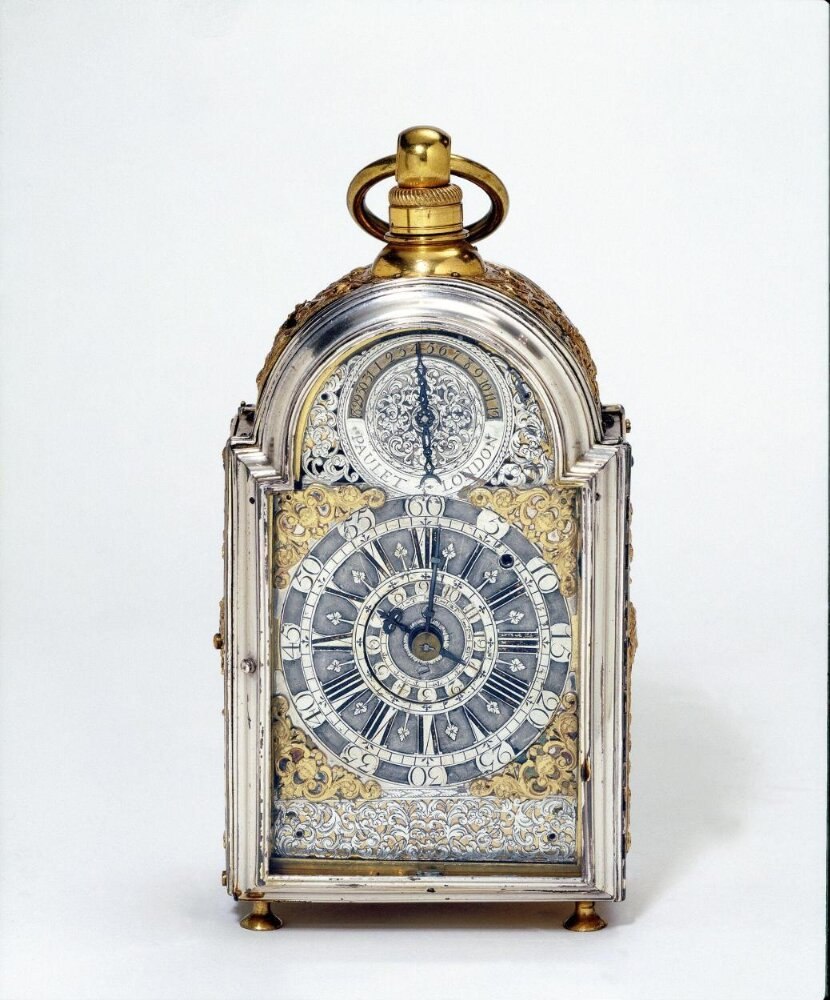
This small bracket clock, bearing the signature 'Paulet London', dates to approximately 1710. Measuring 19.5 cm in height, 10 cm in width, and 7.5 cm in depth, it is of a compact size intended for portability. The clock features a complex dial configuration comprising a primary time-telling dial, a central dial for setting an alarm, and a top-positioned dial for tracking the calendar. Mechanically, the movement is designed to strike hours in passing and repeat both hours and quarters. The case displays gilt-brass ornamentation, noted for stylistic similarities to the designs of Daniel Marot, a French architect influential in England at the time.

Front view of the Paulet bracket clock showing the primary time dial, alarm setting, and calendar indicator.
Front view of the Paulet bracket clock showing the primary time dial, alarm setting, and calendar indicator. — © Victoria and Albert Museum, London. Rights pending — permission not yet requested. Original source

Catalogue identity

Source
collections.vam.ac.uk
Category
Clock · Bracket clock
Maker / attribution
Paulet
Reference
Not recorded
Catalogue / lot identifier
420-1869
Source-reported date
ca. 1710
Source-reported place
London

Source-reported attribution and specifications are not independent authentication. A listing does not establish present ownership, current display, availability or permission to reproduce.

Object description

Movement and Functionality

The clock is engineered with specific complications for its small size, including the ability to strike the hours in passing. Additionally, it offers a repeating function for both the hours and the quarters. The dial layout is intricate, featuring a primary face for indicating the time, alongside two auxiliary dials: a central one for alarm adjustment and a top dial for calendar indications.

Operating this clock necessitates frequent winding, as it is not designed as an eight-day timepiece. The specific arrangement of the auxiliary dials and the repeating mechanism indicate a high degree of technical focus for a clock of these modest dimensions, intended for transport rather than domestic stationary placement.

Evidence for this section
  • “The clock strikes hours in passing and repeats the hours and quarters.”
  • “The central dial at the front is used to set the alarm, and the pointer on the top dial is for the calendar.”
  • “The clock was not an eight-day clock; it had to be wound more frequently.”

Case and Design Influence

The case is characterized by its compact dimensions and portability, designed to be moved between locations. The exterior displays significant gilt-brass decoration applied to the sides, which reflects the popular aesthetic trends of the early 18th century. The ornate nature of these mountings shows a strong connection to the work of Daniel Marot, a prominent French printmaker and architect who was active in The Netherlands and whose design influence was widespread in England at this time.

The inclusion of a carrying handle suggests that the intended use of the clock involved regular movement, potentially even for use on ships where it could be secured to a cabin wall.

Evidence for this section
  • “The gilt-brass decoration on the sides of the case owes much to the influence of Daniel Marot (1663-1752)”
  • “The distinctly Continental style of his clocks and his French name suggest that he was a Huguenot (French Protestant emigré).”
  • “It has been suggested that they might well have been used on board ship, fitted into a case fixed to the wall of a cabin.”

Maker and Attribution

Little formal documentation exists regarding the clockmaker who signed his work as 'Paulet'. Despite this lack of biographical detail, the presence of his signature on various surviving clocks indicates an active career in early 18th-century London. The quality of his work is evidenced by his association with high-status patrons, including royal ownership, as noted in items held in museum collections such as the Metropolitan Museum of Art.

The consistency of his signature and the stylistic elements of his clocks suggest he was part of the Huguenot community of skilled craftsmen in London.

Evidence for this section
  • “Little is known about the maker who signed himself 'Paulet'.”
  • “A clock by him in the Metropolitan Museum, New York bears the royal monogram of Queen Anne (ruled 1702-1714).”
  • “Made in London, the movement signed 'Paulet London'”

Open research questions

  • What is the internal mechanism design used for the repeating strike train in this specific model?
  • Are there archival records or parish registers in London that can confirm the identity of a clockmaker named Paulet active in 1710?

Source evidence

Recorded claims and source quotations for Bracket clock by Paulet
FieldSource-reported valueSource quotation
MakerPaulet“signed himself 'Paulet'”
Dateca. 1710“ca. 1710”
Place of originLondon“Made in London”
Striking mechanismStrikes hours in passing and repeats hours and quarters“strikes hours in passing and repeats the hours and quarters”
Design influenceDaniel Marot“owes much to the influence of Daniel Marot (1663-1752)”
Accession Number420-1869“420-1869”

Visible details

  • The dial features an integrated calendar pointer at the top and an alarm setting dial in the center.
  • The clock case is topped with a prominent brass carrying handle.
  • The clock sits on four small, simple feet.
  • The dial plate is heavily decorated with chased gilt-brass elements.

Research qualifications

  • The exact identity and background of the maker 'Paulet' remain historically obscure.
  • The clock's purported maritime use as a ship's clock remains a suggestion rather than a confirmed provenance.

Photograph identity and source facts were screened before import; rights clearance remains pending.

Consulted source

Bracket clock, Paulet, London, ca. 1710

Reviewed 2026-11-02 · Record 95d2acca35

Terms in this record

Glossary explanations for terms named in this object’s record.