
Skip to content
The Encyclopedia of Horology

Clock · Bracket clock

Bracket clock by George Prior

Partially verified

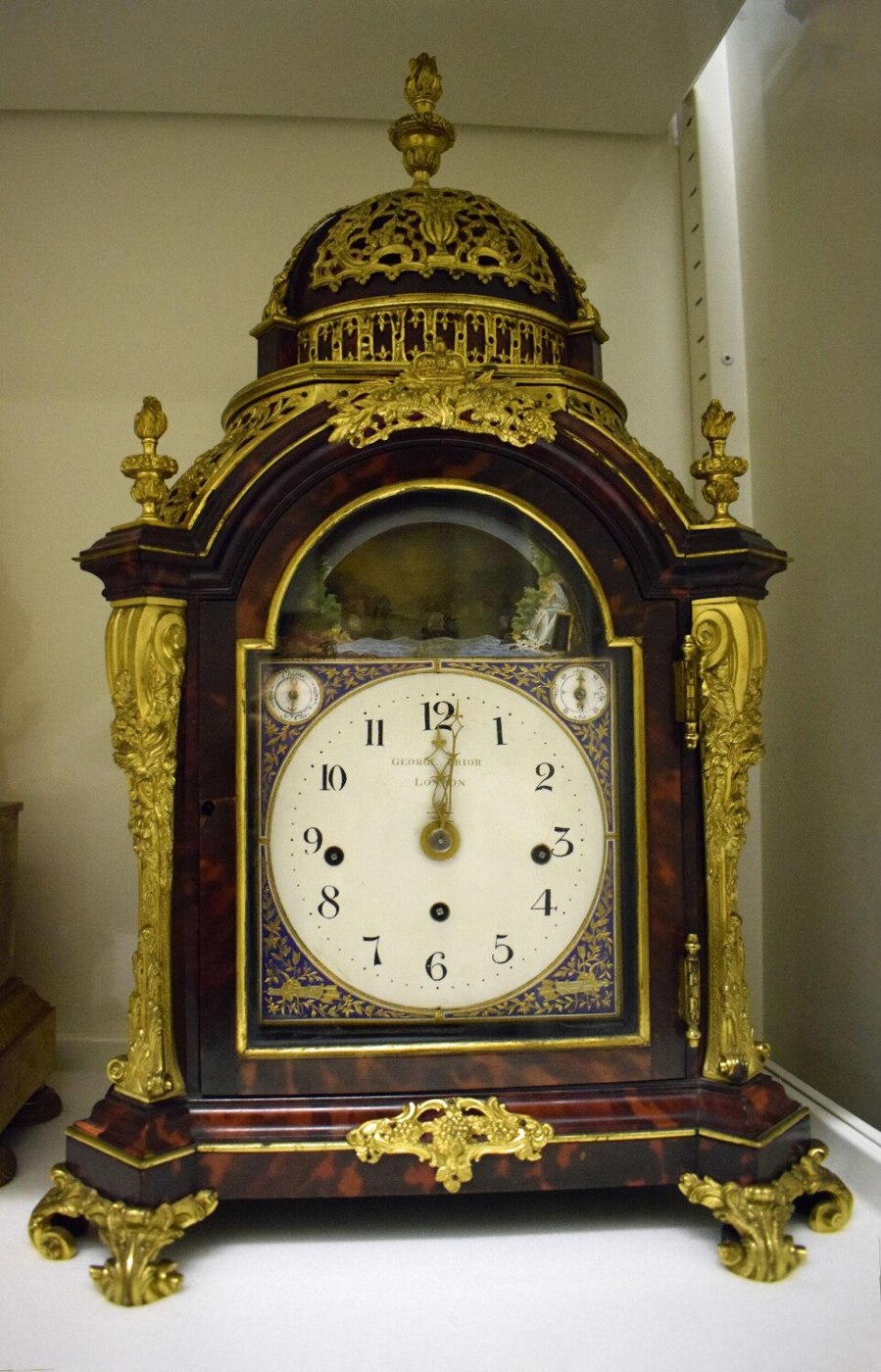
This bracket clock was produced in London by the maker George Prior, circa 1800. The object stands at a height of 54.6 cm and features a case predominantly constructed of tortoiseshell. Its architectural design is supported by four scroll feet and includes ormolu pilasters at the corners, which are finished with decorative flame finials. The clock is surmounted by a domed top that also carries a flame finial. The dial, which is plain in appearance, is positioned beneath a marine processional view. The piece was bequeathed to the Victoria and Albert Museum by John Jones. The clock's inscription identifies the maker, who operated in various London addresses including George Yard and Lombard Street during his active period.

Front view of the bracket clock showing the tortoiseshell case, ormolu pilasters, flame finials, and the dial with marine scene.
Front view of the bracket clock showing the tortoiseshell case, ormolu pilasters, flame finials, and the dial with marine scene. — Victoria and Albert Museum. Rights pending — permission not yet requested. Original source

Catalogue identity

Source
collections.vam.ac.uk
Category
Clock · Bracket clock
Maker / attribution
George Prior
Reference
Not recorded
Catalogue / lot identifier
1010:1-1882
Source-reported date
ca. 1800
Source-reported place
London

Source-reported attribution and specifications are not independent authentication. A listing does not establish present ownership, current display, availability or permission to reproduce.

Object description

Case and Exterior Design

The bracket clock is characterized by a distinctive exterior featuring a tortoiseshell case. The structure is elevated on four scroll feet, providing a base for the main cabinet. The top of the clock is defined by a domed shape, capped with a flame-shaped finial. The overall composition is balanced by the inclusion of matching flame finials that sit atop ormolu pilasters situated at each of the four corners.

Decorative elements are integrated into the primary form. The dial area is surmounted by a marine processional view, which serves as a visual feature above the main timekeeping display.

Evidence for this section
  • “hell case resting on four scroll feet and surmounted by a domed top with a flame finial”
  • “At the corners are ormolu pilasters surmounted by similar finials”
  • “Above the plain dial is a marine processional view”

Maker and Inscription

The object is signed by the maker George Prior, whose work is identified by the inscription on the dial. Historical records indicate that Prior worked at several London locations throughout the late 18th and early 19th centuries, including Goodman's Fields and George Yard. The inscription provides the necessary attribution for the clock, linking the production to his known career timeline.

The maker's activity in London spanned several decades, from 1765 through 1810. The production date of the clock, approximately 1800, aligns with the period when Prior was active at 5 George Yard, Lombard Street, placing this object within his established working timeframe.

Evidence for this section
  • “inscribed ‘George Prior, London’”
  • “George Prior worked at 31 Prescot Street, Goodman's Fields in 1765-88, at Rosamund's Row in 1794, and at 5 George Yard, Lombard Street from 1798-1810.”

Acquisition and Provenance

The clock entered the museum collection as part of a bequest from John Jones. This provenance links the item to a specific historical collection held by the institution. The acquisition is catalogued under the accession number 1010:1-1882, which provides a formal record of its entry into the museum's holdings.

The physical dimensions of the clock were established during the cataloguing process, with the height recorded as 54.6 cm based on the department register. This measurement confirms the scale of the piece as a significant example of a bracket-style timepiece.

Evidence for this section
  • “Bequeathed by John Jones”
  • “Accession number: 1010:1-1882”

Open research questions

  • What type of escapement and striking mechanism is housed within the tortoiseshell case?
  • Are there specific details regarding the marine processional scene that identify the artist or the style of the illustration?

Source evidence

Recorded claims and source quotations for Bracket clock by George Prior
FieldSource-reported valueSource quotation
MakerGeorge Prior“George Prior”
Dateca. 1800“ca. 1800”
Place of originLondon“London”
Accession number1010:1-1882“1010:1-1882”
MaterialTortoiseshell“tortoiseshell”
InscriptionGeorge Prior, London“inscribed ‘George Prior, London’”

Visible details

  • Case is covered in tortoiseshell with scroll feet.
  • Ormolu pilasters flank the dial with flame finials above.
  • Marine scene located in an arch above the dial.
  • Clock dial bears an inscription reading 'George Prior, London'.

Research qualifications

  • The exact date of production is estimated as circa 1800.
  • Details regarding the internal movement are not described in the source.

Photograph identity and source facts were screened before import; rights clearance remains pending.

Consulted source

Clock, Prior, George, ca. 1800

Reviewed 2026-11-02 · Record d3c21d7847

Terms in this record

Glossary explanations for terms named in this object’s record.