
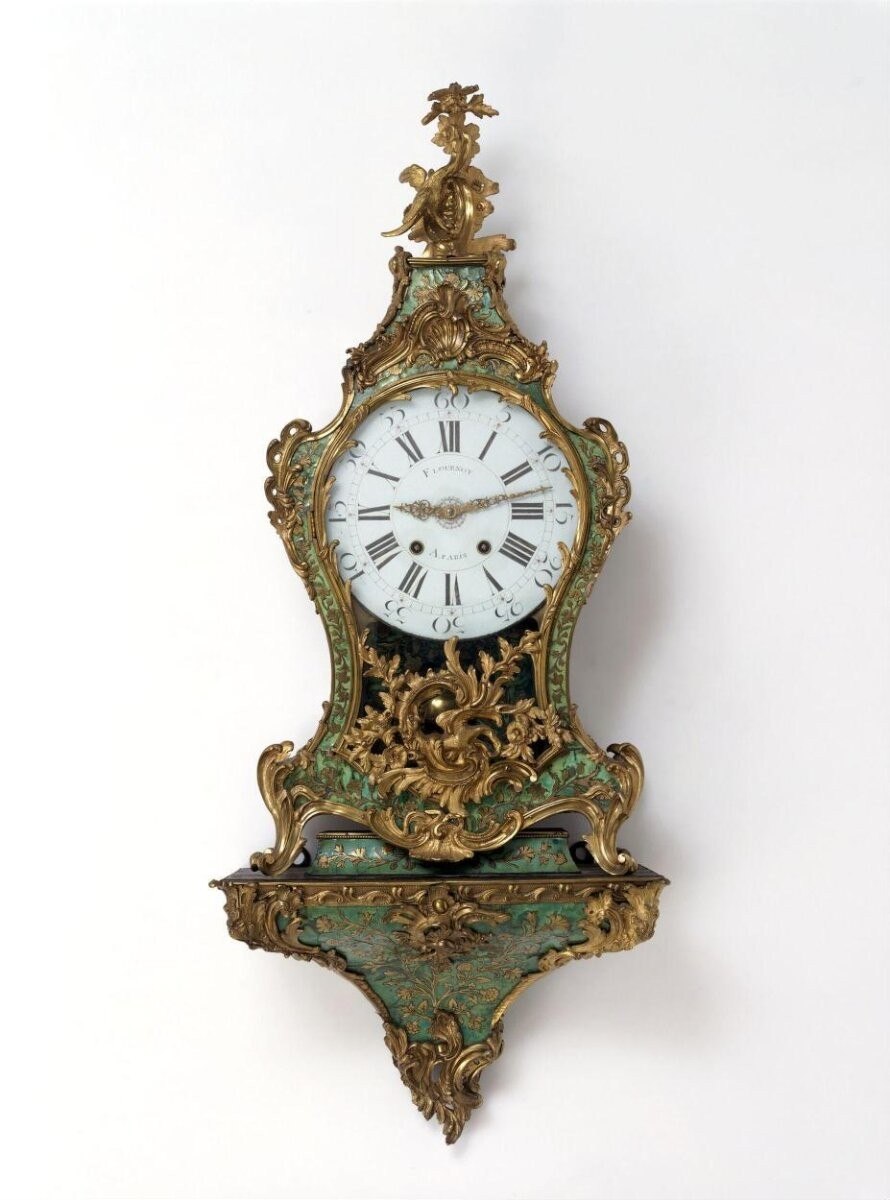
Case Construction and Design
The clock and bracket are constructed with a boulle-work veneer. This technique utilizes horn backed with green pigment, combined with engraved brass inlays. The surface is decorated with floral patterns, specifically carnations, which are suggestive of motifs found on Middle Eastern ceramics. The overall aesthetic is influenced by the rococo style.
Gilt bronze mounts are applied to the case, featuring foliage scrolls, bunches of flowers, and shell motifs. Positioned directly below the clock section is a dragon-shaped mount, which is described as providing a chinoiserie effect to the overall design of the object.
The case is stamped 'F. Goyer J.M.E.' The use of green-pigmented boulle-work on clock cases remained prevalent through the mid-18th century, despite its decline in popularity for larger furniture items around 1715.
Evidence for this section
- “The case of this bracket clock is veneered with boulle-work”
- “case stamped ‘F. Goyer J.M.E.’”
- “Directly below the clock is a dragon giving the design a chinoiserie effect.”
- “Green boulle-work, as seen here, was very popular during the 1740s and 1750s.”