
Skip to content
The Encyclopedia of Horology

Clock · Mantel clock

B.J. Kerridge Eight-Day Mantel Clock

Partially verified

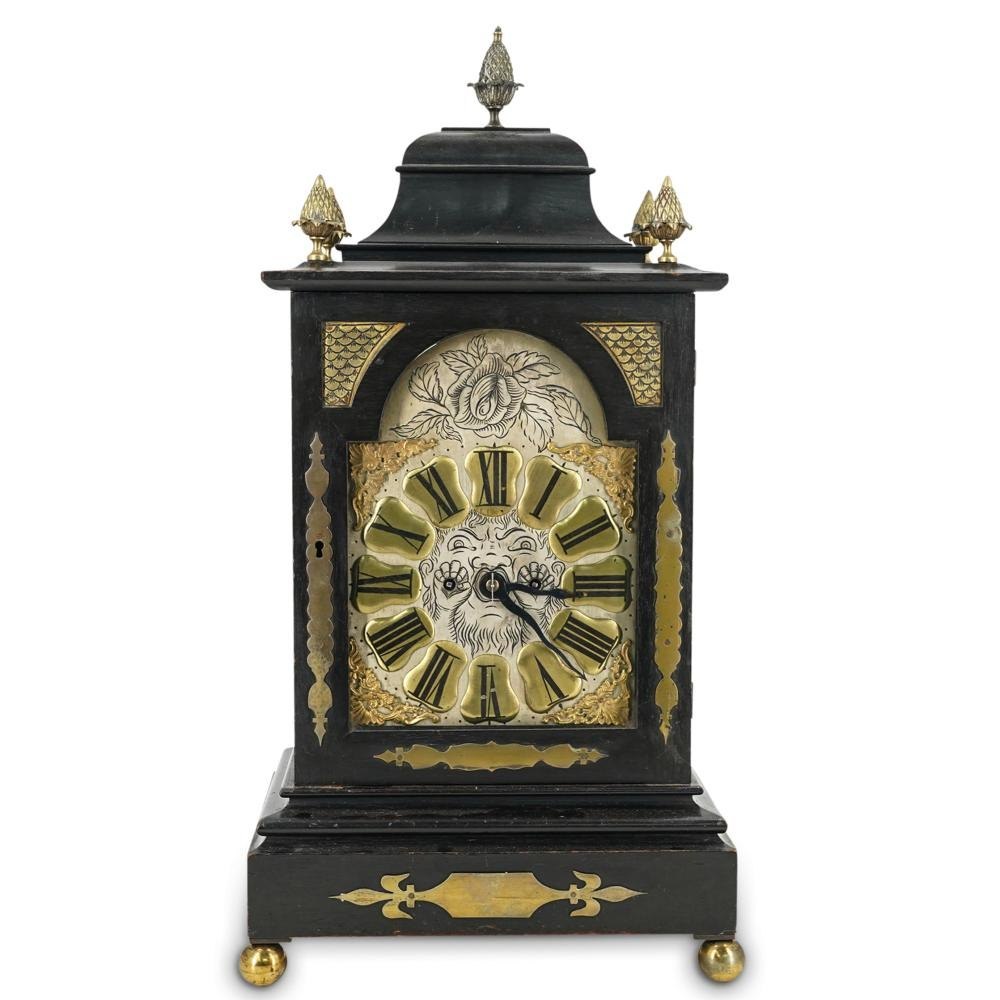
This 19th-century English mantel clock, dated 1884, was crafted by B.J. Kerridge. The timepiece is defined by its eight-day chain fusee movement, which is enclosed within a wooden casing. The exterior design incorporates bronze elements, specifically trim pieces and spherical feet. The aesthetic is punctuated by five pineapple-shaped finials mounted atop the clock. The dial features distinct ornamental etching, including an ogre's visage and a prominent rose motif above the chapter ring, while the corners are finished with floral and foliage embellishments. Measuring 25.75 inches in height, 9.75 inches in width, and 13.5 inches in length, the clock is accompanied by its pendulum and a clock key. The movement is inscribed with the maker's details, including the location and year of manufacture, WIMBORNE 1884.

Front view of the 19th-century B.J. Kerridge mantel clock showing the dial detail and pineapple finials.
Front view of the 19th-century B.J. Kerridge mantel clock showing the dial detail and pineapple finials. — Auction house “Akiba Galleries”, via Invaluable. Rights pending — permission not yet requested. Original source

Catalogue identity

Source
orbiscollectibles.com
Category
Clock · Mantel clock
Maker / attribution
B.J. Kerridge
Reference
Not recorded
Catalogue / lot identifier
Source URL identifies the listing
Source-reported date
1884
Source-reported place
England

Source-reported attribution and specifications are not independent authentication. A listing does not establish present ownership, current display, availability or permission to reproduce.

Object description

Case and Dial Decoration

The casing of this mantel clock is constructed from wood and features several distinct decorative accents in bronze. It stands on four spherical bronze feet and is adorned with five pineapple-shaped finials. The front of the wooden case includes bronze trimmings that complement the overall design.

The dial is notable for its intricate etched imagery. Central to the dial is an etched depiction of an ogre's visage. Above this, a large rose motif is etched into the upper portion of the dial, while the four corners are filled with etched floral and foliage patterns. These ornamental features are consistent with the documented aesthetic of the piece.

Evidence for this section
  • “housed in a wooden casing accented with bronze trimmings and rests upon spherical bronze feet”
  • “five pineapple-shaped finials crowning the casing”
  • “The dial is a work of intricate artistry, decorated with an etched ogre's visage and hands, while the corners display floral and foliage embellishments. An etched rose motif is prominently featured above the dial.”

Movement and Functionality

The clock is powered by an eight-day chain fusee movement. This mechanical system is designed to provide consistent power over a week-long duration between windings. The movement is directly associated with the maker B.J. Kerridge and the location of Wimborne, as confirmed by the engravings on the movement.

The clock is provided with its original key and pendulum, which are necessary for the operation of the fusee mechanism.

Evidence for this section
  • “features a sophisticated eight-day chain fusee movement”
  • “The movement is engraved with the maker's name, 'B. J. Kerridge', and the location and year 'WIMBORNE 1884'.”
  • “This functional antique timepiece comes complete with its pendulum and original clock key”

Identification and Chronology

The clock is attributed to the maker B.J. Kerridge based on the inscription found on the movement. The date of 1884 is explicitly marked on the movement, identifying the object as a product of the late 19th century.

The object is classified as an English mantel clock, though the specific workshop location provided is Wimborne. The documentation provides physical dimensions which serve as a reference for the size and scale of the example.

Evidence for this section
  • “crafted by B.J. Kerridge in 1884”
  • “The movement is engraved with the maker's name, 'B. J. Kerridge', and the location and year 'WIMBORNE 1884'.”

Open research questions

  • What is the specific horological background or history of the maker B.J. Kerridge in Wimborne?
  • Are there other recorded examples of Kerridge clocks that utilize this specific 'ogre' dial motif?

Source evidence

Recorded claims and source quotations for B.J. Kerridge Eight-Day Mantel Clock
FieldSource-reported valueSource quotation
MakerB.J. Kerridge“crafted by B.J. Kerridge”
Date1884“WIMBORNE 1884”
Movement Typeeight day chain fusee“eight-day chain fusee movement”
Height25.75 inches“25.75 inches in height”
Width9.75 inches“9.75 inches in width”
Length13.5 inches“13.5 inches in length”
Materialswood, bronze“housed in a wooden casing accented with bronze trimmings”
InscriptionsB. J. Kerridge, WIMBORNE 1884“engraved with the maker's name, 'B. J. Kerridge', and the location and year 'WIMBORNE 1884'”

Visible details

  • Etched ogre face on the central dial area
  • Five pineapple finials on top of the case
  • Dark wooden case with brass or bronze decorative plates
  • Spherical feet at the base

Research qualifications

  • The exact composition of the 'bronze' trimmings is not technically verified
  • The degree of original versus replaced components in the movement is not detailed

Photograph identity and source facts were screened before import; rights clearance remains pending.

Consulted source

19th Century B.J. Kerridge eight day mantel clock

Reviewed 2026-11-02 · Record b930b7e704

Terms in this record

Glossary explanations for terms named in this object’s record.