
Skip to content
The Encyclopedia of Horology

Tool · English azimuth dial

Azimuth Dial

Partially verified

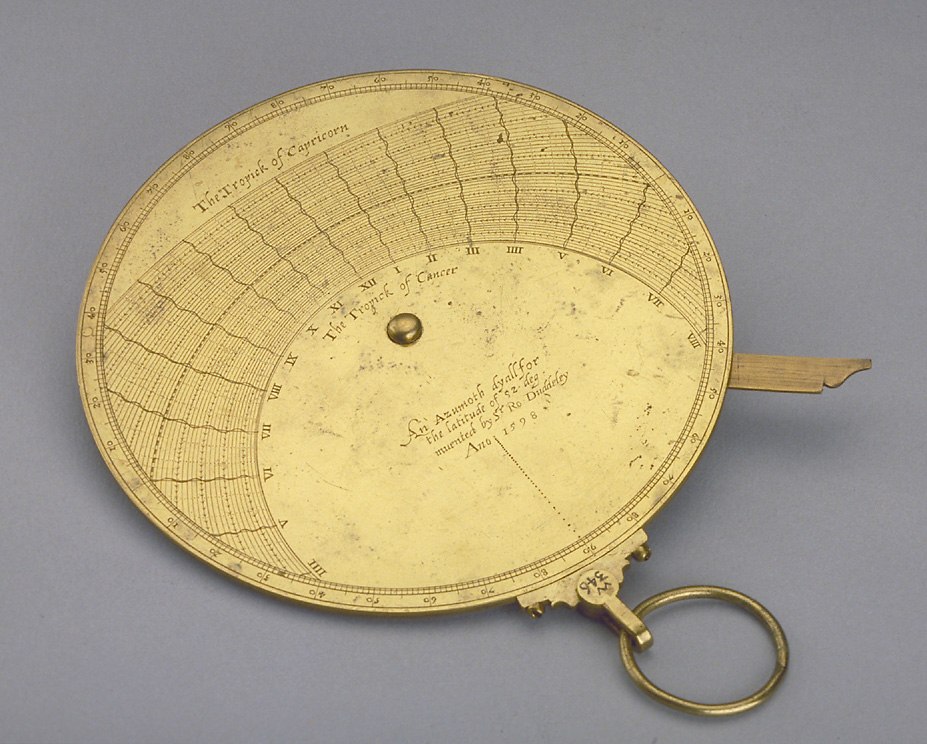
This brass instrument, measuring 145 mm in diameter, is configured as an azimuth dial with an integrated planisphere. Its construction follows the general form of an astrolabe, featuring a mater equipped with a simple throne and suspension ring. The reverse side serves as the primary azimuth dial, displaying specific lines for solar declination and hour markings ranging from IIII to XII to VIII, with divisions at 20-minute intervals. The mater itself is engraved with a Gemma Frisius universal projection, with the ecliptic marked by zodiacal symbols. The instrument includes a semi-circular plate featuring a corresponding universal projection. An inscription on the azimuth dial attributes its invention to Sir Robert Dudley in 1598. The instrument is currently held in the British Museum. The ruler and fixing mechanism are identified as modern replacements. This object is documented in the catalogue of European Scientific Instruments by F. A. B. Ward.

Reverse of the brass azimuth dial showing the Tropic of Cancer and the maker's inscription.
Reverse of the brass azimuth dial showing the Tropic of Cancer and the maker's inscription. — British Museum, London. Rights pending — permission not yet requested. Original source

Catalogue identity

Source
www.mhs.ox.ac.uk
Category
Tool · English azimuth dial
Maker / attribution
Not established
Reference
Not recorded
Catalogue / lot identifier
MLA 1894,6-15.2
Source-reported date
circa 1600
Source-reported place
England

Source-reported attribution and specifications are not independent authentication. A listing does not establish present ownership, current display, availability or permission to reproduce.

Object description

Construction and Layout

The instrument is constructed from brass and measures 145 mm in diameter, mimicking the structural form of an astrolabe. A simple throne with a suspension ring is attached to the mater's rim. The rim itself is engraved with a double degree scale, including a 0 to 360 circle and a 0 to 90 quadrant arrangement, subdivided down to 1-degree increments.

The reverse of the device functions as an azimuth dial. Engravings include labelled tropics for Cancer and Capricorn, as well as an equator indicated by a double line with alternate shading. Solar declinations are marked by lines with arrowheads at 5-degree intervals, further subdivided to 1 degree. The hour lines are numbered IIII through XII to VIII, allowing for 20-minute readings.

Evidence for this section
  • “The instrument is similar in shape to an astrolabe”
  • “The rim of the mater bears a double degree scale”
  • “The reverse of the instrument is laid out as an azimuth dial.”

Projection and Components

The interior of the mater features a Gemma Frisius universal projection, with the ecliptic marked using standard zodiacal signs. This is paired with a semi-circular plate that reflects the same universal projection system.

While the primary plate and mater are original to the instrument's construction, the ruler and the associated fixing mechanism are catalogued as later replacements.

Evidence for this section
  • “The mater itself is engraved with a Gemma Frisius universal projection.”
  • “The ruler and fixing mechanism are replacements.”

Inscription and Provenance

The azimuth dial contains an inscription within the circle created by the marking for the Tropic of Cancer. This text specifies that the instrument was intended for a latitude of 52 degrees and attributes its invention to Sir Robert Dudley in 1598. The piece is currently part of the collection at the British Museum in London.

The instrument was acquired by the British Museum in 1894. It is recorded in the institution's inventory as MLA 1894,6-15.2 and is included in F. A. B. Ward's catalogue of European Scientific Instruments published in 1981.

Evidence for this section
  • “In the circle created by the markings for the tropic of Cancer is the inscription 'An Azumoth dyall for the latitude 52 deg. invented by Sr Ro Duddeley Ano 1598'.”
  • “The instrument was purchased in 1894”

Open research questions

  • What materials were used for the original ruler and fixing mechanism before they were replaced?
  • Are there records of other surviving instruments using this specific Gemma Frisius universal projection configuration from the same period?

Source evidence

Recorded claims and source quotations for Azimuth Dial
FieldSource-reported valueSource quotation
Inventory numberMLA 1894,6-15.2“Registration no. MLA 1894,6-15.2”
Diameter145 mm“145 mm in diameter”
MaterialBrass“Brass; 145 mm in diameter”
InscriptionAn Azumoth dyall for the latitude 52 deg. invented by Sr Ro Duddeley Ano 1598“An Azumoth dyall for the latitude 52 deg. invented by Sr Ro Duddeley Ano 1598”
Replacement partsRuler and fixing mechanism“The ruler and fixing mechanism are replacements.”
Datecirca 1600“circa 1600”

Visible details

  • Features a suspension ring at the top of the throne
  • Reverse side engraved with tropics and hour lines
  • Includes a central pivot point for the instrument components
  • Degree scales visible along the outer rim

Research qualifications

  • The ruler and fixing mechanism are reported as replacements
  • Attribution of invention to Sir Robert Dudley relies on the accuracy of the inscription

Photograph identity and source facts were screened before import; rights clearance remains pending.

Consulted source

Azimuth Dial

Reviewed 2026-10-26 · Record 0b0c25a4a5

Terms in this record

Glossary explanations for terms named in this object’s record.