
Skip to content
The Encyclopedia of Horology

Clock · Automaton and musical clock

Automaton and Musical Clock by Tobias Morris

Partially verified

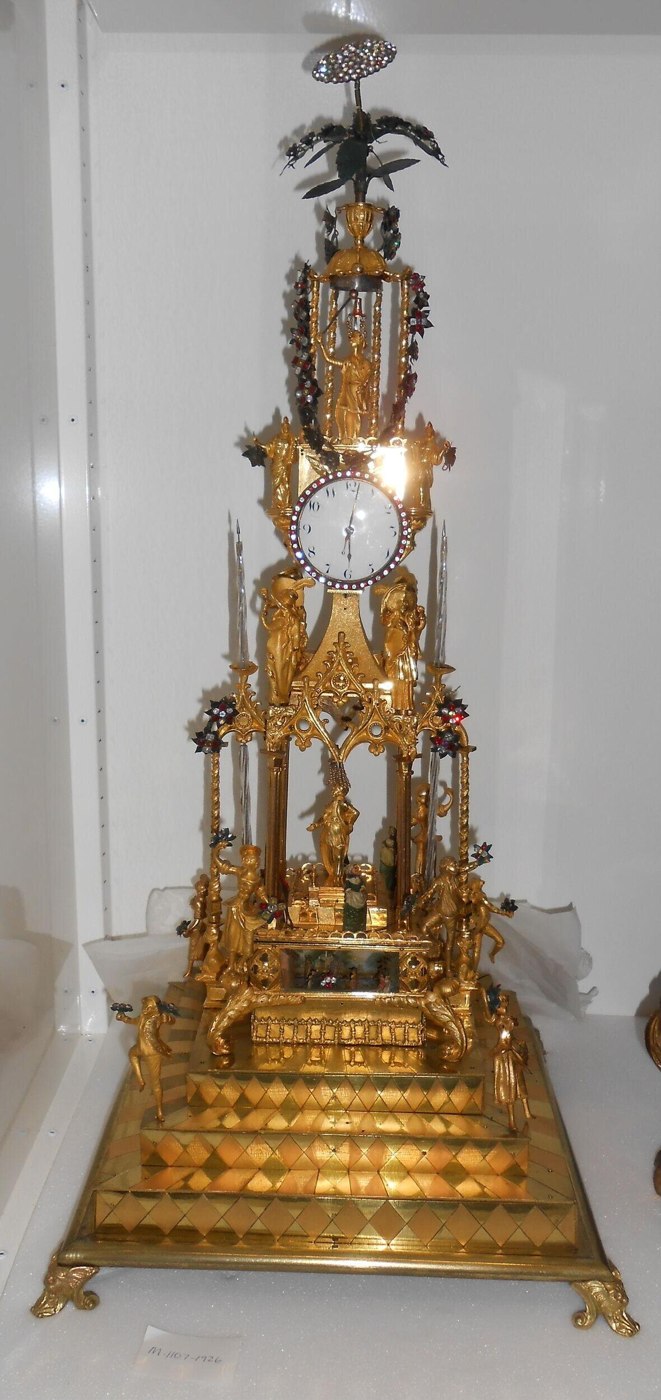
This automaton musical clock, accessioned as M.1107-1926, was produced by Tobias Morris in London between 1794 and 1812. The construction is executed in gilt bronze, extensively decorated with coloured pastes. Measuring 28 1/2 inches in height and 14 inches in width, the clock stands on a stepped square plinth supported by four feet cast with grotesque animal masks. The architectural structure features a baldacchino in the Decorated Gothic style, housing various mechanical automata, including dancing figures and revolving painted silhouettes. The clock movement is contained within a 7.2 cm diameter drum. The overall design incorporates multiple twisted columns, a canopy supporting a draped female figure, and a finial in the form of a flower basket. Power for the mechanical motions is provided by a musical box movement within the plinth, utilizing a fusee and chain drive to sound seven bells.

Front view of the automaton clock showing the central dial, revolving platform with figures, and the Decorated Gothic architectural structure.
Front view of the automaton clock showing the central dial, revolving platform with figures, and the Decorated Gothic architectural structure. — Victoria and Albert Museum. Rights pending — permission not yet requested. Original source

Catalogue identity

Source
collections.vam.ac.uk
Category
Clock · Automaton and musical clock
Maker / attribution
Tobias Morris
Reference
Not recorded
Catalogue / lot identifier
M.1107-1926
Source-reported date
1794-1812
Source-reported place
United Kingdom
Source-reported serial
144

Source-reported attribution and specifications are not independent authentication. A listing does not establish present ownership, current display, availability or permission to reproduce.

Object description

Case and Automaton Architecture

The clock is built upon a substantial stepped square base, which rises through an elaborate multi-stage plinth structure. The architecture draws from Decorated Gothic influences, defined by a series of fluted and twisted columns. These elements support a double-canopied arrangement, which serves as the housing for the primary dial and various mechanical figures. The upper canopy is surmounted by an intricate finial fashioned as a basket of flowers, set with red and white brilliants.

The automaton components are integrated into the base and canopy stages. A central platform holds a turbaned figure, surrounded by eight painted silhouette figures that revolve in a circular groove. Below this, a secondary set of figures is mounted on an internal traveling belt, moving horizontally across a landscape background. Draped female statuettes and dancing figures holding bouquets are positioned throughout the structure to complete the theatrical assembly. The motion for the clock's striking function was designed to connect with a draped female figure holding a bell-hammer, though the activation mechanism relies on the train of the clock movement.

Evidence for this section
  • “The clock case is flanked by two statuettes each carrying a rosette in one hand”
  • “The main canopy protects a central turbaned figure mounted on a square, rotatable platform”
  • “The motions are all powered by a musical box movement contained with the plinth”

Movement and Dial

The current timekeeping movement is housed within a 7.2 cm diameter drum. It is characterized as a large watch movement, measuring 5.3 cm across the plates, and is widely considered to be a replacement for the original. The dial is white enamel, featuring an outer ring of minute dots and inner Arabic numerals. The hands are fashioned from brass, with the minute hand notably featuring a tail.

Technical details of the movement include a pierced bridge balance-cock inscribed with the word 'PATENT'. The regulator mechanism utilizes an index that moves over an arc marked for speed adjustments, from 'SLOW' to 'FAST'.

Evidence for this section
  • “The present movement is essentially that of a large watch, with plates 5.3 cm diameter”
  • “the backplate is signed 'No.144 MORRIS TOBIAS LONDON'; this movement is probably a replacement.”
  • “The pierced bridge balance-cock is marked 'PATENT'”

Signatures and Provenance

The object is signed by the maker, Tobias Morris, on both the dial assembly and the movement backplate. The inscription 'No.144 MORRIS TOBIAS LONDON' identifies the piece and its series-based marking. These details are used to attribute the clock to the London market during the late 18th to early 19th century.

The item entered the collection through the bequest of Lt. Col. G. B. Croft-Lyons, a Fellow of the Society of Antiquaries (FSA). The piece remains identified by the accession number M.1107-1926, which links it directly to the Croft-Lyons donation records held by the museum.

Evidence for this section
  • “Signed: MORRIS, TOBIAS, LONDON”
  • “Bequeathed by Lt.Col.G.B. Croft Lyons FSA”
  • “Accession number: M.1107-1926”

Open research questions

  • What specific type of movement originally powered the automaton before the current replacement watch movement was installed?
  • Are there surviving records of other 'No.144' clocks by Tobias Morris that might help confirm the production date of the original housing?

Source evidence

Recorded claims and source quotations for Automaton and Musical Clock by Tobias Morris
FieldSource-reported valueSource quotation
MakerTobias Morris“Maker: MORRIS, Tobias”
Date1794-1812“Date: 1794-1812”
Serial Number144“No.144 MORRIS TOBIAS LONDON”
Dimensions28 1/2 in high by 14 in wide“Height: 28 1/2 in; Width: 14 in”
MaterialsGilt bronze and coloured pastes“Gilt bronze set with coloured pastes”
Movement MechanismFusee and chain driven musical box“musical box movement contained with the plinth, which is driven through by a fusee and chain and sounds on 7 bells.”
ProvenanceLt. Col. G. B. Croft-Lyons“Bequeathed by Lt.Col.G.B. Croft Lyons FSA”

Visible details

  • White enamel dial measuring 6.5 cm in diameter
  • Dancing figures positioned at the corners of the plinth
  • Basket of flowers finial featuring red and white brilliants
  • Grotesque animal mask feet supporting the square base

Research qualifications

  • The current movement is described as a probable replacement
  • One dancing figure is noted as missing from the middle step of the plinth

Photograph identity and source facts were screened before import; rights clearance remains pending.

Consulted source

Clock

Reviewed 2026-10-26 · Record a49409543b

Terms in this record

Glossary explanations for terms named in this object’s record.