
Skip to content
The Encyclopedia of Horology

Clock · Architectural cabinet clock

Augsburg tortoiseshell veneer cabinet and clock

Partially verified

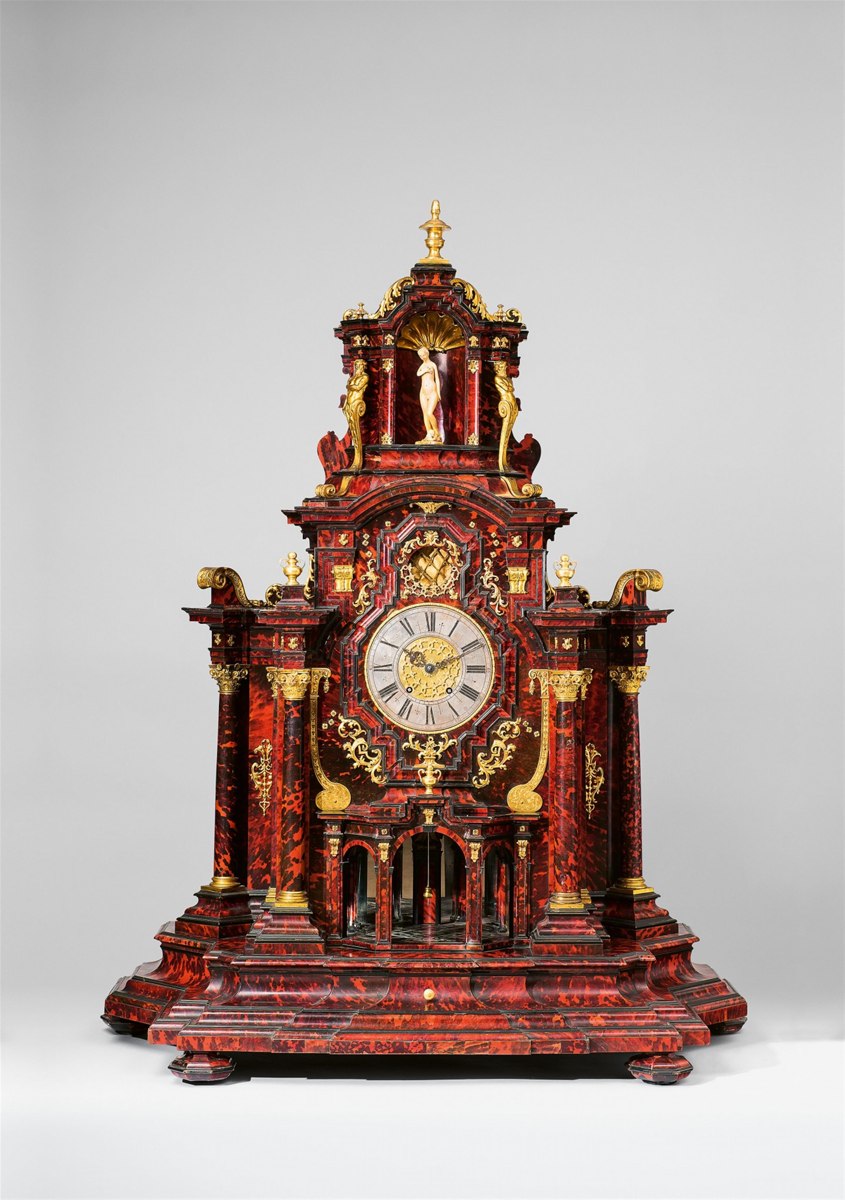
This large Baroque architectural cabinet clock features a case veneered in red tortoiseshell, palisander, and ebony on oak, embellished with ormolu mounts. Constructed in three primary tiers, the clock incorporates a breakfront plinth with a central drawer on octagonal bun feet, an open mirrored loggia with tin inlay tendrils, and a removable upper niche containing an ivory figure of Venus flanked by herm pilasters. The central section displays a tin chapter ring with Roman numerals and outer Arabic minute marks surrounding an engraved gilt center. The source reports an eight-day movement with verge escapement, pear-form pendulum, and striking/repeating mechanism.

Full frontal view of the architectural tortoiseshell and ormolu cabinet clock
Full frontal view of the architectural tortoiseshell and ormolu cabinet clock — Lempertz. Rights pending — permission not yet requested. Original source

Catalogue identity

Source
www.lempertz.com
Category
Clock · Architectural cabinet clock
Maker / attribution
Workshop of Heinrich Eichler the Elder (attributed)
Reference
Not recorded
Catalogue / lot identifier
707
Source-reported date
Late 17th /early 18th C.
Country
Germany

Source-reported attribution and specifications are not independent authentication. A listing does not establish present ownership, current display, availability or permission to reproduce.

Object description

Case Construction

This architectural cabinet clock, dating to the late 17th or early 18th century, features a case constructed of oak veneered in red tortoiseshell, palisander, and ebony. The design comprises three sections, including a breakfront plinth with a central drawer resting on four octagonal bun feet. Above this sits a mirrored loggia adorned with tin inlay tendrils.

The clock is designed for frontal viewing; the source states the back is not veneered, indicating it was intended to be positioned against a wall. The structure includes a removable upper section featuring an ivory figure of Venus with a dolphin in a crowning niche, flanked by two herm pilasters.

Evidence for this section
  • “Tortoiseshell, palisander, and ebony veneer on oak; ormolu mountings.”
  • “The breakfront plinth with a central drawer rests on four octagonal bun feet. Above this, a mirrored loggia with tin inlay tendrils.”
  • “This large Augsburg architectural clock is designed to be viewed from the front. Thus, the back of the clock is not veneered”
  • “An ivory figure of Venus with a dolphin in the crowning niche, flanked by two herm pilasters.”

Dial and Movement

The central section contains a tin dial with large Roman and smaller Arabic numerals. The clock is equipped with an eight-day movement featuring a verge escapement and a pear-form pendulum. It includes an indirect half-hourly striking mechanism and hourly striking to a bell, with a repetition function on one side.

The source notes that the movement includes curved baluster columns.

Evidence for this section
  • “The tin dial with large Roman and smaller Arabic numerals.”
  • “Eight-day movement with verge escapement, pear-form pendulum, indirect half-hourly striking and hourly striking to a bell, repetition to one side.”
  • “The pendulum movement thought to be replaced, with curved baluster columns.”

Attribution and Condition

The cabinet is attributed to the workshop of Heinrich Eichler the Elder. This attribution is based on research by Christine Kowalski, who connected the case type to designs found in the Augsburg Museum graphics collection inscribed 'Henricum Eichler Aug.'

The source records that several elements are replacements, including the bell, the ivory sculpture, and the vase finial. Additionally, the pendulum movement is thought to be a replacement, and the tail of the dolphin accompanying the Venus figure is broken.

Evidence for this section
  • “attributed to the workshop of Heinrich Eichler the Elder.”
  • “Some elements replaced (incl. the bell, the ivory sculpture, the vase final). The dolphin's tail broken.”
  • “The pendulum movement thought to be replaced”

Open research questions

  • What is the basis for the assessment that the pendulum movement is a replacement?
  • Are there archival records documenting the specific history of repairs to the ivory sculpture and dolphin?

Source evidence

Recorded claims and source quotations for Augsburg tortoiseshell veneer cabinet and clock
FieldSource-reported valueSource quotation
MaterialsTortoiseshell, palisander, and ebony veneer on oak; ormolu mountings“Tortoiseshell, palisander, and ebony veneer on oak; ormolu mountings.”
DimensionsH 135.5, W 106.5, D 44 cm“H 135.5, W 106.5, D 44 cm.”
Movement typeEight-day movement with verge escapement and pear-form pendulum“Eight-day movement with verge escapement, pear-form pendulum, indirect half-hourly striking and hourly striking to a bell, repetition to one side.”
Dial descriptionTin dial with large Roman and smaller Arabic numerals“The tin dial with large Roman and smaller Arabic numerals.”
AttributionWorkshop of Heinrich Eichler the Elder“attributed to the workshop of Heinrich Eichler the Elder.”

Visible details

  • Red-and-black tortoiseshell veneer paired with stepped ripple moldings and gilt bronze capitals, mounts, and finials.
  • Central arcade/loggia supported by paired red tortoiseshell-clad columns showing an open view to the mirrored interior.
  • Circular metal chapter ring with pierced and sculpted blued or dark metal hands and three winding arbors.

Research qualifications

  • Source notes the pendulum movement is thought to be replaced.
  • Certain decorative and functional elements are noted as replacements, including the bell, the ivory sculpture, and the vase finial, with damage to the dolphin's tail.

Photograph identity and source facts were screened before import; rights clearance remains pending.

Consulted source

A splendid Augsburg tortoiseshell veneer cabinet and clock - Lot 707

Reviewed 2026-10-22 · Record 1294abed50

Terms in this record

Glossary explanations for terms named in this object’s record.