
Skip to content
The Encyclopedia of Horology

Clock · Table clock

Astronomical table clock

Partially verified

This astronomical table clock is held in the collection of The Metropolitan Museum of Art, New York (accession number 17.190.747). According to the museum, the clock dates to the second quarter of the 17th century. The case is constructed from gilded brass and gilded copper, measuring approximately 25 inches in height and 10 inches in width and depth. The clock features multiple dials crafted from gilded brass and silver. The object is associated with subject tags concerning astronomy and the zodiac. The museum record does not currently attribute a maker to the piece, and formal study to confirm the object's specific origins, maker, or broader classification within horological types remains as required research. The current documentation is limited to the descriptive details and technical specifications provided by the museum's European Sculpture and Decorative Arts department.

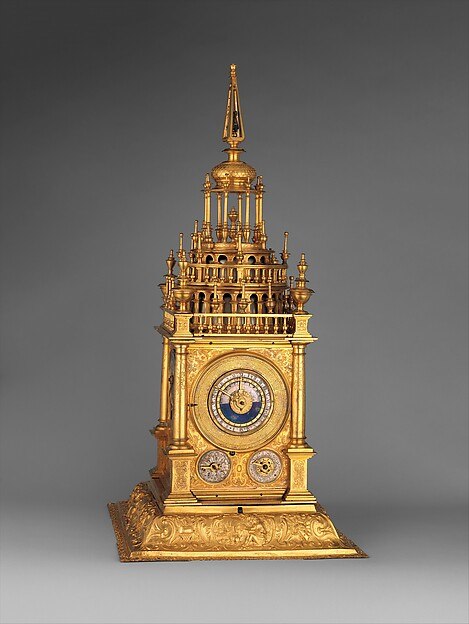
The astronomical table clock as viewed in the collection of The Metropolitan Museum of Art.
The astronomical table clock as viewed in the collection of The Metropolitan Museum of Art. — The Metropolitan Museum of Art, New York. Rights pending — permission not yet requested. Original source

Catalogue identity

Source
orbiscollectibles.com
Category
Clock · Table clock
Maker / attribution
Not established
Reference
Not recorded
Catalogue / lot identifier
17.190.747
Source-reported date
second quarter 17th century
Source-reported place
Not established

Source-reported attribution and specifications are not independent authentication. A listing does not establish present ownership, current display, availability or permission to reproduce.

Object description

Construction and Materials

The astronomical table clock is defined by a complex architectural structure comprising a main body and a multi-level superstructure. The case is manufactured primarily from gilded brass and gilded copper, which provides the object with its aesthetic finish. The overall form stands at a height of 25 inches, with a base and width dimensions of 10 inches square.

The dials are constructed using a mix of gilded brass and silver, intended to provide visual legibility for the astronomical indications presented on the face.

Evidence for this section
  • “Case: gilded brass and gilded copper; Dials: gilded brass and silver; Movement: brass, gilded brass, and steel”
  • “Overall: 25 × 10 × 10 in. (63.5 × 25.4 × 25.4 cm)”

Horological Features

The clock incorporates several dial indicators, although the specific astronomical functions are represented by the subject tags of astronomy and the zodiac. The primary face is dominated by a central dial, supplemented by two smaller subsidiary dials positioned below it, which appear to manage different cyclical or planetary data points.

The design utilizes varied metal surfaces to differentiate the functional segments of the dials.

Evidence for this section
  • “Dials: gilded brass and silver”
  • “Subject tags assigned by the museum: Astronomy, Zodiac.”

Provenance and Identification

The object is catalogued by the European Sculpture and Decorative Arts department at The Metropolitan Museum of Art in New York. It is identified under the museum accession number 17.190.747, and the museum has assigned it the internal identifier 193624. The dating of the object is estimated to the second quarter of the 17th century.

As of the current documentation, the museum has not established a specific maker for the clock. Further research is necessary to classify the object within a specific workshop or geographic tradition, as the present record serves as an open-access transcript of the museum's provided physical characteristics rather than a complete scholarly history.

Evidence for this section
  • “Astronomical table clock in The Metropolitan Museum of Art, New York (accession 17.190.747)”
  • “The museum dates it second quarter 17th century.”
  • “Met object 17.190.747 (ID 193624)”

Open research questions

  • Can the workshop or geographical origin be attributed based on the specific architectural style of the case?
  • What are the specific astronomical functions indicated by the primary and subsidiary dials?

Source evidence

Recorded claims and source quotations for Astronomical table clock
FieldSource-reported valueSource quotation
Accession Number17.190.747“17.190.747”
Datesecond quarter 17th century“second quarter 17th century”
Case Materialsgilded brass and gilded copper“Case: gilded brass and gilded copper”
Dial Materialsgilded brass and silver“Dials: gilded brass and silver”
Movement Materialsbrass, gilded brass, and steel“Movement: brass, gilded brass, and steel”
Dimensions25 x 10 x 10 in.“25 × 10 × 10 in. (63.5 × 25.4 × 25.4 cm)”
Subject TagsAstronomy and Zodiac“Astronomy, Zodiac”

Visible details

  • The clock features a tiered, architectural superstructure
  • The primary dial is centered above two smaller subsidiary dials
  • The base and case exhibit intricate ornamental metalwork
  • The dial centers include applied silver or contrasting metal components

Research qualifications

  • The specific maker of this clock remains unidentified by the source
  • The geographical origin of the object is not provided in the source record

Photograph identity and source facts were screened before import; rights clearance remains pending.

Consulted source

Astronomical table clock, second quarter 17th century

Reviewed 2026-11-02 · Record 79ce08cb50

Terms in this record

Glossary explanations for terms named in this object’s record.