
Skip to content
The Encyclopedia of Horology

Clock · Astronomical chiming and calendar clock

Astronomical chiming and calendar clock

Partially verified

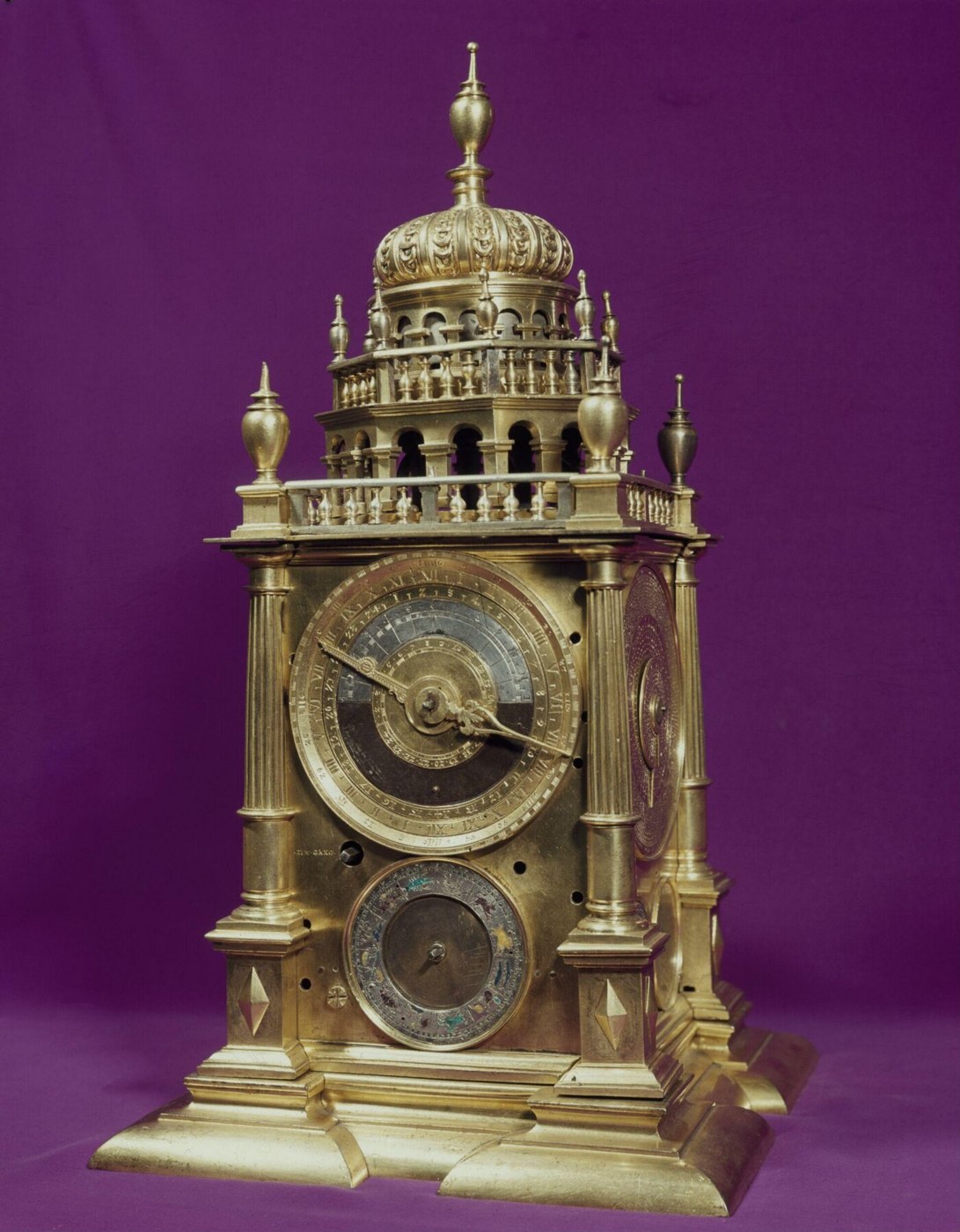
This South German astronomical, chiming, and calendar clock, dated to approximately 1620, is housed in a gilt-copper architectural case featuring a two-stage cupola. The clock is constructed with brass or copper plates and components, incorporating silver and translucent enamel dials. The front elevation includes a main 24-hour dial with a sun pointer, positioned above a silvered dial ring depicting zodiac signs and degrees. The rear face presents an astrolabe dial marked for 48 degrees latitude, along with a ring representing the seven days of the week. Calendar functions are displayed on the side faces, with extensive indicators for movable feasts, saints' days, and solar cycles. Various components, including motion-work wheels, are described as renewed from their original state.

Front view of the astronomical chiming clock.
Front view of the astronomical chiming clock. — Victoria and Albert Museum, London. Rights pending — permission not yet requested. Original source

Catalogue identity

Source
collections.vam.ac.uk
Category
Clock · Astronomical chiming and calendar clock
Maker / attribution
Not established
Reference
Not recorded
Catalogue / lot identifier
M.52-1952
Source-reported date
circa 1620
Source-reported place
Southern Germany

Source-reported attribution and specifications are not independent authentication. A listing does not establish present ownership, current display, availability or permission to reproduce.

Object description

Case Construction

The clock is contained within an architectural case of gilt brass or copper. The rectangular body rests on a base with recessed centers on each side. At each corner, the design incorporates a fluted three-quarter Doric column, each resting on a rectangular plinth decorated with a flattened pyramidal stud.

Above the main cornice, a gallery features baluster pillars with urn-shaped finials. The roof structure consists of a two-stage cupola, beginning with an octagonal arcade and ending in a circular arcade, both capped with additional urn-shaped finials. The roof of the cupola is finished with radiating ribs and scale patterns.

Evidence for this section
  • “Gilt brass or copper case of architectural form.”
  • “At each corner of the body a fluted three-quarter Doric column resting on a rectangular plinth”
  • “Above the cornice is a gallery with baluster pillars and an urn-shaped finial at each corner.”
  • “Within the balustrade, a two-stage cupola, the lower stage formed as an octagonal arcade surmounted by a gallery”

Dial Configuration

The front of the clock features a primary 24-hour dial with minute, quarter, and 24-hour rings, alongside a sun pointer. Below this, a silvered ring indicates zodiac signs and degrees. The rear face contains an astrolabe dial marked for 48 degrees of latitude, situated above a cast ring depicting deities associated with the days of the week.

The calendar functions are divided between the side faces. The right side features a calendar for July through December with saints' days, while the left side displays a calendar for January through June, incorporating movable feasts, solar cycles, and dominical letters. Smaller enamelled dials are provided for quarter-chime spacing and alarm settings.

Evidence for this section
  • “Main 24-hour dial, on front of clock.”
  • “Silvered dial ring below A, with signs of the zodiac”
  • “On rear of clock, astrolable dial with mater marked 48 GRAD”
  • “Large calendar dial. Outermost ring: daily calendar for the 6 months July to December”

Movement

The clock utilizes a posted frame movement featuring square brass corner-posts. It is designed with three distinct trains for going, quarter-chiming, and hour-striking. The barrels, fusees, and various arbors are constructed of brass, while the majority of the wheels are made of iron.

The original configuration has undergone several alterations, including the renewal of some motion-work wheels. The going train is equipped with a fusee and chain, a brass crown-wheel, a verge escapement, and an iron balance-wheel. The motion work drives a pierced brass hand and a sun pointer, with complex internal drives for the various calendar and astronomical functions.

Evidence for this section
  • “The movement is mounted within a posted frame, with square brass corner-posts”
  • “Three trains for going, quarter-chiming and hour-striking respectively.”
  • “Barrels, fusees and strike and chime work arbors are of brass, almost all wheels of iron, except for some renewed motion-work wheels.”
  • “Going train in front half of movement, with fusee and chain, brass crown-wheel, verge escapement and iron balance-wheel.”

Open research questions

  • What is the specific nature of the 'renewals' performed on the motion-work?
  • Did the calendar functions originally sync with the primary 24-hour train before the recorded alterations?

Source evidence

Recorded claims and source quotations for Astronomical chiming and calendar clock
FieldSource-reported valueSource quotation
Object typeClock“Object type: Clock”
Accession numberM.52-1952“Accession number: M.52-1952”
Date1620“Date: 1620”
Place of originSouthern Germany“Place of origin: Southern Germany (made);”
MaterialsGilt brass or copper, silvered and enamelled“Materials and techniques: Gilt brass or copper, silvered and enamelled.”
Height41.8 cm“Height: 41.8 cm”
Latitude indication48 degrees“astrolable dial with mater marked 48 GRAD, for latitude 48 degrees.”

Visible details

  • Case architectural form with fluted three-quarter Doric columns
  • Two-stage cupola surmounted by an urn-shaped finial
  • Astrolabe dial on rear marked 48 GRAD
  • Calendar dials include indications for saints, festivals, and dominical letters

Research qualifications

  • Some components and motion-work wheels identified as renewed
  • Mechanical linkage between quarter-chiming train and quarter-indicating dial is missing
  • Original function of specific shutter mechanism is altered

Photograph identity and source facts were screened before import; rights clearance remains pending.

Consulted source

Clock

Reviewed 2026-10-26 · Record f62cad4c51

Terms in this record

Glossary explanations for terms named in this object’s record.