
Skip to content
The Encyclopedia of Horology

Tool · Sanskrit-inscribed astrolabe

Astrolabe with sighting tube, inventory 30402

Partially verified

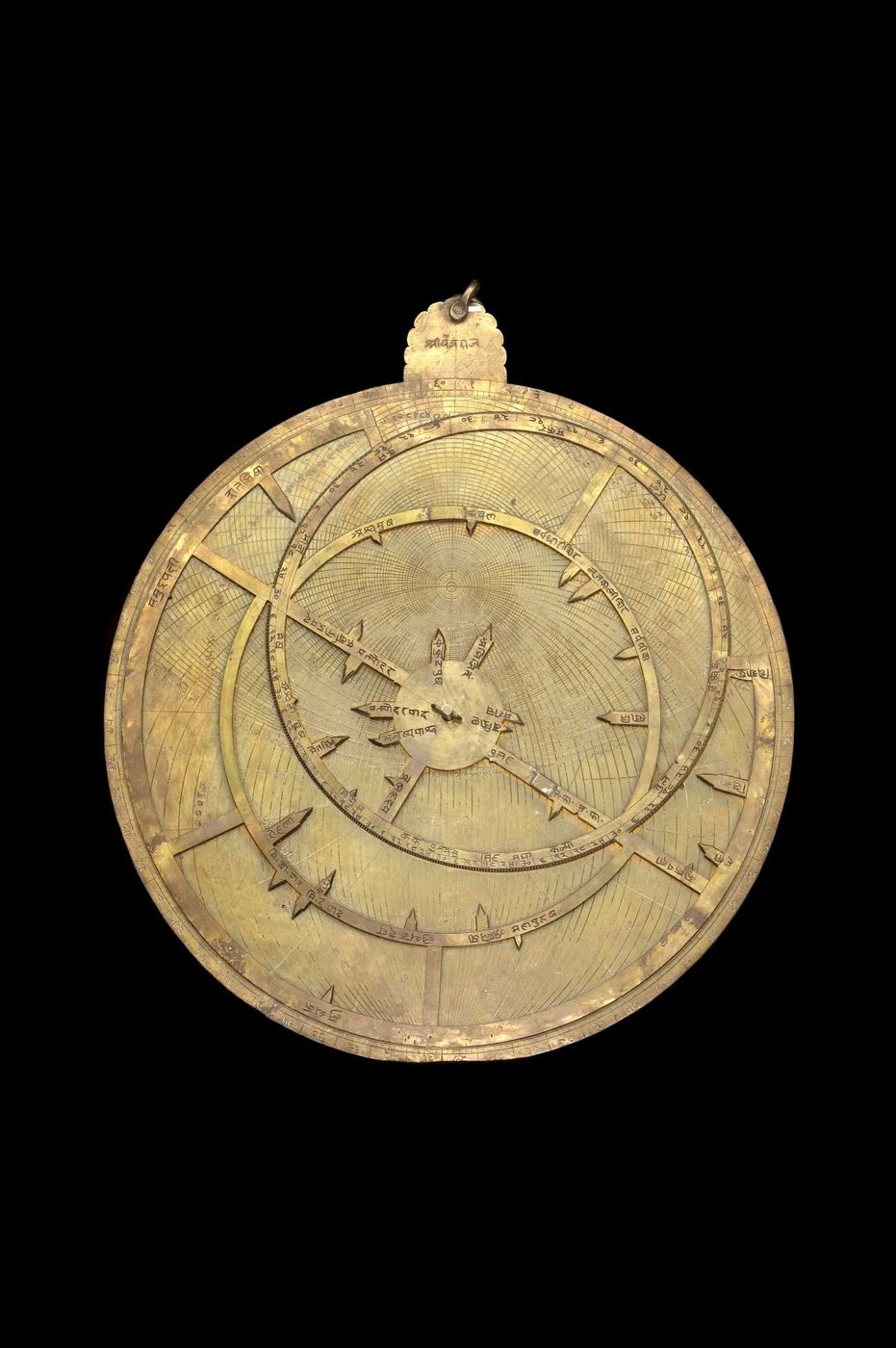
This brass astrolabe, designated inventory number 30402, is attributed to Indian manufacture, specifically Jaipur, during the late 18th or early 19th century. It features a large diameter and a single plate engraved for a latitude of 27°. The throne bears an inscription in Sanskrit, 'श्रीयंत्रराज' ('The glorious astrolabe'), which points to the significance of astronomical instruments in the region following the foundation of an observatory by maharajah Jai Singh II. The mater and limb are constructed from a single piece of brass. Acquired by the History of Science Museum, Oxford, in 1988, the piece was previously part of the Time Museum collection in Rockford, Illinois.

Full front view of the brass astrolabe showing the rete, throne with Sanskrit inscription, and the central pin and wedge.
Full front view of the brass astrolabe showing the rete, throne with Sanskrit inscription, and the central pin and wedge. — History of Science Museum, University of Oxford. Rights pending — permission not yet requested. Original source

Catalogue identity

Source
www.mhs.ox.ac.uk
Category
Tool · Sanskrit-inscribed astrolabe
Maker / attribution
Not established
Reference
Not recorded
Catalogue / lot identifier
30402
Source-reported date
late 18th or early 19th century
Source-reported place
India

Source-reported attribution and specifications are not independent authentication. A listing does not establish present ownership, current display, availability or permission to reproduce.

Object description

Construction and Assembly

The astrolabe is manufactured from brass and features a large, single-plate design. The mater and the limb are created as a single-piece construction. The assembly includes a simple, engraved throne with an integrated base, supporting a brass ring and an omega-type shackle. The rete is of a simple design, showing repairs on the horizontal bar and the equatorial strap, and is secured to the instrument with a pin and wedge arrangement.

The instrument is notable for its large physical size relative to the collection. A primary feature is the double-ended alidade which, alongside standard pin-hole sights, integrates a sighting tube.

Evidence for this section
  • “The throne is of the simple, engraved type made of brass attached with integrated base”
  • “The mater and limb are of one-piece construction.”
  • “the alidade has a sighting tube characteristic of Indian instruments.”

Scales and Markings

The womb of the astrolabe is engraved for a latitude of 27°, which corresponds to the location of Jaipur. It contains a comprehensive series of lines including the equator, Tropic of Cancer, Tropic of Capricorn, and various horizon indicators, all inscribed in Sanskrit script. The azimuths are divided every 3°, and the unequal hours are marked with Devanagari numerals.

The back of the instrument contains seven scales, including altitude scales for the upper quadrants, degree scales for the lower quadrants, and a shadow square divided in fingers and feet. The rete zodiac is labelled with Sanskrit names for the signs, and star positions are indicated with dagger pointers.

Evidence for this section
  • “the womb being engraved for 27°.”
  • “The back contains 7 scales of the following types: Altitude; Degree; Sine/Cosine; Shadow square.”
  • “The zodiac on the rete is labelled: मेष , वृष , मिथुन , कर्क , सिंह , कन्या , तुल , वृश्चिक , धन , मकर , कुंभ , मीन .”

Provenance and Historical Context

This instrument was acquired by the History of Science Museum, Oxford, in 1988, following its purchase at a Christie's auction in London. Prior to this, it was part of the Time Museum collection in Rockford, Illinois (inventory number 1056), having been originally sourced through the Paris collector Alain Brieux.

The astrolabe is attributed to the center of astrolabe manufacture in Jaipur, a trade that flourished following the establishment of the observatory by maharajah Jai Singh II in the early 18th century.

Evidence for this section
  • “Purchased at Christie's, London, in 1988”
  • “It was in one of the auction sales (14 April 1988, lot 149) of items from the Time Museum, Rockford, Illinois”
  • “The Time Museum's founder Seth Atwood (??) had bought it from Alain Brieux, a Paris dealer and collector.”

Open research questions

  • Does metallurgic analysis confirm the brass composition matches other Jaipur-attributed instruments of this era?
  • Are there extant astrolabes from Jai Singh II's observatory that share identical scale geometry or star nomenclature?

Source evidence

Recorded claims and source quotations for Astrolabe with sighting tube, inventory 30402
FieldSource-reported valueSource quotation
Inventory Number30402“Inventory no. 30402”
MaterialBrass“Material Brass”
OriginJaipur, India“This astrolabe was probably made in Jaipur, in Northern India.”
Latitude27°“single plate engraved for 27°, the latitude of Jaipur.”
Star Count38“The rete contains 38 stars.”
ProvenanceTime Museum, Rockford, Illinois“It was in one of the auction sales (14 April 1988, lot 149) of items from the Time Museum, Rockford, Illinois”
Throne Inscriptionश्रीयंत्रराज (The glorious astrolabe)“inscription across the throne, श्रीयंत्रराज ('The glorious astrolabe').”

Visible details

  • Sanskrit inscription 'श्रीयंत्रराज' on the throne
  • Sighting tube attached to the back of the alidade
  • Rete features 38 stars with dagger pointers
  • Omega-shaped shackle at the throne assembly

Research qualifications

  • Exact date of manufacture is imprecise, given as late 18th or early 19th century
  • Attribution to Jaipur is considered probable by the source

Photograph identity and source facts were screened before import; rights clearance remains pending.

Consulted source

Astrolabe, inventory 30402 (India, late 18th or early 19th)

Reviewed 2026-10-26 · Record 89409cd634

Terms in this record

Glossary explanations for terms named in this object’s record.

Other sanskrit-inscribed astrolabe records