
Skip to content
The Encyclopedia of Horology

Tool · Sanskrit-inscribed astrolabe

Astrolabe (inventory no. 52478)

Partially verified

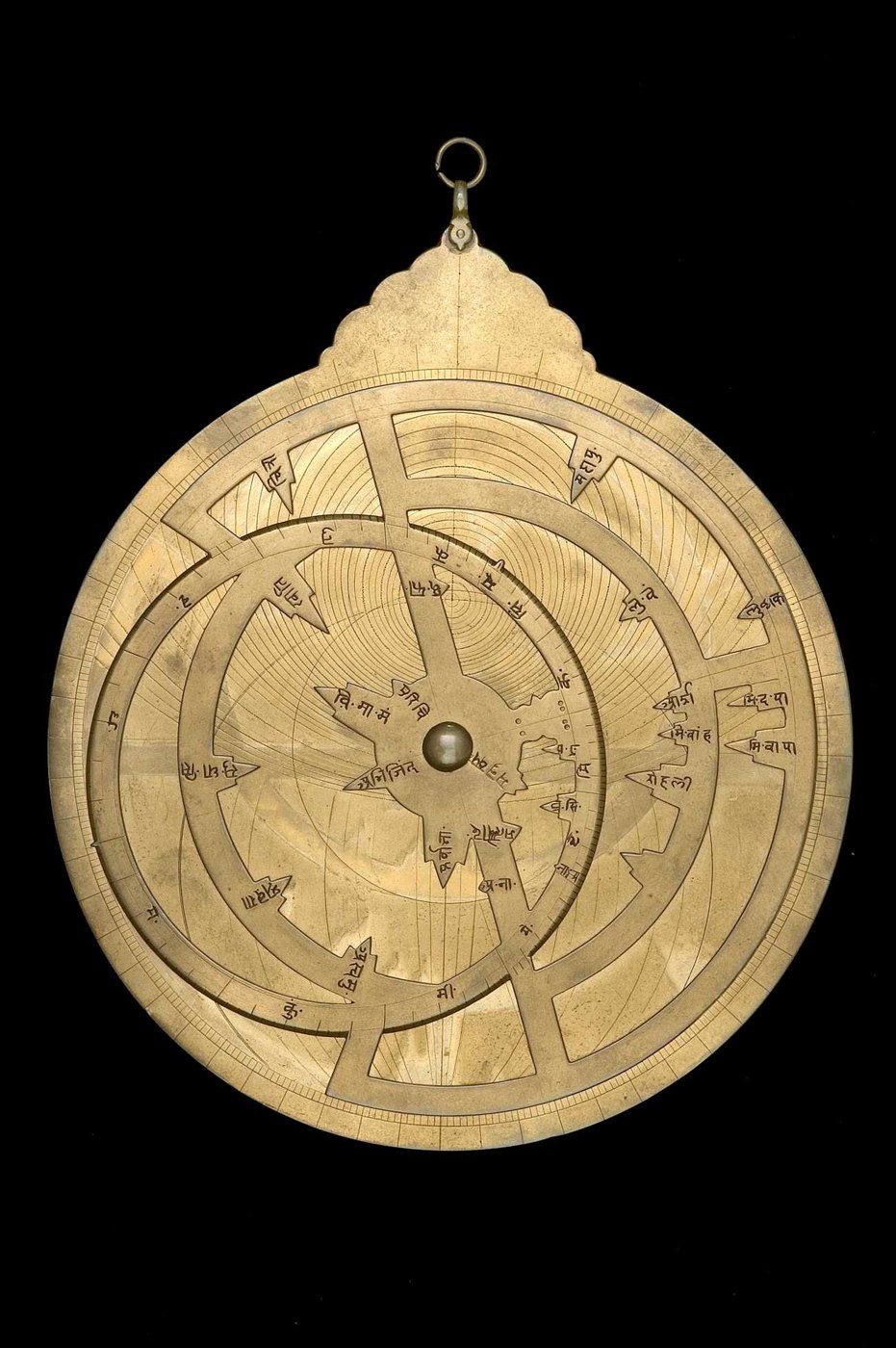
This 18th-century brass astrolabe (inventory no. 52478) is a scientific instrument attributed to manufacture in Jaipur, India. Presented to the History of Science Museum, Oxford, by J. A. Billmeir in 1957, the object is characterized by its one-piece mater and limb construction and a specific Indo-Persian type throne. A distinguishing feature of the instrument is an alidade equipped with a large-diameter sighting tube, intended for celestial observation. The back of the astrolabe is partially engraved, limited to the upper-left quadrant, with the remaining scales and lines left unmarked, leading to the assessment that the piece is unfinished. The rete incorporates 27 star pointers and is secured by a nut and bolt assembly identified as a later addition. The instrument includes Sanskrit labeling for its zodiacal divisions and star identifications, as observed in the primary collection documentation.

Front view of the brass astrolabe showing the rete, throne, and limb scales.
Front view of the brass astrolabe showing the rete, throne, and limb scales. — History of Science Museum, University of Oxford. Rights pending — permission not yet requested. Original source

Catalogue identity

Source
www.mhs.ox.ac.uk
Category
Tool · Sanskrit-inscribed astrolabe
Maker / attribution
Not established
Reference
52478
Catalogue / lot identifier
1957-84/172A
Source-reported date
18th century
Source-reported place
India

Source-reported attribution and specifications are not independent authentication. A listing does not establish present ownership, current display, availability or permission to reproduce.

Object description

Construction and Design

The astrolabe is constructed from brass, featuring a one-piece mater and limb. It is fitted with an Indo-Persian style throne, which is vaguely Moorish arch in shape and features an integrated base. The ring is a simple round cross-section type, while the shackle is omega-shaped.

The rete is of the 'tropics-full' type and contains 27 star pointers. It is attached to the main body via a nut and bolt, both of which are documented as later replacements to the original configuration. The instrument is considered unfinished as several scales and lines remain unmarked.

Evidence for this section
  • “The mater and limb are of one-piece construction.”
  • “The throne is of the indo-persian type made of brass”
  • “The rete contains 27 stars.”
  • “A number of the scales and other lines are unmarked, suggesting that the astrolabe is unfinished.”

Alidade and Sighting Mechanism

A key component of the instrument is the double-ended alidade, which features a notable sighting tube affixed to its two sights. This tube has a large diameter, which potentially hindered precise altitude measurements of stars due to its size.

Furthermore, the inclusion of the sighting tube rendered the instrument inconvenient for solar observation, as an observer cannot view the sun directly through the aperture. The tube is conjectured to have been intended for night-time sighting of dimmer celestial bodies.

Evidence for this section
  • “A remarkable feature of this alidade is the sighting tube attached to the two sights.”
  • “the large diameter of the tube would have limited the precision with which the altitude of a star could be measured.”
  • “a sighting tube is inconvenient when trying to find the altitude of the sun, for the observer cannot look directly at the sun.”

Provenance and Documentation

The instrument was accessioned by the History of Science Museum in 1957 (accession number 1957-84/172A) following its presentation by J. A. Billmeir, who acquired the piece between 1955 and 1957.

Professors S.R. Sarma and Chris Minkowski provided the transcription and translation for the Sanskrit inscriptions located on the rete.

Evidence for this section
  • “Presented by J. A. Billmeir in 1957”
  • “Billmeir bought it during the period 1955-57.”
  • “this instrument was probably made in Jaipur, in Northern India.”
  • “Special thanks to Professors S.R. Sarma and Chris Minkowski for their help transcribing and translating the Sanskrit on this instrument.”

Open research questions

  • What is the approximate date of the later nut and bolt replacement?
  • Are there remaining archival records from the Billmeir collection that detail the acquisition of this specific instrument?

Source evidence

Recorded claims and source quotations for Astrolabe (inventory no. 52478)
FieldSource-reported valueSource quotation
Inventory number52478“Inventory number: 52478”
Place of originJaipur, India“this instrument was probably made in Jaipur, in Northern India.”
Date18th century“Date 18th century”
Throne styleIndo-Persian“The throne is of the indo-persian type made of brass”
ConstructionOne-piece mater and limb“The mater and limb are of one-piece construction.”
Rete stars27“The rete contains 27 stars.”
ProvenancePresented by J. A. Billmeir in 1957“Presented by J. A. Billmeir in 1957”

Visible details

  • The instrument features an Indo-Persian type throne with a vertical central line.
  • The back displays engravings only in the upper-left quadrant, indicating an unfinished state.
  • The alidade includes a fixed sighting tube of significant diameter.
  • The rete is of the 'tropics-full' type with 27 star pointers.

Research qualifications

  • The nut and bolt securing the rete are described as later additions.
  • The instrument is considered unfinished due to numerous unmarked scales and lines.

Photograph identity and source facts were screened before import; rights clearance remains pending.

Consulted source

Astrolabe, inventory 52478 (India, 18th century)

Reviewed 2026-10-26 · Record 66ef59f2be

Terms in this record

Glossary explanations for terms named in this object’s record.

Other sanskrit-inscribed astrolabe records