
Skip to content
The Encyclopedia of Horology

Tool · Latin-inscribed astrolabe

Astrolabe, Inventory 47901

Partially verified

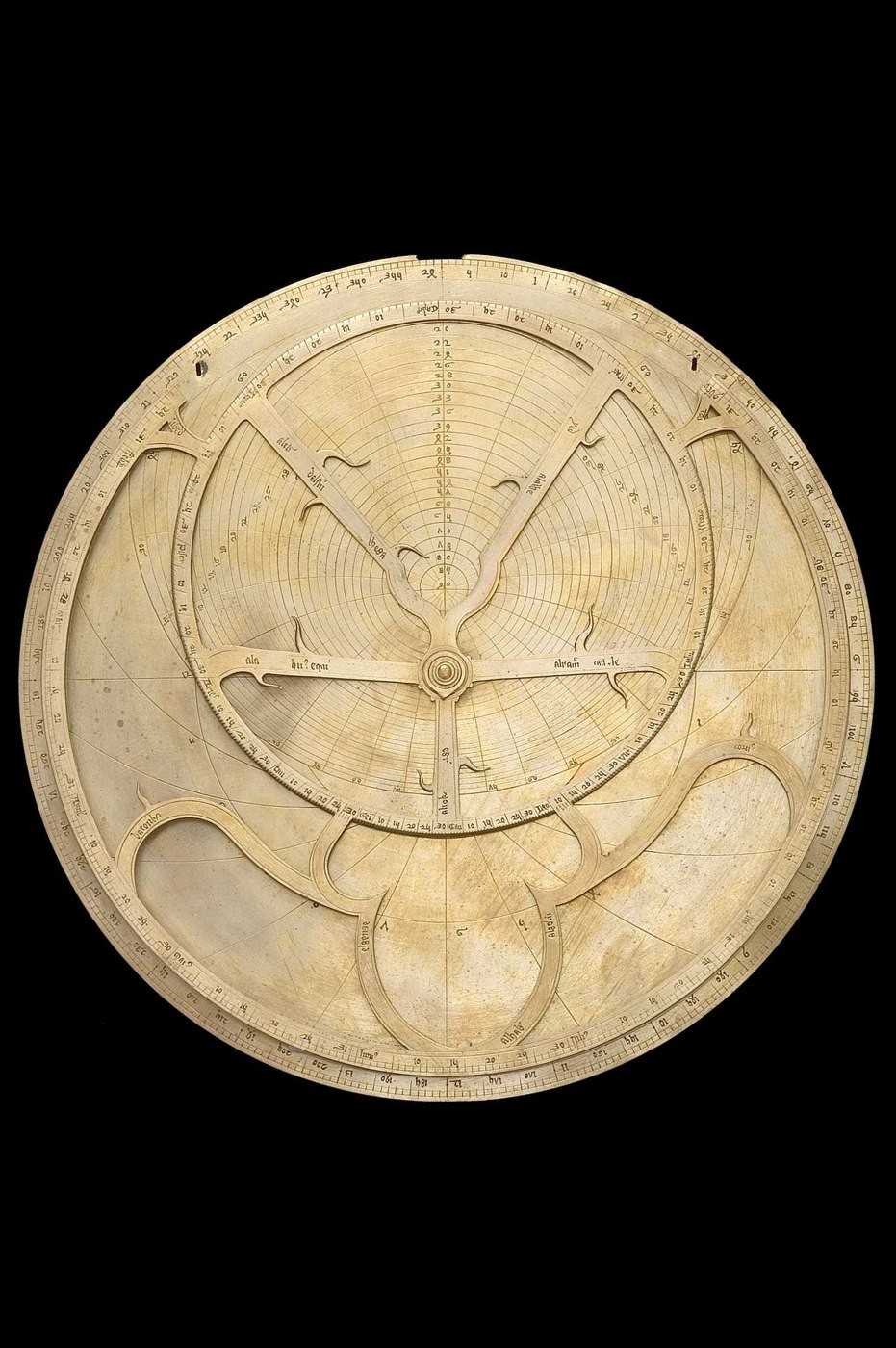
This brass astrolabe, designated inventory number 47901, dates to approximately 1350 and is associated with Oxford. Unlike many European counterparts, this instrument is constructed from a single, thin plate, which serves as both the mater and the limb. The womb is engraved for a latitude of 51°, matching that of Oxford. Due to the absence of a distinct limb or womb, the Y-shaped rete is riveted directly to the plate. An unusual design choice involves the calendar being placed on the outer band of the rete, the Tropic of Capricorn, rather than the back. The back of the instrument is entirely occupied by a quadrant, providing an increased scale for observational use. , and seventeen stars marked with flamant pointers. It is currently held by the History of Science Museum, Oxford, having been acquired via Oriel College in 1924.

Front view of the astrolabe, showing the Y-shaped rete, the engraved plate, and the outer calendar band.
Front view of the astrolabe, showing the Y-shaped rete, the engraved plate, and the outer calendar band. — History of Science Museum, University of Oxford. Rights pending — permission not yet requested. Original source

Catalogue identity

Source
www.mhs.ox.ac.uk
Category
Tool · Latin-inscribed astrolabe
Maker / attribution
Not established
Reference
47901
Catalogue / lot identifier
1924-23
Source-reported date
ca. 1350
Source-reported place
Oxford

Source-reported attribution and specifications are not independent authentication. A listing does not establish present ownership, current display, availability or permission to reproduce.

Object description

Construction and Design

The instrument is constructed from a single thin plate of brass, which serves as the base for all functional components. Because the design omits a traditional separate limb and womb, the outer edge of this plate serves as the limb, containing both an equal hours scale and a degree scale. The Y-shaped rete is mounted to this plate using a central rivet.

This configuration is noted as unusual for European astrolabes of the period. The plate is dedicated to a latitude of 51°, suitable for Oxford, and carries almucantars, azimuths, and circles such as the equator and the Tropic of Capricorn. The lack of additional tympans reflects a specific focus on the local environment of the maker.

Evidence for this section
  • “It consists of a single, thin plate.”
  • “The limb of this instrument is nothing more than the outer edge of the single plate.”
  • “the Y-shaped rete is rivetted to the plate.”
  • “the plate is engraved for 51°, intended as the latitude of Oxford.”

Rete and Back Scales

The rete features seventeen stars, identified by flamant pointers. A departure from the configuration of most period instruments, the calendar is located on the outer band of the rete at the Tropic of Capricorn. The zodiac labels are also engraved on the rete, utilizing Gothic numerals for the scales.

The entirety of the back of the instrument is utilized for a quadrant, which allows for a larger scale than would be possible if the back also contained the calendar. The back displays three primary scales: a degree scale, a quadrant arc, and an unequal hours scale.

Evidence for this section
  • “The rete contains 17 stars.”
  • “Another unusual feature of this astrolabe is the calendar found on the outer band of the rete”
  • “Since the entire back of this instrument is engraved with a quadrant, the maker had to relocate the calendar.”
  • “The back contains 3 scales of the following types: Degree; Quadrant arc; Unequal hours.”

Provenance and Historical Context

The astrolabe is part of the collection of the History of Science Museum in Oxford, on loan from Oriel College since 1924. It is associated with the 14th-century intellectual environment in Oxford, specifically the 'Merton School' of astronomer-physicians. While it has been suggested that the object may have originated from the bequest of Simon Bredon, no definitive documentary proof confirms his ownership of this specific piece.

The instrument is regarded as having been designed for active use by scholars rather than for display.

Evidence for this section
  • “Lent by Oriel College, Oxford, in 1924”
  • “It has been said to have been part of a bequest to the college by Simon Bredon”
  • “The pragmatic and utilitarian design of this instrument suggests that it was intended to be used”
  • “Both astrolabes have all the appearance of having been designed, possibly even made, by scholars for their own use.”

Open research questions

  • Can metallurgical analysis confirm the specific composition of the brass to further narrow the date of manufacture?
  • Does the specific arrangement of the star pointers correlate with any other surviving 14th-century Oxford mathematical instruments?

Source evidence

Recorded claims and source quotations for Astrolabe, Inventory 47901
FieldSource-reported valueSource quotation
Inventory number47901“Inventory no. 47901”
Dateca. 1350“Date ca. 1350”
MaterialBrass“Material Brass”
Latitude51°“the plate is engraved for 51°, intended as the latitude of Oxford.”
Stars17“The rete contains 17 stars.”
Acquisition1924“Lent by Oriel College, Oxford, in 1924”
ConstructionSingle thin plate“It consists of a single, thin plate.”
Rete styleY-shaped“the Y-shaped rete is rivetted to the plate.”

Visible details

  • Single thin brass plate construction with integrated limb
  • Calendar engraved on the Tropic of Capricorn band of the rete
  • Back face entirely occupied by a quadrant scale
  • Rete attached to the plate via a rivet

Research qualifications

  • The specific attribution to a Merton School fellow remains speculative
  • The original ownership by Oriel College is described as presumed

Photograph identity and source facts were screened before import; rights clearance remains pending.

Consulted source

Astrolabe, inventory 47901 (Oxford, ca. 1350)

Reviewed 2026-10-26 · Record d61e68fdd8

Terms in this record

Glossary explanations for terms named in this object’s record.