Construction and Design
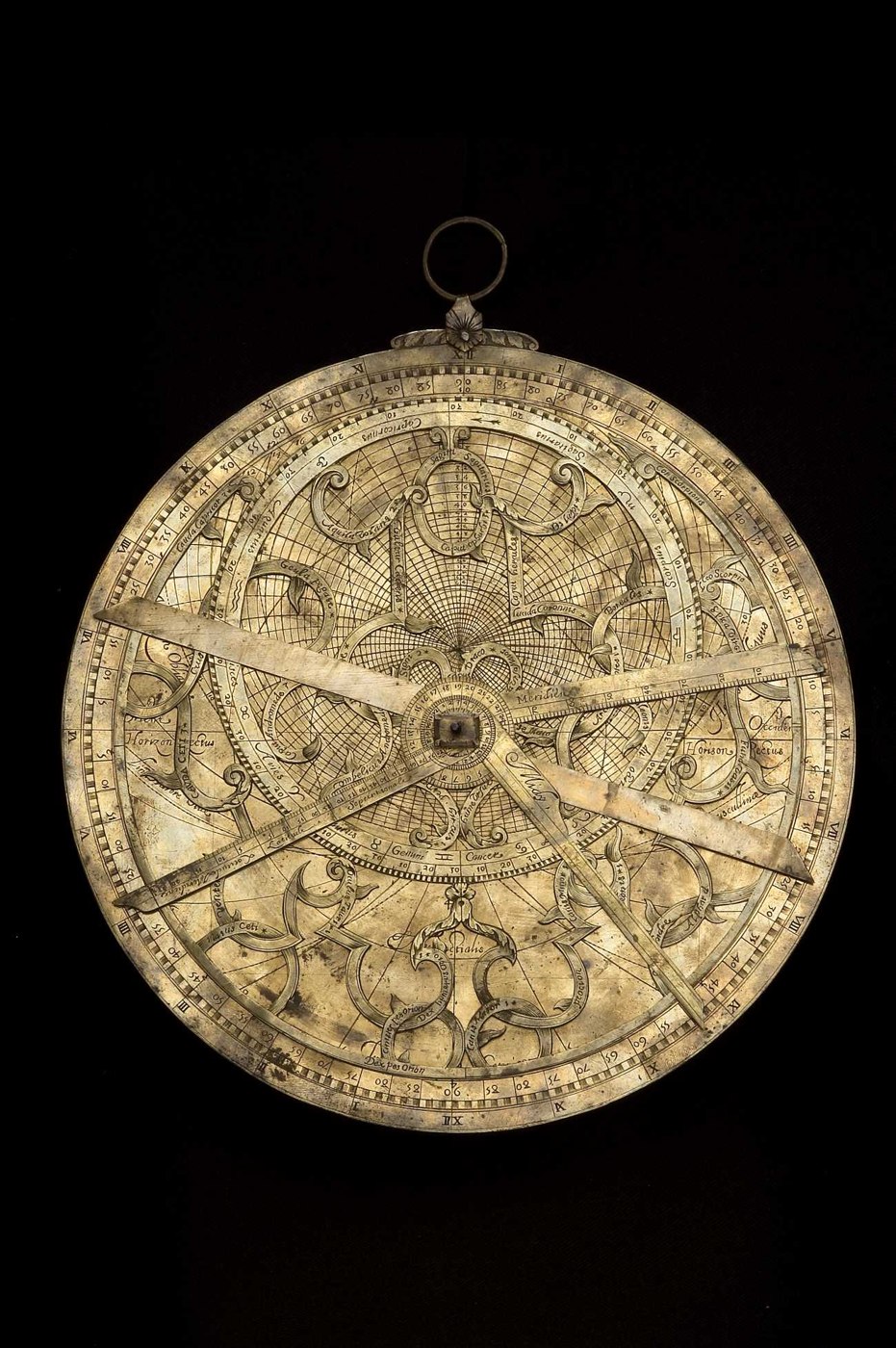
The astrolabe is constructed primarily of brass and exhibits fine decorative detail, particularly on its components. The throne is an engraved, integrated base extending from the limb, which is itself part of the primary plate. This structure supports an omega-shaped shackle adorned with engraved lines resembling flower petals. The rete is noted for its ornate design, which employs a trompe l’oeil effect, using shading on the lattice and star pointers to simulate three-dimensional interwoven strapwork.
The central pointer is specifically marked with 64 small hashmarks along its perimeter. The integration of the limb and mater into a single brass plate forms the foundation of the device, which also carries the primary degree and hour scales necessary for astronomical observation.
Evidence for this section
- “The throne is of the simple,
engraved type made of brass attached with integrated base
made of brass”
- “extensive use is
made of shading to suggest a three-dimensional effect, both
on the strapwork and on the star pointers. A trompe
l’oeil effect of interwoven lattice is achieved.”
Rete and Astronomical Scales
The rete contains 41 stars, each marked with a distinctive flammant pointer. The zodiacal signs are engraved along the ecliptic scale, ranging from Aries through Pisces, each clearly labeled. The back of the instrument is equipped with six distinct circular, concentric, and eccentric scales: degree, zodiacal signs, calendar, a shadow square, and a windrose. These are complemented by inscriptions indicating the cardinal directions in French, specifically "Midy" (South), "Occident" (West), "Septentrion" (North), and "Orient" (East).
The internal womb plate is configured for a latitude of approximately 49 degrees. It displays circles for the equator, the tropics, and various lines including the horizon rectus and obliquus. The unequal hours and horoscopic houses are numbered using stamped script, providing a comprehensive functional layout for celestial measurement.
Evidence for this section
- “The rete contains 41 stars.”
- “The back contains 6 scales of the following
types:
Degree; Zodiacal signs; Calendar; Shadow square; Windrose.”
Provenance and Attribution
Inventory number 35082 was presented to the History of Science Museum, Oxford, by Lewis Evans in 1924. While the exact acquisition history of the object prior to this donation is not recorded, its stylistic features serve as the basis for its attribution. The instrument is unsigned, but its decorative style, particularly the rete, is compared to that of inventory no. 34268, which shares similarities with the work of the Louvain-based workshops and the known designs of Philippe Danfrie.
The pin and nut assembly currently holding the instrument together is suspected to be a later replacement. Despite the lack of a maker's mark or signature, the piece is categorized within the context of Parisian instrument-making around the year 1600 based on these technical and visual comparisons.
Evidence for this section
- “Presented by Lewis Evans in
1924”
- “The unusual style and decoration of the rete of
this astrolabe is closely comparable to that of inventory no.
34268 ,
hence the attribution of this unsigned instrument to the same
maker, Philippe Danfrie, of Paris.”