Skip to content
The Encyclopedia of Horology

Tool · Geographic astrolabe

Astrolabe by François Morillard (inventory no. 53966)

Partially verified

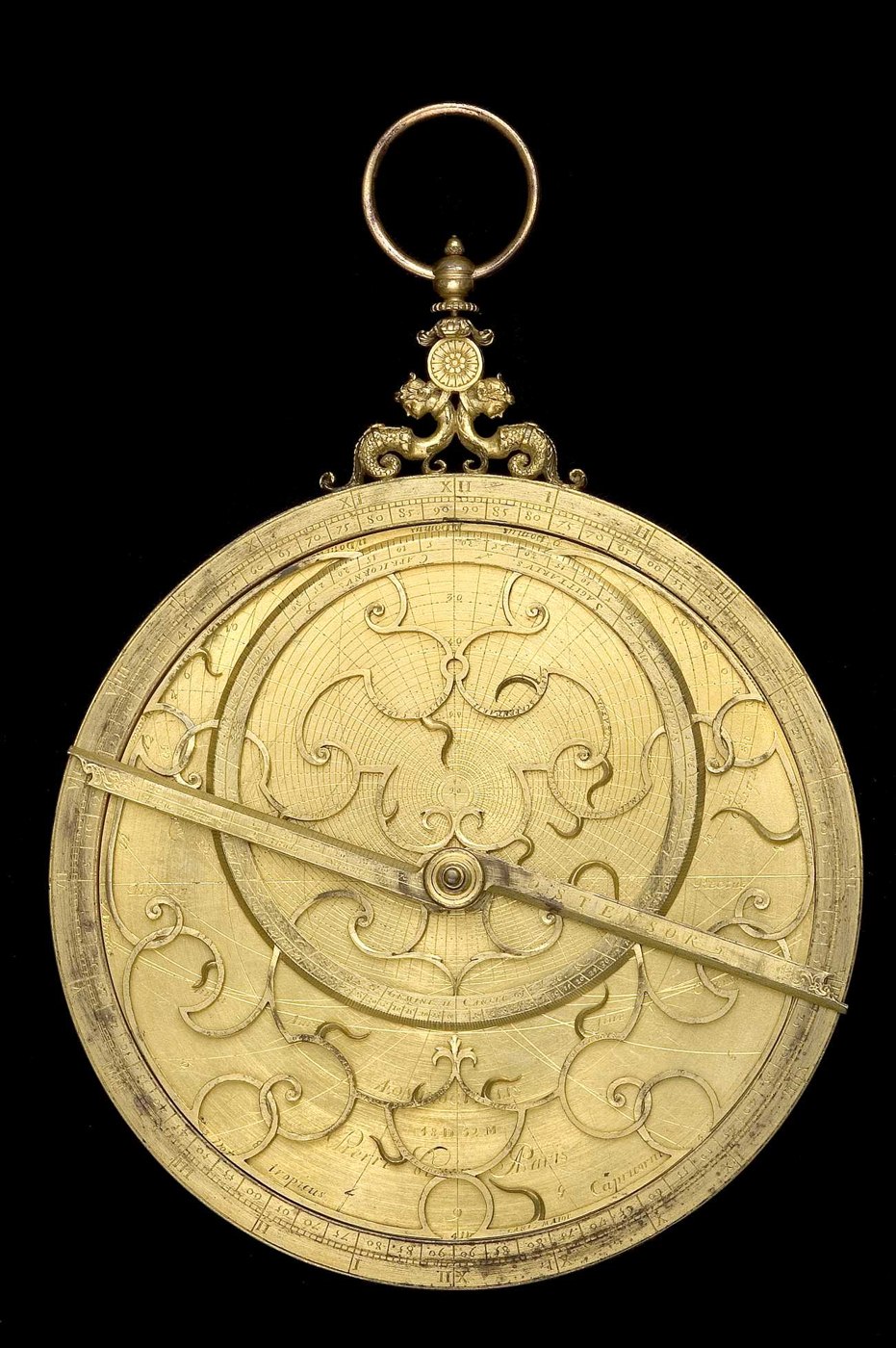
This gilt brass astrolabe was made by François Morillard in Narbonne in 1600. It features an ornate rete with seventeen stars and a mater of one-piece construction with a limb bearing wind directions. The back contains eleven diverse astronomical scales, including altitude, zodiacal, and calendar divisions, alongside a shadow square. Signed 'Fr. Morillard Lugdunen. faciebat Narb. Anno M.VIc', the instrument includes a throne decorated with scrollwork and a rotating pin-type shackle. The astrolabe was later modified in Paris during the late 17th century by Pierre Sevin, who supplied a plate for the latitude of Paris and a replacement regula with a cursor and brachiolum. The object was presented to the History of Science Museum by J. A. Billmeir in 1957.

Front view of the astrolabe showing the rete, regula, and limb inscriptions.
Front view of the astrolabe showing the rete, regula, and limb inscriptions. — History of Science Museum, University of Oxford. Rights pending — permission not yet requested. Original source

Catalogue identity

Source
www.mhs.ox.ac.uk
Category
Tool · Geographic astrolabe
Maker / attribution
François Morillard
Reference
Not recorded
Catalogue / lot identifier
53966
Source-reported date
1600
Source-reported place
Narbonne

Source-reported attribution and specifications are not independent authentication. A listing does not establish present ownership, current display, availability or permission to reproduce.

Object description

Construction and Design

The astrolabe is constructed of gilt brass, featuring a throne of simple type decorated with s-shaped scrollwork and a small disc engraved with a flower on both sides. The mater and limb are of one-piece construction. The limb is inscribed with wind directions, including SYROCCHO, LEVANTE, GRECO, TRAMONTANO, MAGISTRAL, PONENTE, and LEBECCIO. The instrument is suspended by a simple band ring and a rotating pin-type shackle.

The back contains eleven scales, including altitude, zodiacal signs, calendar, windrose, dominical letter, solar cycle, golden number, epact, perpetual calendar, and a shadow square. The instrument is signed by the maker on the back. The rete is of an ornate type containing seventeen stars marked with flamant pointers and zodiacal labels in Latin.

Evidence for this section
  • “The throne is of the simple type made of brass with s-shaped scroll work support(s) made of brass and has a simple, band ring made of brass and rotating pin type shackle made of brass”
  • “The back contains 11 scales of the following types: Altitude; Zodiacal signs; Calendar; Windrose; Dominical letter; Solar cycle; Golden number; Epact; Perpetual calendar; Shadow square.”

Projection and Modifications

This astrolabe features a unique southern projection of the terrestrial sphere, which departs from the more common north polar projections found in other instruments of the period. This specific plate depicts the terrestrial globe from the north looking south, with the plane of projection tangent at the south pole, effectively placing Madagascar to the left of Africa and South America to the right.

In the late 17th century, the instrument underwent modifications by the Parisian maker Pierre Sevin. He added a plate calibrated for the latitude of Paris, featuring a De Rojas universal projection on the reverse side. Additionally, he supplied a new regula, cursor, and brachiolum to ensure the functional compatibility of the instrument for its new user.

Evidence for this section
  • “The remarkable feature of this instrument is the southern projection of the terrestrial sphere.”
  • “The astrolabe currently has just one other plate, added for a later owner by the late 17th-century Parisian maker Pierre Sevin.”

Provenance and History

The astrolabe was previously part of the Chadenat collection in Paris. It was displayed at the Musée des Arts Décoratifs in 1932. J. A. Billmeir acquired the object at the Chadenat auction held at the Hôtel Drouot on 24 May 1956.

Following its acquisition, it was presented to the History of Science Museum in 1957. The modifications performed by Pierre Sevin in the 1670s or 1680s suggest the astrolabe remained in active use in a Parisian context well after its initial manufacture in 1600.

Evidence for this section
  • “Billmeir bought it at the auction sale of the Chadenat collection at the Hotel Drouot, Paris, on 24 May 1956.”
  • “The additional plate for the latitude of Paris made by Pierre Sevin, and the case of about the same date, indicate that it was modified for a Parisian owner in the 1670s or 1680s.”

Open research questions

  • What is the historical origin of the 'Fr. Morillard Lugdunen' signature attribution?
  • Are there extant archival records from Pierre Sevin confirming the specific commission for the modification of this instrument?

Source evidence

Recorded claims and source quotations for Astrolabe by François Morillard (inventory no. 53966)
FieldSource-reported valueSource quotation
MakerFrançois Morillard“Fr. Morillard Lugdunen. faciebat Narb. Anno M.VIc”
Place of manufactureNarbonne“Place Narbonne”
Date1600“Date 1600”
MaterialGilt brass“Material Gilt brass”
Inventory Number53966“Inventory no. 53966”
AcquisitionPresented by J. A. Billmeir in 1957“Presented by J. A. Billmeir in 1957”
Later ModifierPierre Sevin“added for a later owner by the late 17th-century Parisian maker Pierre Sevin”
Stars17“The rete contains 17 stars.”

Visible details

  • Throne features s-shaped scrollwork support and small disc with engraved flower
  • Regula includes cursor and small brachiolum
  • Back includes an 11-scale arrangement with perpetual calendars

Research qualifications

  • The exact late 17th-century date of the Sevin modifications remains approximated
  • The source notes the southern projection's reversal of the terrestrial sphere as a variation from typical north polar projections

Photograph identity and source facts were screened before import; rights clearance remains pending.

Consulted source

Astrolabe, inventory 53966 (Narbonne, 1600)

Reviewed 2026-10-26 · Record 692bbbebbc

Terms in this record

Glossary explanations for terms named in this object’s record.

Other geographic astrolabe records