
Skip to content
The Encyclopedia of Horology

Tool · Geographic astrolabe

Geographic astrolabe, inventory 53211

Partially verified

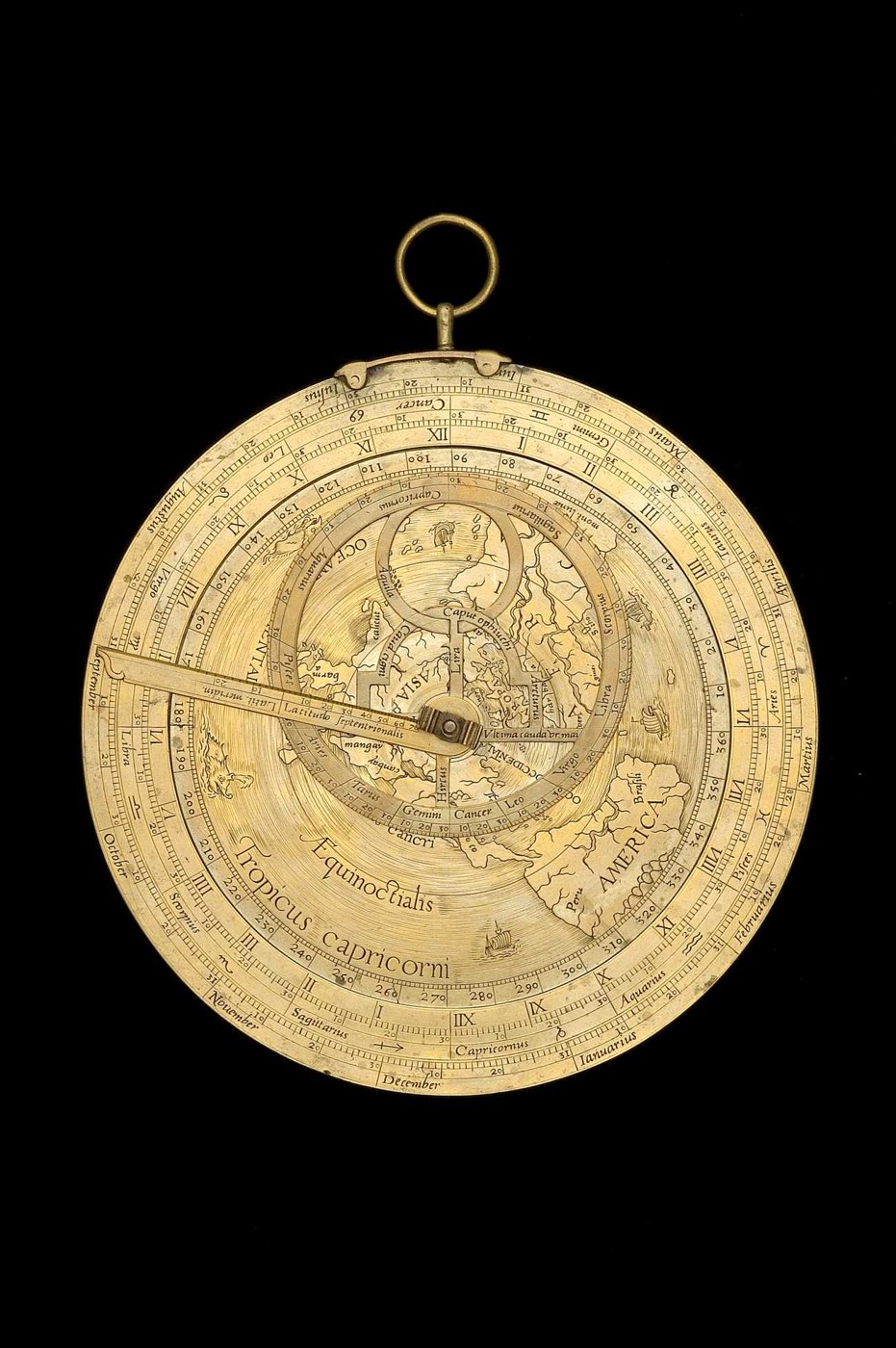
This brass geographic astrolabe, made by Gillis Coignet in 1560, differs from traditional astrolabes by featuring a single plate with an ornate terrestrial projection rather than the heavens. The projection maps the earth from the North Pole to the Tropic of Capricorn, detailing Europe, North Africa, the Near East, and the Americas. The instrument includes a rete marked with eight stars and flamant-style pointers, a mater with an extremely broad limb featuring calendar, zodiacal, and equal hours scales, and a back containing a 'trigonus' sundial and a de Rojas universal projection. The instrument was presented to the museum by Lewis Evans in 1924, having been acquired by him from a dealer in Florence in 1905.

Front view of the geographic astrolabe showing the rete, the broad limb with scales, and the geographic plate projection.
Front view of the geographic astrolabe showing the rete, the broad limb with scales, and the geographic plate projection. — History of Science Museum, University of Oxford. Rights pending — permission not yet requested. Original source

Catalogue identity

Source
www.mhs.ox.ac.uk
Category
Tool · Geographic astrolabe
Maker / attribution
Gillis Coignet
Reference
53211
Catalogue / lot identifier
1924-0/2027
Source-reported date
1560
Source-reported place
Antwerp

Source-reported attribution and specifications are not independent authentication. A listing does not establish present ownership, current display, availability or permission to reproduce.

Object description

Construction and Geographic Plate

The astrolabe is constructed of brass and features a three-piece mater and limb assembly. The limb is noted for being extremely broad, supporting three distinct circular, concentric scales: a calendar scale, a zodiacal signs scale, and an equal hours scale. The womb area of the instrument is blank.

This projection encompasses the globe from the North Pole down to the Tropic of Capricorn. It depicts recognizable continental masses, including Europe, the Near East, and portions of the New World, specifically noting Mexico, Brazil, and Peru, which aligns with Antwerp's economic interests at the time.

Evidence for this section
  • “The mater and limb are of three pieces construction. An extremely broad limb.”
  • “In some cases, as here, the primary or only plate in the instrument was a geographic projection.”
  • “This instrument, made by Gillis Coignet in 1560, has only a single plate, which bears an ornate geographic projection of the earth”

Rete, Throne, and Back Plate

The zodiacal signs are engraved around the perimeter of the rete. The rete is secured to the center of the astrolabe using a nut and bolt assembly.

The instrument is suspended by a simple round-section ring connected via an eye-bolt shackle to a simple-type brass throne, which is secured to the main body with a riveted base. The back of the astrolabe is highly complex, featuring a 'trigonus' sundial as described by Gemma Frisius, alongside a rotating plate integrated with a de Rojas universal projection. This back portion also features a degree scale ranging from 0 to 90 degrees.

Evidence for this section
  • “The rete is of the ecliptic (none) type. The zodiac on the rete is labelled: Aries , Tarus , Gemini , Cancer , Leo , Virgo , Libra , Scorpius , Sagittarius , Capricornus , Aquarius , Pisces”
  • “There are 8 stars on the rete marked with flamant pointers.”
  • “Contains a 'trigonus', a type of sundial described by Gemma Frisius, on top of a de Rojas style projection.”

Signatures and Provenance

The astrolabe is signed by the maker on the rule, reading 'Ægidius cuiniet antuerpianus facieb. A.° 1560', which translates to 'Aegidius Coignet made this at Antwerp, in the year 1560'. While the single-ended rule bears this signature, it is reported to be a replacement for the original and is fixed in an immovable position, intended for use with the sundial located on the back of the instrument.

The provenance records indicate that the astrolabe was presented to the History of Science Museum in Oxford by Lewis Evans in 1924. Evans had previously purchased the instrument from a Florence-based dealer named Pallotti in 1905.

Evidence for this section
  • “Ægidius cuiniet antuerpianus facieb. A.° 1560”
  • “Presented by Lewis Evans in 1924”
  • “Evans bought it from Pallotti, a dealer of Florence, in 1905.”

Open research questions

  • What is the physical evidence that the currently attached rule is a replacement for the original?
  • Are there archival records relating to the astrolabe during the period between its 1560 creation and its 1905 purchase by Lewis Evans?

Source evidence

Recorded claims and source quotations for Geographic astrolabe, inventory 53211
FieldSource-reported valueSource quotation
MakerGillis Coignet“Maker Gillis Coignet”
Date1560“Date 1560”
Inventory number53211“Inventory no. 53211”
MaterialBrass“Material Brass”
SignatureÆgidius cuiniet antuerpianus facieb. A.° 1560“Ægidius cuiniet antuerpianus facieb. A.° 1560”

Visible details

  • The terrestrial plate features labeled regions including 'AMERICA', 'Brazil', and 'Peru'.
  • The rete contains eight named stars with flamant-style pointers.
  • The back features a 'trigonus' sundial and a rotatable plate with a de Rojas projection.
  • The rule bears an engraved signature: 'Ægidius cuiniet antuerpianus facieb. A.° 1560'.

Research qualifications

  • The rule is identified as a replacement and not the original component.
  • The attribution to Gillis Coignet is based on the maker's engraved signature on the instrument.

Photograph identity and source facts were screened before import; rights clearance remains pending.

Consulted source

Astrolabe, inventory 53211 (Antwerp, 1560)

Reviewed 2026-10-26 · Record 2a522485d9

Terms in this record

Glossary explanations for terms named in this object’s record.