
Skip to content
The Encyclopedia of Horology

Tool · Latin-inscribed astrolabe

Astrolabe by Egnazio Danti

Partially verified

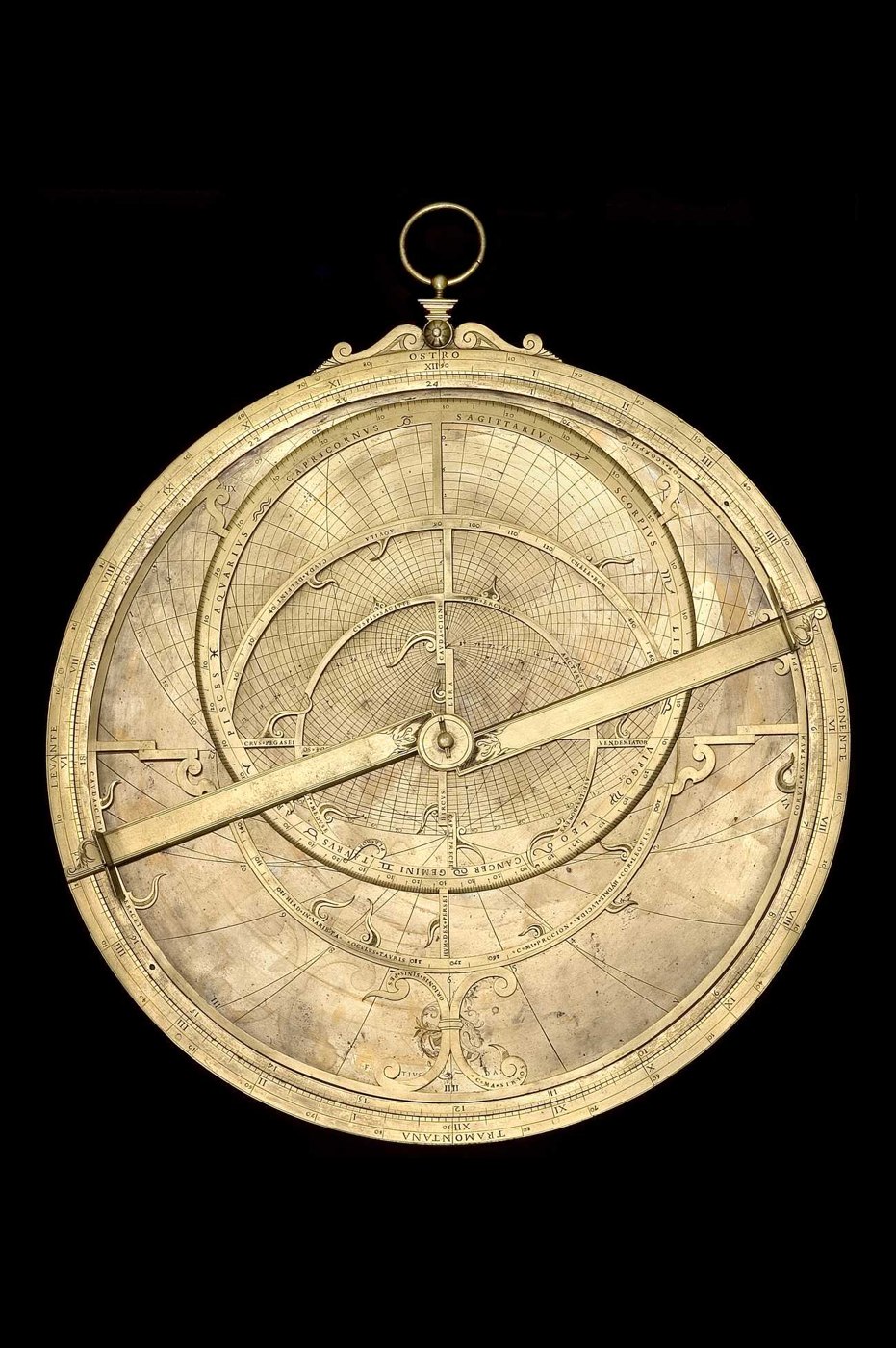
This gilt brass astrolabe, inventory number 52209, dates to approximately 1570 and is associated with Egnazio Danti, who authored the first Italian-language book on the astrolabe. The instrument features a throne with s-shaped scroll work, a square ornate shackle, and a simple round-section brass ring. Acquired by the History of Science Museum through the Lewis Evans collection in 1924, it was previously sold at the 1911 Roussel collection auction in Paris.

Front view of the Danti astrolabe showing the rete, alidade, and the limb scales.
Front view of the Danti astrolabe showing the rete, alidade, and the limb scales. — History of Science Museum, University of Oxford. Rights pending — permission not yet requested. Original source

Catalogue identity

Source
www.mhs.ox.ac.uk
Category
Tool · Latin-inscribed astrolabe
Maker / attribution
Egnazio Danti
Reference
Not recorded
Catalogue / lot identifier
52209
Source-reported date
ca. 1570
Source-reported place
Florence

Source-reported attribution and specifications are not independent authentication. A listing does not establish present ownership, current display, availability or permission to reproduce.

Object description

Construction and Design

This astrolabe is manufactured from gilt brass and exhibits complex decorative elements, including an s-shaped scroll work support on the throne and an ornate, square box-type shackle reminiscent of classical column capitals. The mater and limb are formed as a single-piece construction, supporting circular concentric scales for altitude and equal hours on the outer limb.

The rete is notable for its 'tropics-full' design, which includes circles for the ecliptic, the equator, and the Tropic of Cancer. Thirty-one stars are indicated on the rete with flamant pointers, and the zodiac signs are engraved in Latin. The center of the instrument is secured with a pin featuring an ornate engraved head.

Evidence for this section
  • “Throne, Ring and Shackle made of gilt brass with s-shaped scroll work support(s)”
  • “The mater and limb are of one-piece construction.”
  • “The rete is of the tropics-full (with equator) type.”
  • “Head of pin is an ornate engraved head.”

Universal Projection and Components

The reverse of the astrolabe features a de Rojas universal projection. This component includes Latin-inscribed Arctic circles and various meridians and parallels engraved with modern European numerals.

The instrumentation includes a double-ended, counter-changed alidade and a single-ended rule. The rule is identified as a replacement, though it is equipped with a sliding bracchiola and features an ornate engraved head at its center.

Evidence for this section
  • “The back is a de Rojas universal projection.”
  • “The rule is not original.”
  • “Alidade Double-ended, counter-changed.”
  • “An ornate engraved head decorates the center of the regula.”

Provenance and Signature

The instrument is signed 'F. EGNATIVS DANTES' near a coat of arms, which is presumed to be his own, although it remains unidentified. The manufacture is attributed to Danti or performed under his supervision. Danti is known for writing the first Italian-language treatise on the astrolabe in 1569.

The astrolabe was part of the Roussel collection in Paris until it was purchased at auction on March 13, 1911, as lot 70. It was later presented to the History of Science Museum in Oxford by Lewis Evans in 1924, and is registered under the accession number 1924-0/2072.

Evidence for this section
  • “Danti, author of the first Italian-language book on the astrolabe (1569), either made or supervised the making of this astrolabe for himself”
  • “his name appears around a coat of arms, presumably his own”
  • “Evans bought it at the auction sale of the Roussel collection in Paris on 13 March 1911 (lot 70).”
  • “Presented by Lewis Evans in 1924”

Open research questions

  • What is the specific identity of the coat of arms featured on the instrument?
  • Was there a specific reason or technical modification required that necessitated the replacement of the original rule?

Source evidence

Recorded claims and source quotations for Astrolabe by Egnazio Danti
FieldSource-reported valueSource quotation
MakerEgnazio Danti“Maker Egnazio Danti”
MaterialGilt brass“Material Gilt brass”
Dateca. 1570“Date ca. 1570”
PlaceFlorence“Place Florence”
Inventory number52209“Inventory no. 52209”
ProvenanceAcquired from the Roussel collection, Paris, 1911“Evans bought it at the auction sale of the Roussel collection in Paris on 13 March 1911 (lot 70).”
Star count31“The rete contains 31 stars.”
Rule statusReplacement“The rule is not original.”

Visible details

  • S-shaped scroll work on the throne
  • 31 stars marked with flamant pointers on the rete
  • Ornate engraved head on the central pin
  • Square, ornate box-type shackle

Research qualifications

  • The coat of arms has not been positively identified
  • The rule is noted as a replacement

Photograph identity and source facts were screened before import; rights clearance remains pending.

Consulted source

Astrolabe, inventory 52209 (Florence, ca. 1570)

Reviewed 2026-10-26 · Record b647a00673

Terms in this record

Glossary explanations for terms named in this object’s record.