
Skip to content
The Encyclopedia of Horology

Movement · Pocket watch movement

Antique Watch Movement

Partially verified

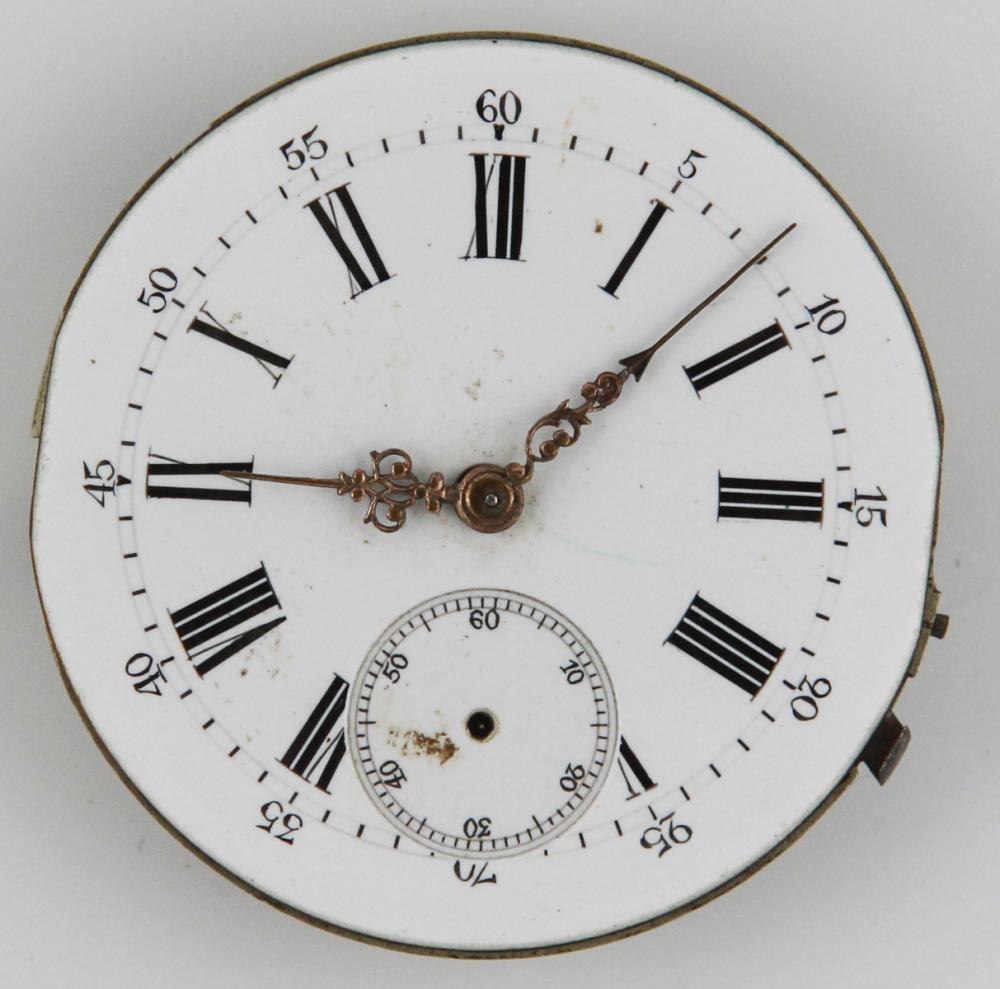
This antique watch movement is an unrestored mechanism designed for a pocket watch. It features an enamel or white-surfaced dial printed with black Roman numerals for the primary time display and a secondary, smaller sub-dial at the six o'clock position for constant seconds, marked in intervals of ten. The movement is fitted with decorative, pierced, filigree-style hands. The mechanical components are visible from the reverse side, revealing a balance wheel, gear train, and a regulator lever marked with the terms "avance" and "retard". The object is offered as a loose movement. The auction description reports that the consigner stated the movement is functional, though this claim has not been verified by the auction house.

Front view of the antique pocket watch movement showing the dial, subsidiary seconds register, and ornate hands.
Front view of the antique pocket watch movement showing the dial, subsidiary seconds register, and ornate hands. — Pasadena Auction House (via Invaluable). Rights pending — permission not yet requested. Original source

Catalogue identity

Source
www.invaluable.com
Category
Movement · Pocket watch movement
Maker / attribution
Not established
Reference
Not recorded
Catalogue / lot identifier
2002
Source-reported date
Not established
Source-reported place
Not established

Source-reported attribution and specifications are not independent authentication. A listing does not establish present ownership, current display, availability or permission to reproduce.

Object description

Dial and Hands

The movement features a white circular dial displaying standard Roman numerals for the hours. The dial includes a subsidiary seconds register positioned at the six o'clock mark, which uses smaller Arabic numerals in increments of ten to display the passing seconds. The dial surface shows signs of age and minor discoloration near the subsidiary dial.

The time is indicated by two pierced, ornate hands, which retain a metallic finish. These hands contrast with the white dial surface, providing legibility for the primary hour and minute track. The overall design follows a traditional pocket watch aesthetic intended to be housed within a casing.

Evidence for this section
  • “classic dial with Roman numerals and ornate hands”

Mechanical Configuration

The reverse side of the movement reveals a bridge-mounted gear train and a balance wheel assembly. The architecture allows for the observation of the mechanical interaction between the wheels and the balance cock. A central regulator arm is clearly visible, positioned over the balance bridge.

The regulator is marked with the French terms "avance" and "retard," indicating the adjustment direction for the watch's rate. The bridge plates and components appear to be made of a metallic alloy, showing some surface wear consistent with age and previous use. The movement is presented as a standalone item, separate from any watch case.

Evidence for this section
  • “The mechanism, visible from the reverse, offers a glimpse into the intricate workings of early timekeeping technology.”

Condition and Attribution

The movement is sold as an antique component. The current state of the movement is not fully assessed by the auction house, and the provided information relies on claims made by the consigner regarding its operating state. No specific manufacturer, date, or geographic origin is identified in the provided documentation.

The item is being sold in an as-is condition without returns. The provided images show the movement alongside a ruler for scale, indicating its physical size.

Evidence for this section
  • “Please note that all watches listed as 'running' does not imply they are in perfect condition; we rely on information provided by consignors.”
  • “All items, along with their descriptions and provenance, are sold "as is," with no returns or refunds.”

Open research questions

  • What is the specific movement caliber or serial number hidden on the main plate?
  • Can the manufacturer be identified through specific bridge shapes or the style of the regulator markings?

Source evidence

Recorded claims and source quotations for Antique Watch Movement
FieldSource-reported valueSource quotation
Lot number2002“Lot 2002”
Consigner statementThe movement is reported to be functional by the consigner, though the auction house has not performed testing.“According to the consigner, the movement is functional, although it has not been tested by the auction house.”
Dial markersRoman numerals“classic dial with Roman numerals”

Visible details

  • Dial has a subsidiary seconds sub-dial at the 6 o'clock position
  • Hands feature intricate, pierced floral or foliate patterns
  • Regulator index arm is marked with 'avance' and 'retard'
  • Movement layout suggests a keyless or stem-wound configuration

Research qualifications

  • Functionality remains unverified by the auction house
  • Origin, exact date of manufacture, and manufacturer are not stated

Photograph identity and source facts were screened before import; rights clearance remains pending.

Consulted source

Antique Watch Movement

Reviewed 2026-10-26 · Record ab8e09079b

Terms in this record

Glossary explanations for terms named in this object’s record.