
Skip to content
The Encyclopedia of Horology

Clock · Carriage clock

Antique French Brass Carriage Clock

Partially verified

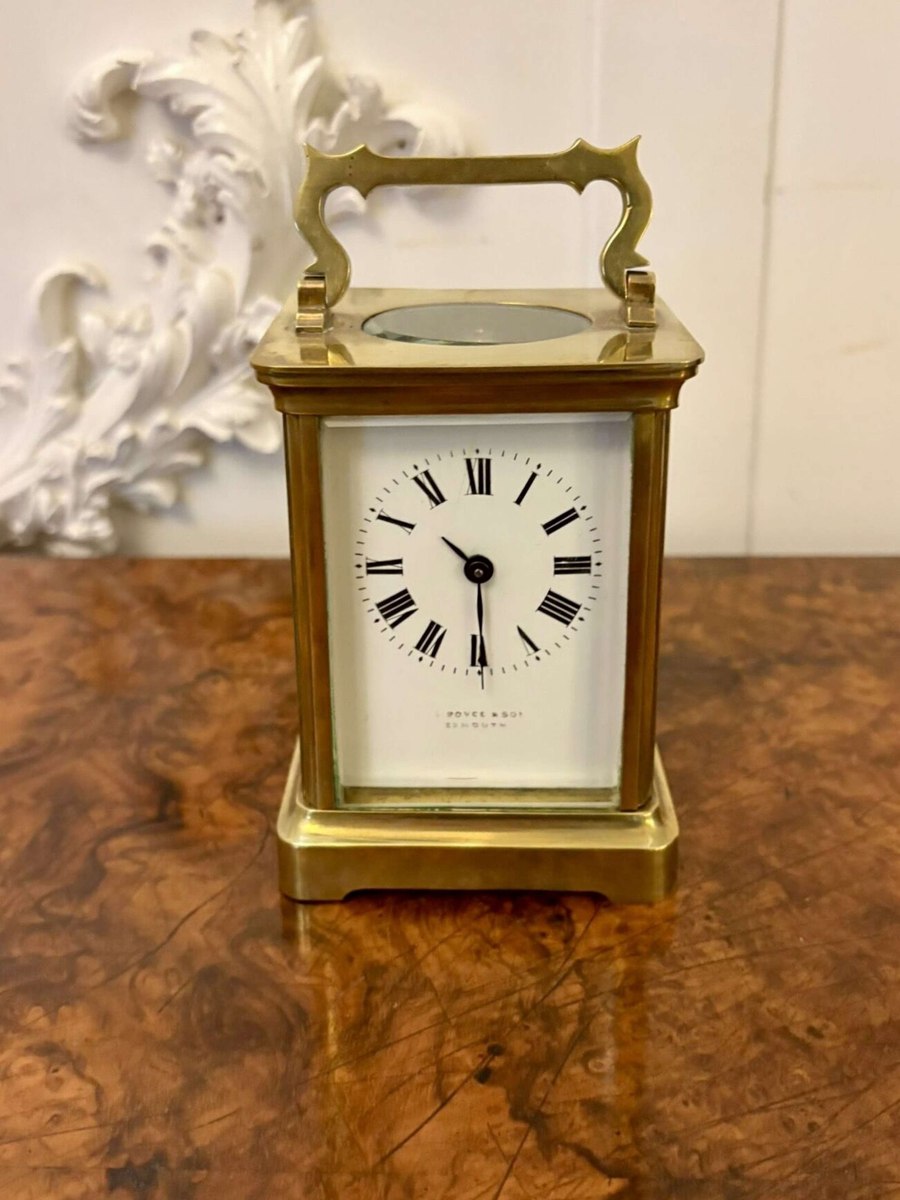
This antique French carriage clock is constructed in a traditional brass case fitted with bevelled glass panels and an overhead folding carrying handle. An upper circular bevelled glass window provides an inspection view of the escapement platform. The white enamel dial features black Roman hour markers with minute ticks and blued steel hands. As reported by the source, the clock contains an eight-day movement requiring weekly winding and dates to circa 1900, measuring 14.5 cm in height, 8 cm in width, and 6.5 cm in depth.

Front view of the brass carriage clock showing the white enamel Roman dial, folding handle, and top oval/circular window
Front view of the brass carriage clock showing the white enamel Roman dial, folding handle, and top oval/circular window — London City Antiques Limited. Rights pending — permission not yet requested. Original source

Catalogue identity

Source
www.antiquesboutique.com
Category
Clock · Carriage clock
Maker / attribution
Not established
Reference
3027 (AB-276095)
Catalogue / lot identifier
itm276095
Source-reported date
1900
Country
France

Source-reported attribution and specifications are not independent authentication. A listing does not establish present ownership, current display, availability or permission to reproduce.

Object description

Case Construction and Exterior Form

The clock is built in a rectangular brass housing designed with transparent side panels to display the internal movement. The upper surface features a contoured folding brass carrying handle that rests flat against the top brass plate when folded down.

To allow an overhead view of the escapement mechanism, a circular glass inspection aperture is inset directly into the upper plate. As reported by the seller, the clock is housed in a traditional brass case with bevelled glass panels to all sides, measuring 14.5 cm in total height, 8 cm in width, and 6.5 cm in depth.

Evidence for this section
  • “The clock is housed in a traditional brass case with bevelled glass panels to all sides allowing the movement to be viewed.”
  • “Contoured folding brass carrying handle mounted atop the case.”
  • “A folding carrying handle sits neatly on the top of the case above a circular inspection window which allows a view of the escapement.”
  • “Height: 14.5 cm (5.71 inches) Width: 8 cm (3.15 inches) Depth: 6.5 cm (2.56 inches)”

Dial and Hands

The face is composed of a rectangular white enamel dial set with Roman numeral hour markers and blued steel hands.

Direct visual inspection shows a faint retailer or maker inscription printed in black on the lower portion of the white dial below the hand arbor. However, the available photograph lacks sufficient resolution to transcribe or identify this text conclusively.

Evidence for this section
  • “The dial features Roman numerals and blued steel hands, creating a refined and timeless appearance.”
  • “Faint retailer or maker inscription printed in black on the lower portion of the white dial below the hand arbor.”

Reported Movement and Provenance

The seller describes the internal movement as an eight-day mechanism requiring winding once a week. The clock's origin is stated as French with an assigned date of 1900 and a period classification of Early 20th Century.

These technical and dating details rely on dealer description. The listing provides no interior mechanism photographs, calibre identification, or backplate views to verify movement maker stamps or platform escapement architecture independently.

Evidence for this section
  • “The movement is an eight day mechanism, meaning the clock only requires winding once a week.”
  • “Date: 1900”
  • “Origin: French”
  • “Period Early 20th Century”

Open research questions

  • What specific text or signature is printed on the lower half of the white enamel dial below the hand arbor?
  • Does the rear movement backplate bear French maker trademarks, serial numbering, or foundry stamps (such as Couaillet Frères, Drocourt, or Japy Frères)?
  • What escapement architecture (e.g., cylinder platform or lever platform) is visible through the circular upper inspection window?

Source evidence

Recorded claims and source quotations for Antique French Brass Carriage Clock
FieldSource-reported valueSource quotation
Movement durationEight day“The movement is an eight day mechanism, meaning the clock only requires winding once a week.”
Case materialBrass“The clock is housed in a traditional brass case with bevelled glass panels to all sides”
Dial descriptionWhite enamel with Roman numerals and blued steel hands“The dial features Roman numerals and blued steel hands, creating a refined and timeless appearance.”
Dimensions14.5 cm x 8 cm x 6.5 cm“Height: 14.5 cm (5.71 inches) Width: 8 cm (3.15 inches) Depth: 6.5 cm (2.56 inches)”
OriginFrench“Origin: French”
Date1900“Date: 1900”
Assigned periodEarly 20th Century“Period Early 20th Century”
Reported conditionLight age-related wear to brass case, glass panels in good order, movement appears clean“Very good antique condition with light age related wear to the brass case consistent with age and use. The glass panels are in good order and the movement appears clean.”

Visible details

  • Contoured folding brass carrying handle mounted atop the case.
  • Circular glass inspection window set into the upper brass plate.
  • Faint retailer or maker inscription printed in black on the lower portion of the white dial below the hand arbor.

Research qualifications

  • The dial inscription is too faint in the photograph to read definitively without speculation.
  • No rear or interior movement views are provided to verify maker stamps or escapement type.

Photograph identity and source facts were screened before import; rights clearance remains pending.

Consulted source

Antique French Brass Carriage Clock – 8 Day Movement in Antique Carriage Clocks

Reviewed 2026-10-21 · Record f65402e0fd

Terms in this record

Glossary explanations for terms named in this object’s record.