
Skip to content
The Encyclopedia of Horology

Clock · Bracket clock

Antique Bracket Clock by John Cross - London C1825

Partially verified

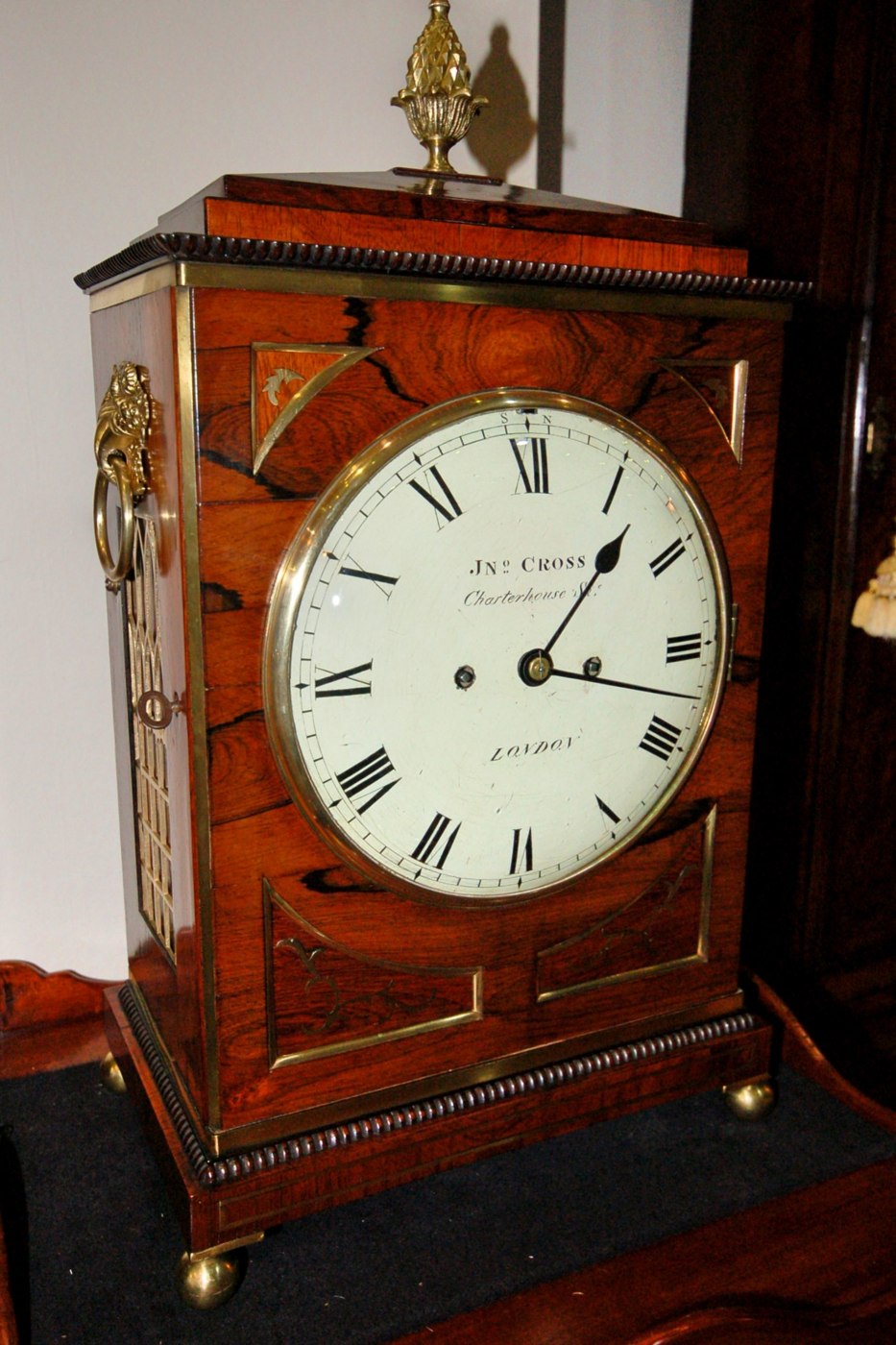
This eight-day bracket clock is attributed to the London maker John Cross, with a date of approximately 1825. The object features a rosewood-veneered cabinet, which is adorned with brass pineapple finials, ball feet, and side carrying handles. The design includes brass inlay and fretwork panels. The clock face consists of a round, white-painted convex dial with Roman numerals, signed by the maker at Charterhouse Square, London, and incorporating a strike/silent mechanism positioned at the twelve o'clock mark. Power is derived from a twin fusee movement that strikes the hours on a single bell. The interior assembly includes a brass backplate with decorative border engraving, which is replicated on the pendulum disc. The clock is additionally fitted with a pendulum holdfast screw for security during transport or storage.

Front view of the rosewood bracket clock by John Cross, featuring the convex dial with strike/silent indicator.
Front view of the rosewood bracket clock by John Cross, featuring the convex dial with strike/silent indicator. — Pendulum of Mayfair. Rights pending — permission not yet requested. Original source

Catalogue identity

Source
www.pendulumofmayfair.co.uk
Category
Clock · Bracket clock
Maker / attribution
John Cross
Reference
Not recorded
Catalogue / lot identifier
Source URL identifies the listing
Source-reported date
circa 1825
Source-reported place
London, England
Source-reported serial
1010

Source-reported attribution and specifications are not independent authentication. A listing does not establish present ownership, current display, availability or permission to reproduce.

Object description

Case and Dial

The bracket clock is housed in a rosewood-veneered wooden cabinet. The design includes a top-mounted brass pineapple finial and rests upon four brass ball feet. The sides are fitted with brass carrying handles and include decorative fretwork panels and brass inlay.

The circular, white-painted convex dial features black Roman numerals. The center of the dial is signed with the maker's name and location, 'Jno Cross, Charterhouse Square, London'. A strike/silent selector is integrated into the dial layout at the twelve o'clock position.

Evidence for this section
  • “The stunning rosewood veneered cabinet of exceptional colour and patination”
  • “The fine white painted convex dial with Roman numerals and signed to the centre by John Cross Charterhouse Square London.”

Movement and Construction

The clock is powered by an eight-day twin fusee movement. This mechanism is configured to strike the hours on a single bell. The clock also includes a repeat function, although the specific mechanical operation is not detailed in the available documentation.

The brass backplate displays border engraving. This same engraving pattern is present on the circular pendulum disc. To facilitate movement security, a pendulum holdfast screw is attached to the backplate.

Evidence for this section
  • “The fine quality twin fusee movement striking the hours on a single bell and with repeat function.”
  • “Lovely border engraving to the backplate and to the pendulum. A pendulum holdfast screw to the backplate.”

Signatures and Attribution

The maker, John Cross, is associated with the addresses 15 Charterhouse Square, London, and 41 Charterhouse Square, London. These locations correspond to documented periods of activity between 1822 and 1845.

The signature appears on the dial as 'Jno Cross' followed by 'Charterhouse Square, London'. The combination of the maker's name, the location, and the stylistic characteristics of the clock cabinet supports the attribution to this specific London workshop, circa 1825.

Evidence for this section
  • “he dial by John Cross, Charterhouse Square – London”
  • “15 Charterhouse Square, Islington, London (1822-1826)”

Open research questions

  • Does the movement contain any hidden maker's stamps or dates not visible on the backplate?
  • What is the specific mechanical design of the repeat function mentioned in the description?

Source evidence

Recorded claims and source quotations for Antique Bracket Clock by John Cross - London C1825
FieldSource-reported valueSource quotation
LocationCharterhouse Square, London“Charterhouse Square – London”
Movement TypeTwin fusee 8-day“twin fusee 8-day bell strike bracket clock”
Case MaterialRosewood“rosewood veneered cabinet”
SKU1010“SKU: 1010”
Strike mechanismSingle bell“striking the hours on a single bell”
Maker's documented dates at location1822-1826 and 1832-1845“15 Charterhouse Square, Islington, London (1822-1826) 41 Charterhouse Square, Islington, London (1832-1845)”

Visible details

  • Brass pineapple finial on top of the cabinet
  • Brass carrying handles on the side panels
  • Engraved decoration on the pendulum disc
  • Strike/silent lever at the twelve o'clock position on the dial

Research qualifications

  • The exact date of manufacture is based on a chronological range provided by the source for the maker's location
  • The specific nature of the 'repeat function' is mentioned but not visually documented

Photograph identity and source facts were screened before import; rights clearance remains pending.

Consulted source

Antique Bracket Clock by John Cross – London C1825

Reviewed 2026-11-02 · Record 9181fe1a30

Terms in this record

Glossary explanations for terms named in this object’s record.