
Skip to content
The Encyclopedia of Horology

Clock · Mantel clock

Aesthetic Movement Oak Cased Mantel Clock

Partially verified

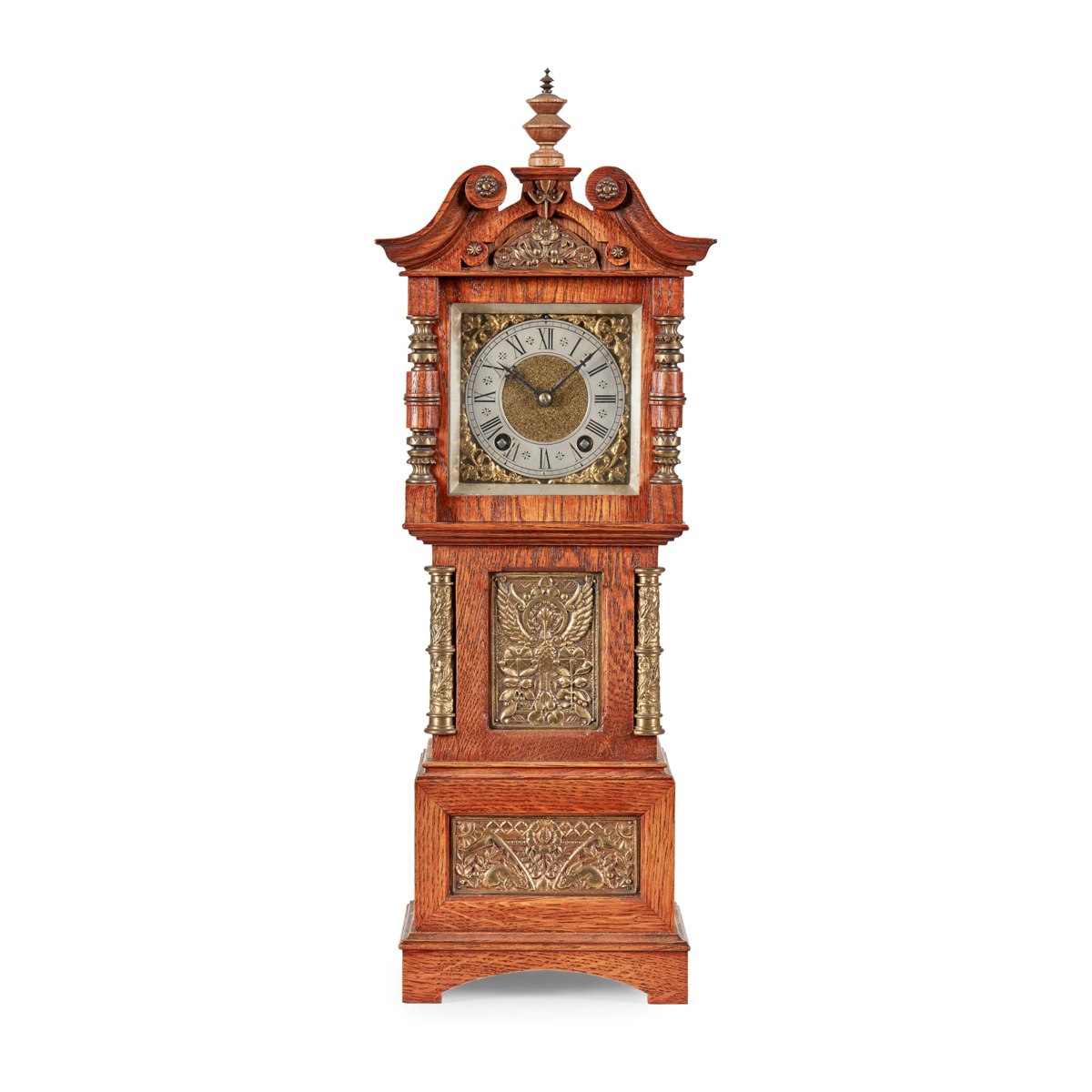
This Aesthetic Movement oak mantel clock dates to circa 1880 and is styled in the form of a miniature longcase clock. The auction house reports a twin-train movement fitted with a silvered chapter ring showing Roman numerals and two winding apertures. The oak case is adorned with cast brass panels executed in the manner of designer Bruce Talbert, flanked by miniature brass columns and wood-turned pillars. The clock measures approximately 51.5 cm high, 8 cm wide, and 14 cm deep, surmounted by a swan-neck pediment with a central finial.

Front view of the Aesthetic Movement oak miniature longcase mantel clock
Front view of the Aesthetic Movement oak miniature longcase mantel clock — Lyon & Turnbull. Rights pending — permission not yet requested. Original source

Catalogue identity

Source
www.lyonandturnbull.com
Category
Clock · Mantel clock
Maker / attribution
Not established
Reference
Not recorded
Catalogue / lot identifier
52
Source-reported date
circa 1880
Source-reported place
United Kingdom

Source-reported attribution and specifications are not independent authentication. A listing does not establish present ownership, current display, availability or permission to reproduce.

Object description

Form and Construction

The clock is constructed of oak in the form of a miniature longcase clock. The hood features a swan-neck pediment surmounted by a central turned finial and floral roundels.

The case architecture includes carved turned wood columns beside the hood and brass half-columns flanking the waist.

Evidence for this section
  • “in the form of a miniature long case clock”
  • “Carved oak swan-neck pediment surmounted by a central turned finial and floral roundels”
  • “Flanking brass half-columns along the waist and carved turned wood columns beside the hood”

Decorative Brass Elements

The waist door and base of the case are inset with relief-cast brass panels featuring stylized flora and winged motifs.

The auction house describes the brass panel designs as being in the manner of Bruce Talbert; the actual authorship is not verified by this source.

Evidence for this section
  • “Relief-cast brass panels set into the waist door and base depicting stylised flora and winged motifs”
  • “the case with cast brass panels in the manner of Bruce Talbert”

Dial and Movement

The clock face features a square dial opening with a silvered chapter ring, Roman numerals, and brass corner spandrels.

The source identifies a twin-train movement, evidenced by two winding apertures on the dial.

Evidence for this section
  • “Square dial opening with silvered chapter ring, Roman numerals, two winding apertures, and brass corner spandrels”
  • “the twin train movement with silvered chapter ring”

Open research questions

  • What is the operational condition of the twin-train movement?
  • Does the rear of the case or the movement mechanism bear any manufacturer marks or evidence of later modification?
  • Is there specific documentation to confirm the production of these brass panels beyond stylistic attribution to Bruce Talbert?

Source evidence

Recorded claims and source quotations for Aesthetic Movement Oak Cased Mantel Clock
FieldSource-reported valueSource quotation
FormMiniature long case clock“in the form of a miniature long case clock”
MovementTwin train movement“the twin train movement with silvered chapter ring”
Panel designIn the manner of Bruce Talbert“the case with cast brass panels in the manner of Bruce Talbert”
Dimensions8cm wide, 51.5cm high, 14cm deep“8cm wide, 51.5cm high, 14cm deep”
Approximate Dimensions8cm wide, 51.5cm high, 14cm deep“8cm wide, 51.5cm high, 14cm deep”
AttributionEnglish School“ENGLISH SCHOOL AESTHETIC MOVEMENT OAK CASED MANTEL CLOCK”

Visible details

  • Carved oak swan-neck pediment surmounted by a central turned finial and floral roundels
  • Square dial opening with silvered chapter ring, Roman numerals, two winding apertures, and brass corner spandrels
  • Relief-cast brass panels set into the waist door and base depicting stylised flora and winged motifs
  • Flanking brass half-columns along the waist and carved turned wood columns beside the hood

Research qualifications

  • Maker is unspecified; described by the auction house as English School
  • Stylistic attribution of the brass panels to Bruce Talbert is in his manner, not verified authorship
  • Movement mechanics and rear case are not visible in the photograph

Photograph identity and source facts were screened before import; rights clearance remains pending.

Terms in this record

Glossary explanations for terms named in this object’s record.