
Skip to content
The Encyclopedia of Horology

Clock · Table clock

Adolf Loos Early Table Clock

Partially verified

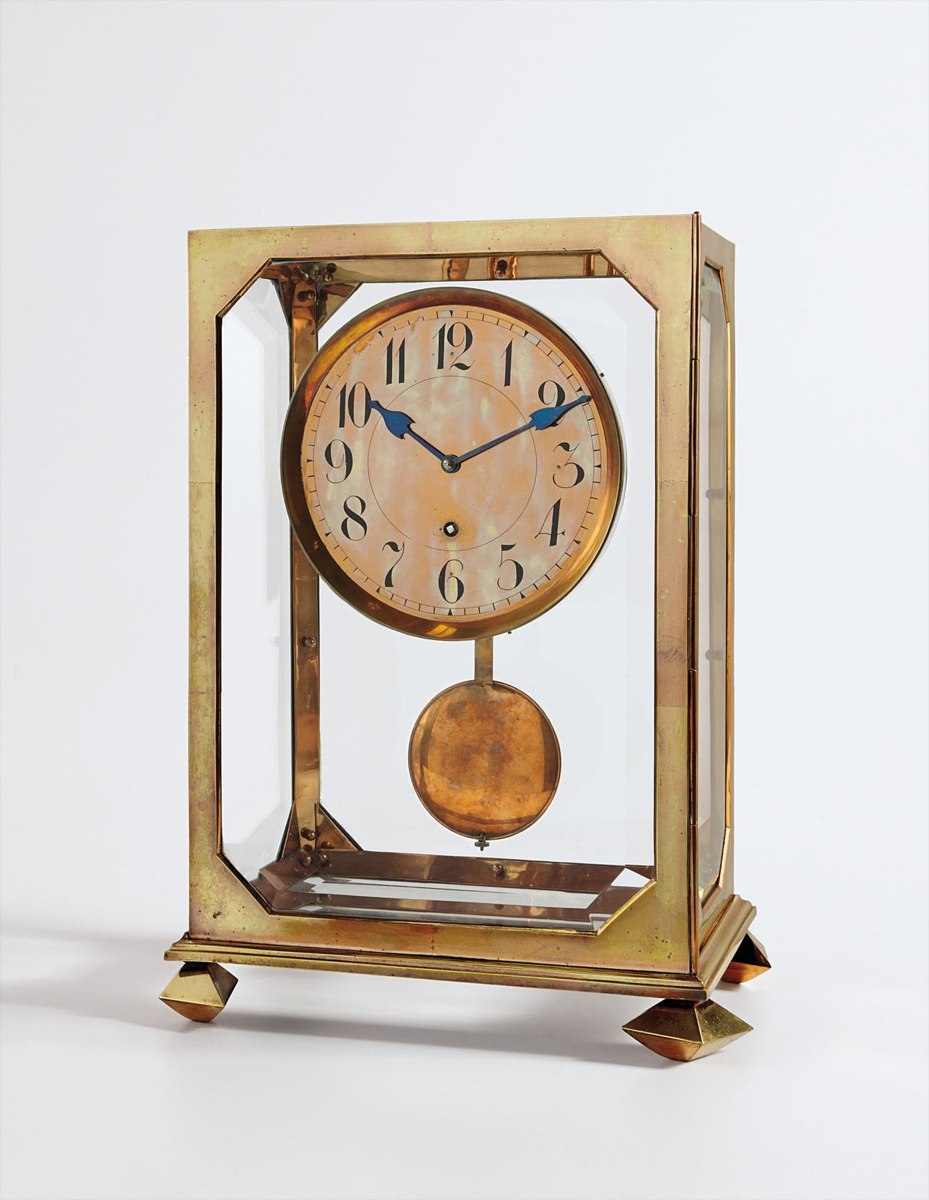
This early table clock, designed circa 1900 by Austrian architect Adolf Loos, features a glazed rectangular housing with canted interior corners and beveled crystal panels on all sides. Fabricated from copper-plated brass, brass, and steel, the structure stands on diagonally oriented faceted crystal-form feet. Its suspended circular dial presents Arabic numerals and blued spade hands positioned above an exposed pendulum bob. The auction catalogue notes the case was probably produced by Viennese metalworker Johannes Heeg, and the reverse of the dial is painted with a later notation dated December 15, 1911.

Frontal three-quarter view of the Adolf Loos early table clock with pendulum and faceted feet
Frontal three-quarter view of the Adolf Loos early table clock with pendulum and faceted feet — Phillips. Rights pending — permission not yet requested. Original source

Catalogue identity

Source
www.phillips.com
Category
Clock · Table clock
Maker / attribution
Adolf Loos (designer); case probably Johannes Heeg
Reference
Not recorded
Catalogue / lot identifier
1
Source-reported date
circa 1900
Country
Austria

Source-reported attribution and specifications are not independent authentication. A listing does not establish present ownership, current display, availability or permission to reproduce.

Object description

Object Description and Dating

This table clock is designed by Austrian architect Adolf Loos. The housing is rectangular, fabricated from copper-plated brass, brass, and steel, with beveled crystal panels on all sides.

The rectangular case design with canted corners indicates it is a model produced before 1906. Based on the face and dimensions, the source suggests a date of circa 1900. The reverse of the face bears a painted notation dated December 15, 1911.

Evidence for this section
  • “circa 1900”
  • “Copper-plated brass, brass, steel, beveled crystal.”
  • “The rectangular case of the present clock positions it prior to 1906, and its face and dimensions plead for 1900.”
  • “The date painted on the reverse of its face— 15.12.911 , or December 15, 1911—would be a typical repair notation of the period”

Construction and Features

The clock features a stepped plinth base supported by four diagonally oriented, faceted crystal-form metal feet. The internal frame is characterized by canted corners.

The clock includes a circular metal dial with Arabic numerals and blued spade hands. A circular pendulum bob is suspended below the dial, which is fixed to the rear glass.

Evidence for this section
  • “Internal frame corners are canted”
  • “Four diagonally oriented faceted crystal-form metal feet supporting the stepped plinth base”
  • “Circular metal dial displaying Arabic numerals and blued spade hands”
  • “Visible circular pendulum bob suspended below the dial”

Attribution and Provenance

The case is attributed to Viennese metalworker Johannes Heeg. Documentation notes that Heeg produced some of Loos’s cases, though it is not confirmed if he produced all of them as he did not sign his work.

The clock is provided with a double-end case and a clock key.

Evidence for this section
  • “Case probably produced by Johannes Heeg, Vienna.”
  • “Metalworker Heeg produced some of Loos‘s cases, although it is not known if he is responsible for all of them, as he did not sign his work.”
  • “Together with its double-end case and clock key.”

Open research questions

  • Are there records confirming the specific commission or estate for which this table clock was originally created?
  • Can the internal movement mechanism be definitively identified by maker, given that the source mentions Gustav Becker as the maker for the earlier Ebenstein model?

Source evidence

Recorded claims and source quotations for Adolf Loos Early Table Clock
FieldSource-reported valueSource quotation
MaterialsCopper-plated brass, brass, steel, beveled crystal“Copper-plated brass, brass, steel, beveled crystal.”
Dimensions21 3/8 x 16 1/4 x 10 1/4 in. (54.3 x 41.3 x 26 cm)“21 3/8 x 16 1/4 x 10 1/4 in. (54.3 x 41.3 x 26 cm)”
Attributed Case MakerProbably Johannes Heeg, Vienna“Case probably produced by Johannes Heeg, Vienna.”
MarkingsReverse of face painted later with 15.12.911“Reverse of face painted later with 15.12.911”
AccompanimentsDouble-end case and clock key“Together with its double-end case and clock key.”

Visible details

  • Glazed rectangular brass-finish case with beveled crystal panels on all sides
  • Internal frame corners are canted
  • Circular metal dial displaying Arabic numerals and blued spade hands
  • Visible circular pendulum bob suspended below the dial
  • Four diagonally oriented faceted crystal-form metal feet supporting the stepped plinth base

Research qualifications

  • Attribution to metalworker Johannes Heeg is noted as probable by the source and is not marked
  • Internal movement is behind the dial and rear glass, with mechanism details based on catalogue descriptions

Photograph identity and source facts were screened before import; rights clearance remains pending.

Consulted source

阿道夫·路斯 The Collector: Icons of Design

Reviewed 2026-10-22 · Record 316cbf936f

Terms in this record

Glossary explanations for terms named in this object’s record.