Case Construction and Decorative Finish
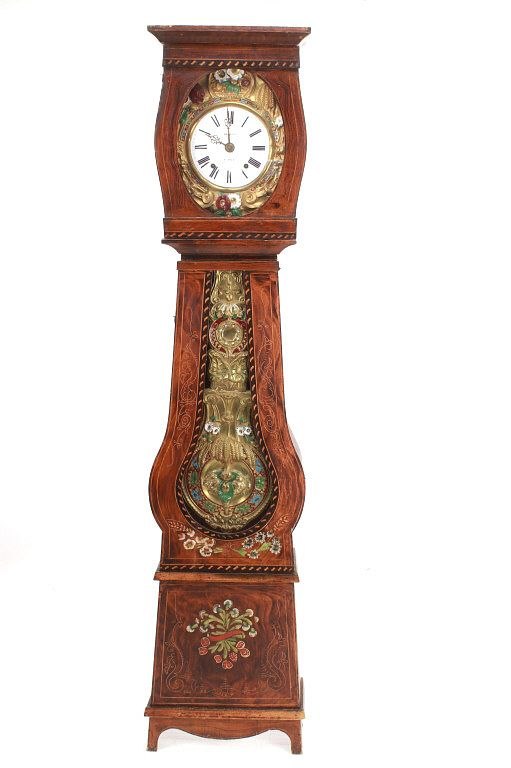
The clock is housed in a pot-bellied, or 'violin,' oak case measuring 7'6" in height. The exterior features painted foliage decoration in red, green, blue, and white, which appears on the front and sides of the case.
The case design incorporates a lower panel face and sides with floral flourishes. Glazed apertures are present, allowing visibility of the dial and pendulum.
Evidence for this section
- “pot-bellied or 'violin' oak case”
- “original red, green, blue and white coloured foilage decoration”
- “Measures 7'6"H x 18.75"W x 10.25"D”
Dial and Visual Appointments
The white enamel dial is inscribed with the clockmaker's name, 'Barbier', and the place of origin, 'Dôle'. The dial is framed by a decorative gilt metal repoussé floral surround.
A corresponding gilt metal repoussé floral surround is also present on the pendulum, which is visible through the trunk section of the case.
Evidence for this section
- “Clockmaker, "Barbier', and place of origin, 'Dôle'”
- “Clock face and pendulum have a gilt metal repousse floral surround.”
Source Limitations and Condition
The movement, pendulum, weights, and winding key are included with the lot. Operational status is unverified, though the source notes the movement has 'some movement.'
Reported condition issues include a missing rear lower panel, replaced glass, and a visible crack in the lower glass.
Evidence for this section
- “Pendulum and weights are included as well as a winding key, rear lower panel is missing, glass has been replaced, lower glass has visible crack.”
- “Unknown if movement is in working order though it has some movement.”
Historical Context and Regional Origin
The auction house provides historical context regarding the development of Comtoise clocks, which are also known as Morbier clocks. These timepieces were traditionally crafted within the Jura Mountains in the Franche-Comté region of eastern France. The source notes that such movements were typically produced by mountain herders during the winter months, who would then travel to markets in the spring to sell their work.
These clocks were historically known as 'A Wag on the Wall' pieces because they originally consisted solely of the movement, pendulum, weights, and key. While they could be displayed in this form, owners frequently commissioned local cabinetmakers to construct custom cases, such as the oak example described here. Dôle, the specific place of origin inscribed on this clock's dial, is identified by the source as being situated in the Bourgogne-Franche-Comté region.
Evidence for this section
- “Comtoise clocks - also referred to as Morbier clocks - were a style of long-case clock originally made in the region of Franche-Comté”
- “The movements of “Comtoise” or “Morbier” clocks were produced in several small towns in the Jura Mountains within the Comte region of France.”
- “The herder’s clocks were referred to as “A Wag on the Wall”, as they consisted only of the movement, pendulum, weights and key.”
Condition and Provenance Notes
According to records provided by the auction house, the clock was acquired from a French chateau in 1975. At the time of this acquisition, it was estimated that the clock was approximately 135 years old. The item includes the necessary movement, weights, pendulum, and winding key for operation, though its mechanical status remains unconfirmed.
Regarding its current condition, the source specifies that the clock is missing its rear lower panel. Furthermore, the glass has been replaced, and the lower glass panel exhibits a visible crack. While the painted foliage on the case remains prominent, the source indicates that the decorative floral flourishes on the sides and the lower panel face are applied via stenciling.
Evidence for this section
- “Clock was purchased from a French Chateau in 1975 at which time the clock was estimated to be 135 years old.”
- “A floral flourish is stenciled on 'violin case' sides and the lower panel face.”
- “rear lower panel is missing, glass has been replaced, lower glass has visible crack.”