
Skip to content
The Encyclopedia of Horology

Clock · Longcase clock

18th-Century Belgian Carved Oak Longcase Clock

Partially verified

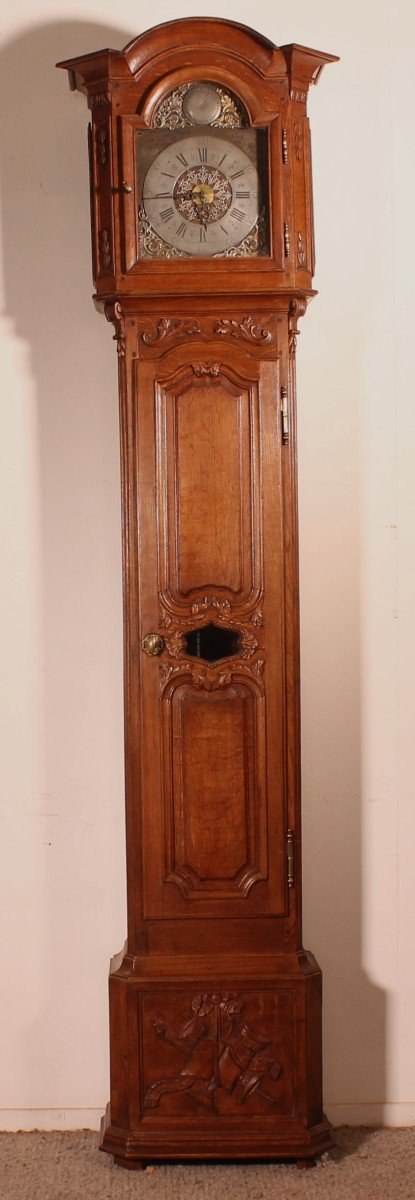
According to the seller, this carved oak floor clock dates to the 18th century and originates from Namur, Belgium, executed in the Louis XV-Transition style. The oak case measures 2.42 meters tall, 60 centimeters wide, and 30 centimeters deep. It features an arched hood with molded cornice elements, a shaped trunk door carved with foliate borders and a central aperture, and a pedestal base decorated with relief carving. The seller reports that the clock retains its original mechanism and features a pewter dial embellished with beading, displaying Roman hour numerals and openwork spandrels.

Full-length front view of the 18th-century Belgian carved oak longcase clock
Full-length front view of the 18th-century Belgian carved oak longcase clock — Alain Michel Antiquité Bruxelles / Proantic. Rights pending — permission not yet requested. Original source

Catalogue identity

Source
www.proantic.com
Category
Clock · Longcase clock
Maker / attribution
Not established
Reference
1392889
Catalogue / lot identifier
Source URL identifies the listing
Source-reported date
18th century
Country
Belgium

Source-reported attribution and specifications are not independent authentication. A listing does not establish present ownership, current display, availability or permission to reproduce.

Object description

Identity and Provenance Attribution

The object is described by the dealer as an 18th-century oak floor clock originating from Namur, Belgium. The listing assigns the piece to the Louis 15th - Transition style.

No clockmaker name, workshop, or serial marking is recorded in the source documentation. The attribution to Namur and dating to the 18th century rest entirely on dealer assertions rather than documented or visible maker signatures.

Evidence for this section
  • “Period: 18th century”
  • “Style: Louis 15th - Transition”
  • “city of namurNamur (belgium)”

Case Construction and Carving

The clock case is constructed of oak, measuring 2.42 meters in height, 60 centimeters in width, and 30 centimeters in depth. The structure presents a full-height composition with an arched hood and prominent cornice molding.

The trunk door is detailed with curvilinear panel moldings, foliate carvings, an exterior latch, and a central shaped aperture. At the lower section, the pedestal base displays a relief-carved panel depicting ribbons and trophies or musical instruments.

Evidence for this section
  • “Material: Oak”
  • “Height: 2m42”
  • “Width: 60cm”
  • “Depth: 30cm”
  • “Full-height carved oak longcase clock with an arched hood and prominent cornice molding.”
  • “Trunk door configured with curvilinear panel moldings, foliate carving, a shaped central viewing opening, and an exterior latch.”
  • “Pedestal base ornamented with a relief-carved panel depicting ribbons and trophies or musical instruments.”

Dial and Movement Details

The dial is described in the listing as made of pewter with beaded edging ("pearling"). Visible observation shows an arched dial configuration incorporating Roman hour numerals, corner spandrels, an engraved center, and a roundel in the upper lunette.

The seller reports that the movement is complete and original. However, the movement plates, escapement, weights, and pendulum are not visible in the provided exterior photograph, leaving internal mechanical components unverified by visual observation.

Evidence for this section
  • “dial of superb quality in pewter with a very beautiful pearling”
  • “Arched dial featuring corner spandrels, an arched lunette roundel, an engraved center, and Roman numerals.”
  • “with its original mechanism”
  • “The clock mechanism is complete”

Open research questions

  • Are there any maker inscriptions, town marks, or dates stamped on the pewter dial or movement backplate?
  • What specific escapement and striking train configurations are present in the movement?
  • What is the condition and originality of the internal weights, pendulum rod, and bob?

Source evidence

Recorded claims and source quotations for 18th-Century Belgian Carved Oak Longcase Clock
FieldSource-reported valueSource quotation
OriginNamur, Belgium“city of namurNamur (belgium)”
MaterialOak“Material: Oak”
Dial MaterialPewter“dial of superb quality in pewter”
Height2m42“Height: 2m42”
Width60cm“Width: 60cm”
Depth30cm“Depth: 30cm”
Period18th century“Period: 18th century”
StyleLouis 15th - Transition“Style: Louis 15th - Transition”
Seller-Stated ConditionPerfect condition (dealer assertion)“Condition: Perfect condition”

Visible details

  • Full-height carved oak longcase clock with an arched hood and prominent cornice molding.
  • Trunk door configured with curvilinear panel moldings, foliate carving, a shaped central viewing opening, and an exterior latch.
  • Pedestal base ornamented with a relief-carved panel depicting ribbons and trophies or musical instruments.
  • Arched dial featuring corner spandrels, an arched lunette roundel, an engraved center, and Roman numerals.

Research qualifications

  • Maker is not recorded in the dealer's listing nor legible on the dial.
  • Internal movement, escapement, and weight train are not visible in the provided exterior photograph.
  • Claims of original mechanism and perfect condition are source-reported by the dealer.

Photograph identity and source facts were screened before import; rights clearance remains pending.

Consulted source

Proantic: 18th Century Oak Longcase Clock From Belgium

Reviewed 2026-10-21 · Record 3cd943abe1

Terms in this record

Glossary explanations for terms named in this object’s record.