
Skip to content
The Encyclopedia of Horology

Pocket watch · Open-face pocket watch

18ct Yellow Gold and Enamel Open Face Pocket Watch

Partially verified

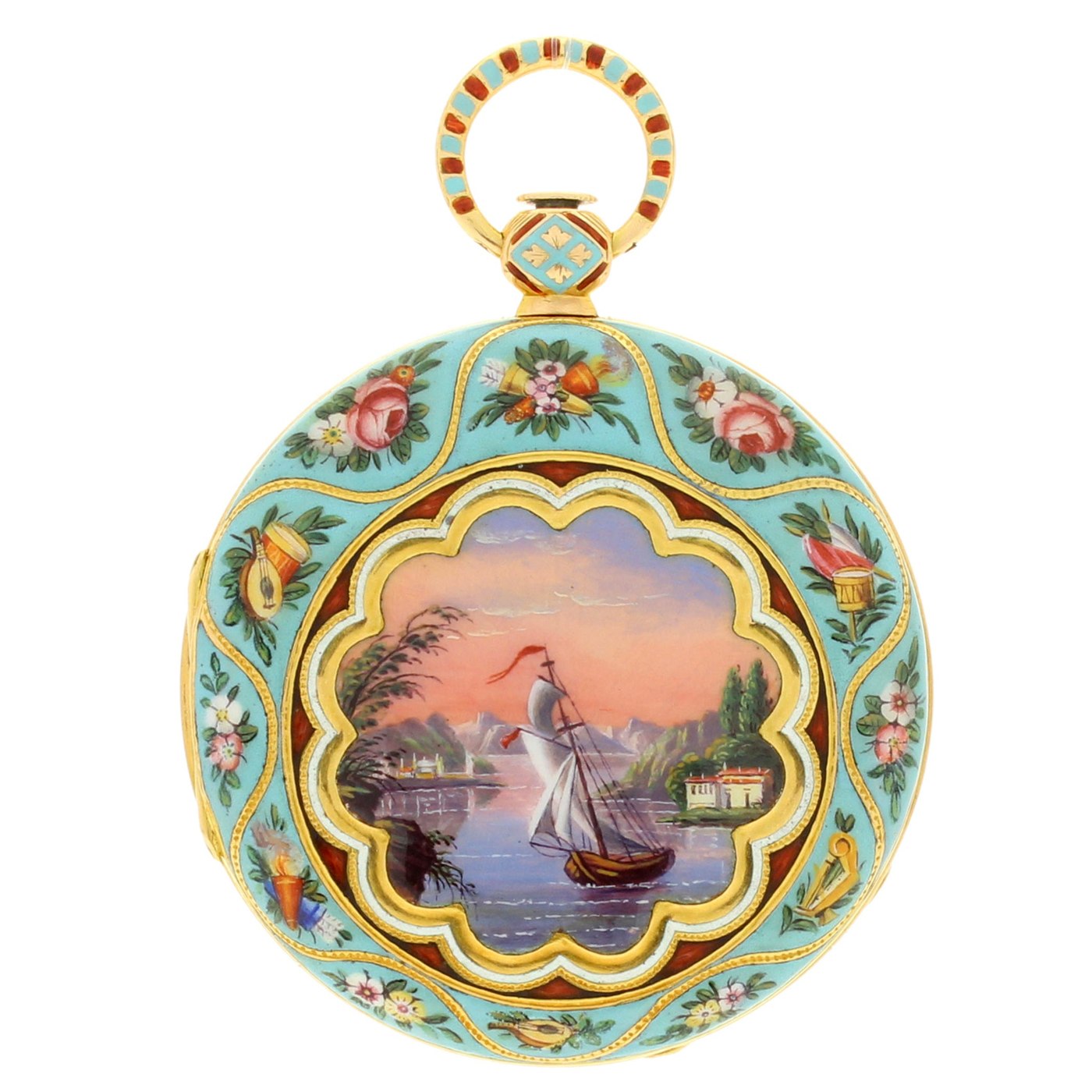
This 18ct yellow gold open face pocket watch dates to the 1840s and is attributed to Swiss manufacture. The piece features an intricate enamel finish, with a central scene on the case back depicting a boat on the river Bosphorus at sunset, surrounded by floral and enamel detailing that extends to the bow and the circumference of the case. The white enamel dial is marked with Eastern Arabic numerals and equipped with steel skeletonised hands. The manual movement is housed within a 18ct yellow gold case measuring 46 mm in diameter and 10 mm in thickness. The watch includes a gilded dust cover that provides apertures specifically for the winding and setting of the mechanism. Although unsigned, the watch is identified as a product manufactured for the Ottoman Empire market, reflecting historical trade relations between Swiss watchmakers and the region during this period.

Exterior view of the 18ct gold and enamel pocket watch showing the Bosphorus river scene on the case back.
Exterior view of the 18ct gold and enamel pocket watch showing the Bosphorus river scene on the case back. — Somlo London. Rights pending — permission not yet requested. Original source

Catalogue identity

Source
www.somlo.com
Category
Pocket watch · Open-face pocket watch
Maker / attribution
Not established
Reference
Not recorded
Catalogue / lot identifier
2244
Source-reported date
1840's
Source-reported place
Switzerland

Source-reported attribution and specifications are not independent authentication. A listing does not establish present ownership, current display, availability or permission to reproduce.

Object description

Case and Enamel Decoration

The pocket watch features an 18ct yellow gold open face case characterized by elaborate enamel ornamentation. The circumference of the case, as well as the areas surrounding the dial and the bow, are decorated with floral motifs and enamel work. The primary decorative element is situated on the center of the case back, which contains a painted enamel scene depicting a boat navigating the river Bosphorus at sunset.

The physical dimensions of the case are 46 mm in diameter with a thickness of 10 mm. The interior of the watch is protected by a gilded dust cover, which features functional apertures designed to facilitate the winding and setting of the movement without exposing the internal components to the external environment.

Evidence for this section
  • “Open face case with gold and enamel featuring enamel detailing around the circumference, surrounding the dial and on the bow.”
  • “Centre of case back painted with enamel scene depicting a boat on the river Bosphorus at sunset.”
  • “Gilded dust cover with apertures for winding and setting”

Dial and Movement

The watch is fitted with a white enamel dial that indicates the time using Eastern Arabic numerals. The dial is completed with a set of steel skeletonised hands. The timekeeping is provided by a manual movement, which is visible when the case is opened.

The watch remains unsigned, though it is contextualized as a Swiss-made item produced during the 1840s. The movement is mounted within the gold casing, with the gilded dust cover serving as a partition between the dial assembly and the mechanical movement.

Evidence for this section
  • “White enamel dial with outer minute track featuring Eastern Arabic numerals with steel skeletonised hands.”
  • “Manual”
  • “(unsigned)”

Historical Context and Attribution

The watch is identified as having been made for the Ottoman Empire market, a destination for many Swiss watchmakers throughout the 19th century.

The object is attributed to the 1840s based on the vendor's records. While the watch is unsigned, its design attributes and specific market orientation are consistent with the items produced by Swiss workshops for international export to Constantinople and beyond during this era.

Evidence for this section
  • “Watchmakers from Geneva, Paris and Blois initiated trade relations with the Ottoman Empire in the beginning of the 17th century.”
  • “Made 1840's”

Open research questions

  • What is the specific identity of the manufacturer given the unsigned nature of the movement?
  • Does the movement contain any hidden maker's marks or stamps beneath the dust cover that identify the workshop?

Source evidence

Recorded claims and source quotations for 18ct Yellow Gold and Enamel Open Face Pocket Watch
FieldSource-reported valueSource quotation
Material18ct yellow gold“18ct yellow gold”
Dating1840s“Made 1840's”
MovementManual“Manual”
Diameter46 mm“Diameter 46 mm”
Thickness10 mm“Thickness 10 mm”
Dial numeralsEastern Arabic“Eastern Arabic numerals”
Dust coverGilded with winding and setting apertures“Gilded dust cover with apertures for winding and setting”

Visible details

  • Case back features a painted enamel scene of a boat on the Bosphorus
  • Dial utilizes Eastern Arabic numerals
  • Steel skeletonised hands
  • Gilded dust cover with winding and setting apertures

Research qualifications

  • The maker is identified as 'unsigned'
  • Country of manufacture is not explicitly stated as Swiss beyond the 'Vendor: Swiss' and general trade context provided in the text

Photograph identity and source facts were screened before import; rights clearance remains pending.

Consulted source

18ct yellow gold Swiss enamel set open face pocketwatch. Made 1840's

Reviewed 2026-11-02 · Record a0fa74ed5d

Terms in this record

Glossary explanations for terms named in this object’s record.