
Schaffhausen, Switzerland · 1898 – 1966
Albert Pellaton
Partially verifiedAutomatic winding mechanisms
Life & work
Albert Pellaton is associated with the pawl-winding automatic system developed at a Schaffhausen manufacture, in which a cam and two pawls convert rotor motion in either direction into winding.
The system is notable for efficiency and for smooth rotor motion, and remained in use across several generations of calibres.
Born in 1898 into a watchmaking family, Albert Pellaton began his professional training before working as a constructor for Vacheron Constantin. In 1944, he moved to IWC Schaffhausen to serve as technical director, a role he maintained until 1966. During his tenure, he developed the renowned Pellaton-winding system for automatic wristwatches, which utilized an modified pawl mechanism for bidirectional winding. His technical contributions at IWC included the development of the Calibre 89, as well as the Calibre 85 family, which became central to the company's manufacturing history.
The fuller biography summarises the open references listed under Sources; each statement was checked against the cited passage. Confirm key dates in period documents before relying on them.
Timeline
Albert Pellaton's recorded dates, dated events from this profile and its sources, and dated pieces and sales from the object catalogue. Dates are as each record gives them.
1898 · Career
Born
1898 · Career
Born in 1898 into a watchmaking family, Albert Pellaton began his professional training before working as a constructor for Vacheron Constantin.
1944 · Career
In 1944, he moved to IWC Schaffhausen to serve as technical director, a role he maintained until 1966.
1948 · Career
Pellaton contributed to the development of the 1948 Mark 11 pilot's watch, which featured an inner soft-iron case for magnetic shielding.
1950 · Career
He engineered the pawl-based automatic winding system, known as the Pellaton-winding, which was patented in 1950 to improve efficiency.
1966 · Career
Died
Training, contributions & innovations
- The pawl-winding automatic system that bears his name
- Contributed to technical leadership at a major Swiss manufacture
- He engineered the pawl-based automatic winding system, known as the Pellaton-winding, which was patented in 1950 to improve efficiency.
- Pellaton oversaw the technical development of influential IWC movements, such as the Calibre 89 with central seconds.
Inventions & patents
- Patent records exist for the winding system; the specification details should be read directly rather than paraphrased from secondary accounts.
Signatures & markings on surviving work
- Not a signing maker in the traditional sense: his work appears inside brand-signed calibres.
Documented works
- He was responsible for the design of the IWC Calibre 89, a movement widely recognized for its longevity in models such as the Mark 11.
- Pellaton contributed to the development of the 1948 Mark 11 pilot's watch, which featured an inner soft-iron case for magnetic shielding.
Collecting significance
Signatures on historic work were applied by retailers and by later hands as well as by makers, so attribution should rest on the movement's construction and on documented provenance rather than on the name alone. A specialist opinion is worth obtaining before any purchase made on the strength of a signature.
Firms, key models & movements
No firm, model or movement in this encyclopedia is yet recorded under this maker's name.
Photographs

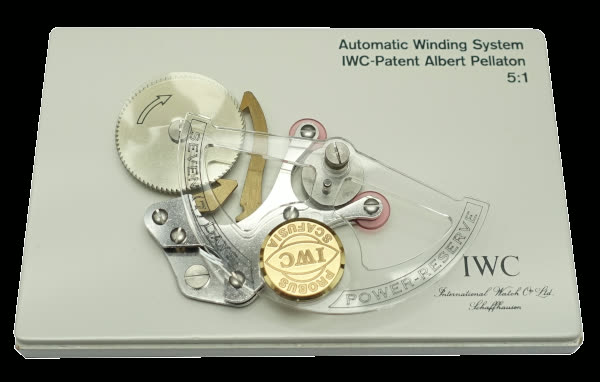
Photographs are illustrative examples of the type, not necessarily the exact object described. Verify details against the source file page.
Sources & references
- Albert Pellaton, Wikipedia (German), retrieved 2026-10-27 (text CC BY-SA 4.0)
- Pellaton, Albert, Watch-Wiki, retrieved 2026-10-27
- Britten, F. J., Old Clocks and Watches and Their Makers
- Loomes, B., reference works on British and European clockmakers (edition-dependent)
- Museum catalogue entries for signed examples
Where sources disagree, the disagreement is stated rather than resolved silently.