
Europe · Early 15th century
The Mainspring and the First Spring-Driven Clocks
Historical attributionSpring power freed the clock from the wall: it made table clocks possible and led to the first pocket watches by 1600, and every mechanical watch still runs on a mainspring.
A coiled spring replaced the falling weight as the power source of clocks in fifteenth-century Europe, making small portable clocks possible and leading to the first pocket watches by 1600.
Background
Mainsprings appeared in 15th-century Europe as a power source for portable timepieces, replacing the weight hanging from a cord that powered earlier mechanical clocks. While many sources erroneously credit the invention of the mainspring to the Nuremberg clockmaker Peter Henlein around 1511, 15th-century sources contain references to portable clocks without weights. Coiled springs were likely utilized in clocks because they had already been applied in locks around 1400, a field in which many early clockmakers were also employed.
The Burgunderuhr, or Burgundy Clock, is the oldest surviving example of a spring-driven clock, with its decoration suggesting it was made around 1430 for Philip the Good. Because a mainspring's torque diminishes as it unwinds, which affects the rate of the timepiece, early makers developed the stackfreed and the fusee to provide more consistent power. The first mainsprings were made of non-tempered steel, and because they did not run for very long, they required winding twice a day.
Written from the encyclopedia entries listed under Sources; each statement was checked against the cited text.
How it works
- The stackfreed was an eccentric cam that provided a strong opposing force when the mainspring was pushing strongly and a weaker force as it decreased.
- The fusee is a cone-shaped pulley that changes the mechanical advantage to even out the force of the mainspring as it runs down.
Later history
- The stackfreed was used in some German timepieces but was abandoned after about a century.
- Fusees were the standard method of evening out torque from the first spring-driven clocks until the 19th century.
Impact on watchmaking
- Germanisches Nationalmuseum — Holds the Burgunderuhr (Burgundy Clock), the oldest surviving clock powered by a mainspring.
- Fusee Stopwork (Maintaining Power and Overwind Prevention) — The fusee and its stopwork, the long-lived answer to the spring's uneven pull.
- Going Barrel (Fuseeless Mainspring Drive) — The going barrel, which eventually replaced the fusee in most watches.
How to verify this yourself
Check the cited museum record or maker's archive first; for patented work, confirm the number and date from the specification itself (Espacenet covers most European, US and Japanese patents) rather than from secondary retellings.
Manufacturers known to have used it
- Fifteenth-century chamber-clock makers in Burgundy and southern Germany
- All later spring-driven clock and watch makers
Related photographs
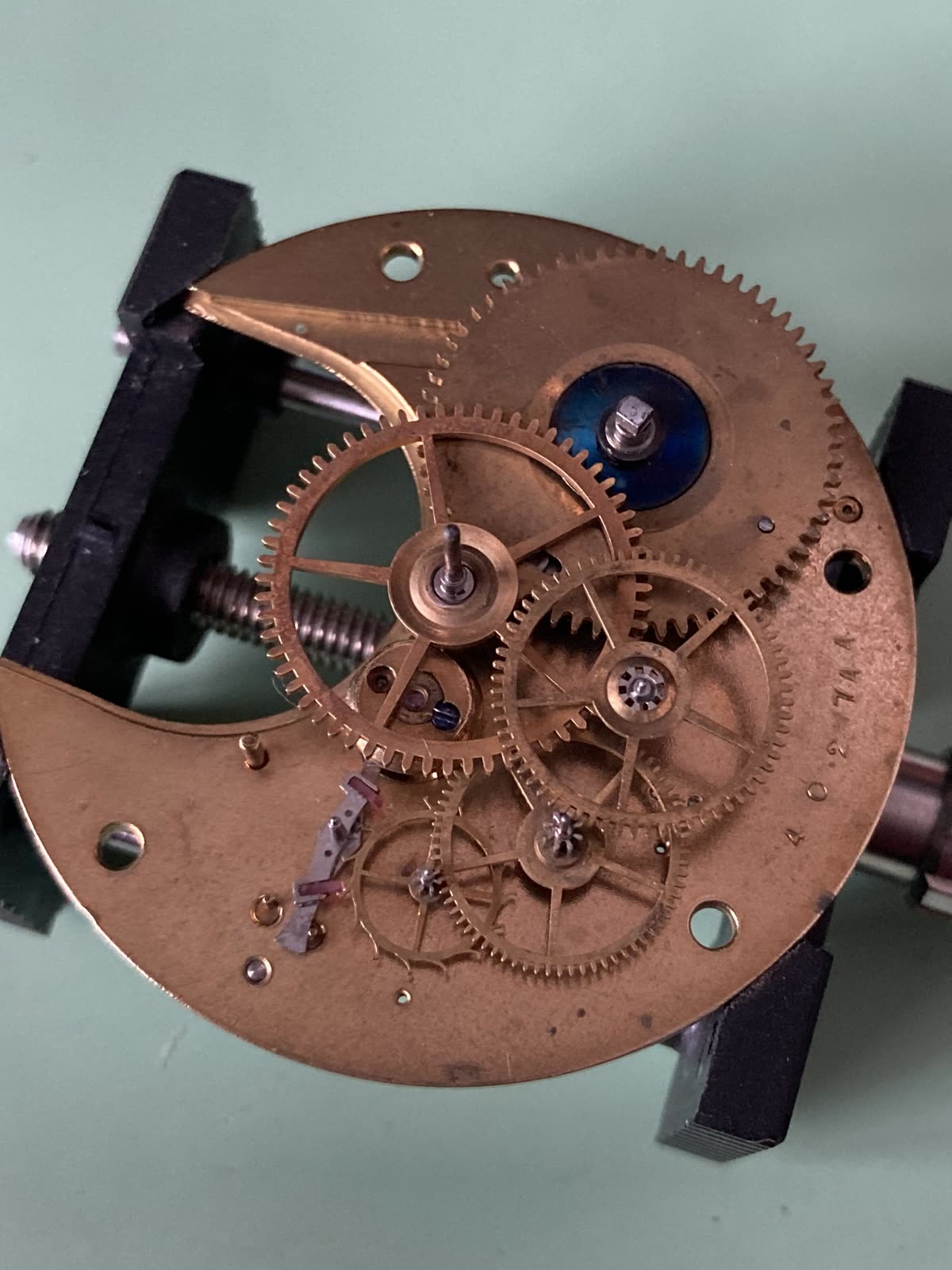
No confidently matched photograph of this subject has been found yet. These photographs show a closely related record, and are not examples of the type described on this page.
Sources & references
- Mainspring, Wikipedia (English), retrieved 2026-11-02 (text CC BY-SA 4.0)
- Wikipedia, Mainspring (revision cited below)
Where sources disagree, the disagreement is stated rather than resolved silently.