
Engraved form watch · England, London
Octagonal watch signed Robert Grinkin
Partially verifiedThe octagonal watch has an engraved silver and brass case, brass dial, silver chapter ring and single hand. Its movement bears the name Robert Grinkin. The museum discusses two London watchmakers of that name, father and son, and suggests that the earlier date may point to the elder. A signature and a plausible date do not remove that qualified identity.
Technical facts
- Accession number
- M.3-2003
- Catalogue record
- O73510
- Dimensions, as catalogued
- Height 5.1 cm; Width 3.1 cm; Depth 2.0 cm
- Catalogue date discrepancy
- ca. 1610–1620 narrative/date field; about 1640 brief description
- Authorship qualifier
- Possibly Robert Grinkin senior; not conclusively identified
- Recorded history
- Movement altered; case engraving rubbed by wear
Historical significance
- The octagonal watch has an engraved silver and brass case, brass dial, silver chapter ring and single hand. Its movement bears the name Robert Grinkin. The museum discusses two London watchmakers of that name, father and son, and suggests that the earlier date may point to the elder. A signature and a plausible date do not remove that qualified identity.
- The production-date field and narrative give about 1610–1620, whereas the brief description describes case and dial as English, about 1640. That inconsistency is recorded here as an unresolved catalogue discrepancy. It is not evidence for a separately verified recasing date. The movement has a verge escapement and gut-driven fusee, according to the physical description.
- The museum says the original movement was altered to prolong use and the case decoration, including scenes from the life of Jesus Christ, is heavily rubbed by wear. Those observations distinguish alteration from the survival of an unchanged early watch. The photograph shows an exterior case view; it is not a measurement of wear or a view of the modified movement.
- Current operation, service history and public display have not been verified. Conservation comes before restoration and repair; a qualified specialist should assess the object before opening, winding or intervention.
Photographs
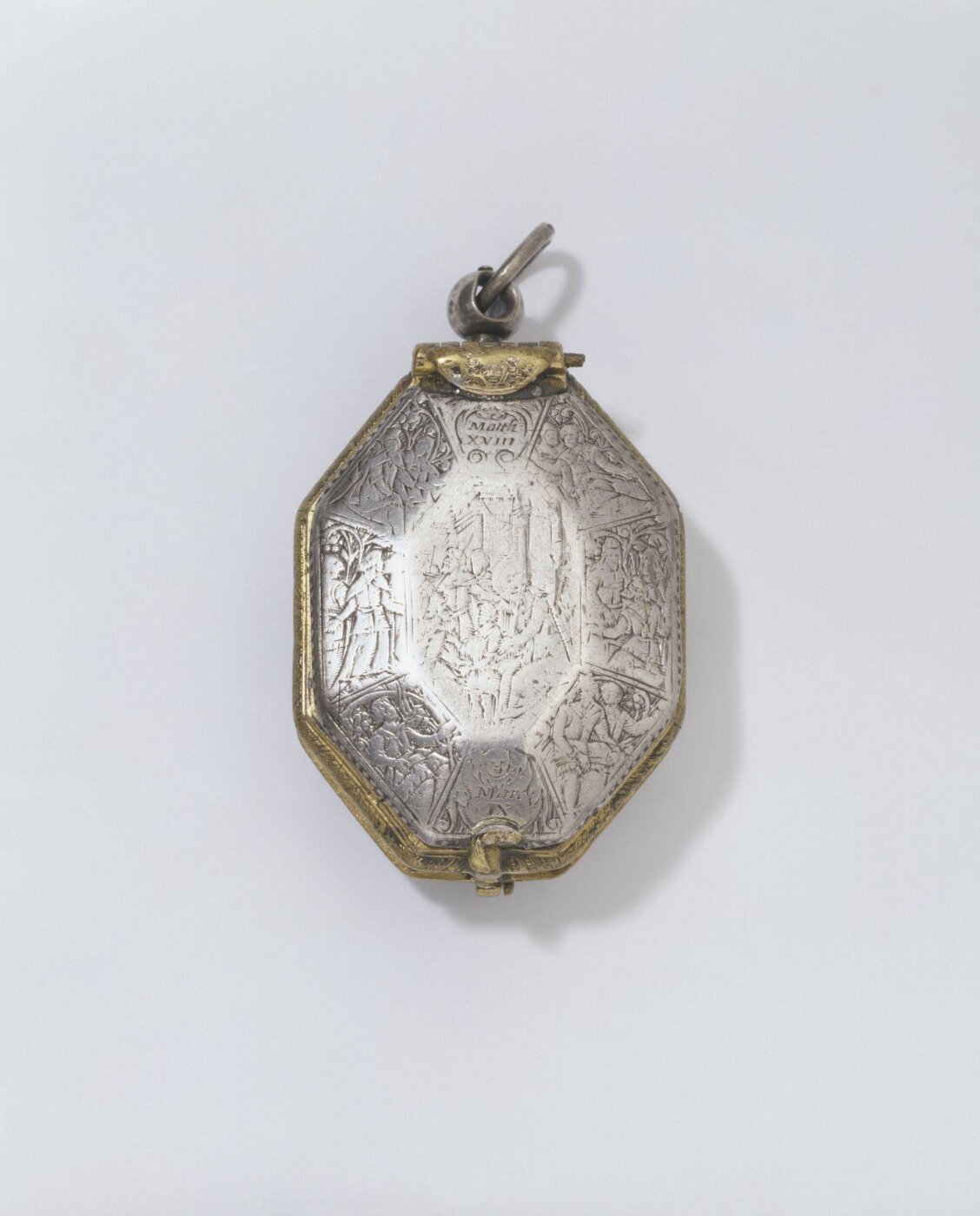
Photographs are illustrative examples of the type, not necessarily the exact object described. Verify details against the source file page.
Sources & references
Where sources disagree, the disagreement is stated rather than resolved silently.