
Paired mantel clock and companion pocket watch, with a mechanism to synchronise and rewind the watch · France
Breguet Pendule Sympathique (clock-and-watch pair)
Partially verifiedBreguet devised a system in which a specially made pocket watch is placed into a cradle atop a companion mantel clock overnight; the clock mechanism engages the watch to correct its time to match the clock and, in some versions, to wind it, a highly sophisticated mechanical solution to the everyday problem of keeping a portable watch accurately set.
Technical facts
- Mechanism
- Mechanical coupling engaging the watch's setting (and in some versions winding) works when seated in the clock's cradle
- Typical complication
- Clock often incorporates its own additional complications (e.g. perpetual calendar or equation of time) independent of the paired watch
Historical significance
- Breguet devised a system in which a specially made pocket watch is placed into a cradle atop a companion mantel clock overnight; the clock mechanism engages the watch to correct its time to match the clock and, in some versions, to wind it, a highly sophisticated mechanical solution to the everyday problem of keeping a portable watch accurately set.
- Very few examples were made in Breguet's lifetime and each surviving pairing (clock plus its specific matched watch) needs individual provenance verification, since watch and clock were built as a matched pair and are only meaningful as documented sets, not as generic 'Breguet Sympathique' types.
Background
In Breguet's pendule sympathique the clock serves as the reference, because its pendulum movement is more precise than the portable watch. In the original system, a rod extends from the clock at midnight to insert into the watch, allowing the watch to compare its time and adjust its balance spring frequency. Breguet sold only five examples of this first generation until 1823, with a further unit sold by Antoine-Louis in 1830. A second generation was later developed by Louis Breguet, who added a winding function that made the clock more appealing to customers.
Written from the encyclopedia entries listed under Sources; each statement was checked against the cited text. Passages from sources in other languages are given in English translation.
Construction and mechanism
- The watch is placed in a cradle on the clock where it is automatically set to the correct time.
Later history
- A Sympathique set is held within the personal collection of Queen Elizabeth II.
Photographs
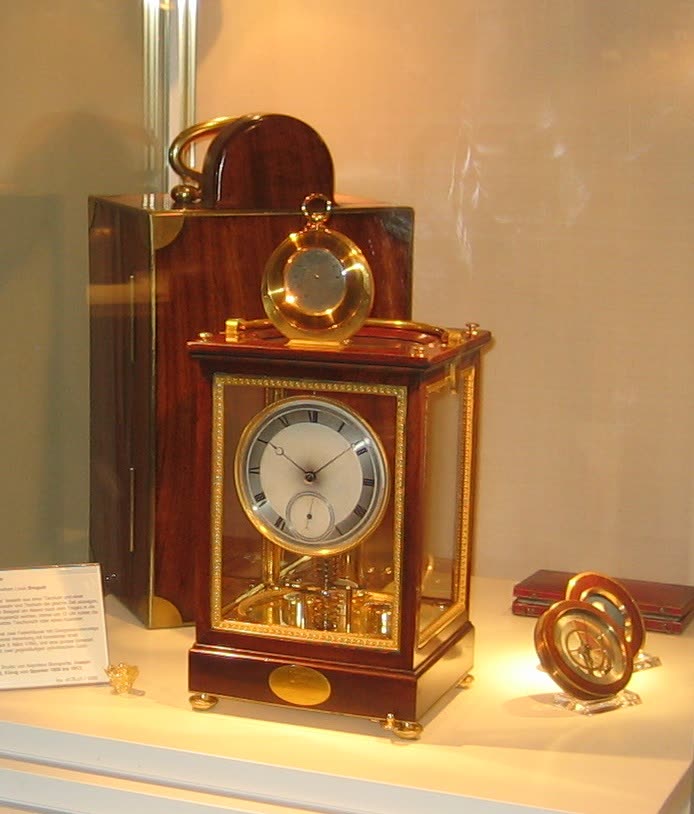
Photographs are illustrative examples of the type, not necessarily the exact object described. Verify details against the source file page.
Sources & references
- Pendule sympathique, Wikipedia (French), retrieved 2026-10-28 (text CC BY-SA 4.0)
- Abraham-Louis Breguet, Wikipedia (English), retrieved 2026-10-28 (text CC BY-SA 4.0)
- Daniels, G., The Art of Breguet
- Musée des Arts et Métiers, published collection materials on Breguet's work
Where sources disagree, the disagreement is stated rather than resolved silently.