
Grande complication pocket watch · France
Breguet No. 160 'Marie-Antoinette'
Partially verifiedReportedly commissioned by an admirer of Marie-Antoinette with instructions to use gold wherever possible and to include every complication then known, though the details and even the identity of the commissioner are recorded through secondary Breguet-company tradition rather than a surviving original commission letter, and should be treated with appropriate caution.
Technical facts
- Complications
- Perpetual calendar, minute repeater, equation of time, power reserve, thermometer, among others
- Case
- Gold, per the reported original brief to use gold wherever technically possible
- A replica
- Breguet (the modern company) produced a reconstruction, sometimes displayed alongside discussion of the original — researchers should be careful to distinguish the original No. 160 from the modern replica in photographs and museum labels
Historical significance
- Reportedly commissioned by an admirer of Marie-Antoinette with instructions to use gold wherever possible and to include every complication then known, though the details and even the identity of the commissioner are recorded through secondary Breguet-company tradition rather than a surviving original commission letter, and should be treated with appropriate caution.
- Took decades to complete and was finished only after Breguet's death by his son and successors.
- Stolen from the L. A. Mayer Museum for Islamic Art, Jerusalem, in 1983 and recovered in 2007; the theft and recovery are themselves well-documented and important provenance events for the object.
Background
The Breguet No. 160, known as the Marie-Antoinette, is a case watch designed by the Swiss watchmaker Abraham-Louis Breguet. It is believed to have been commissioned in 1783 by an admirer of the French Queen, possibly the Swedish count Axel von Fersen the Younger. The watch was designed to include every watch function known at that time and contains 823 individual components. Construction of the timepiece involved the use of high-quality materials including gold, platinum, rubies, and sapphires.
Written from the encyclopedia entries listed under Sources; each statement was checked against the cited text.
Construction and mechanism
- The watch utilizes a shock protection system called the Pare-Chute, which was invented by Breguet himself.
- Sapphires were integrated into the mechanism specifically to help decrease friction.
- The exterior case is constructed from gold, and the face is clear to allow visibility of the movement's gears.
Later history
- On 17 April 1983 the watch was stolen from the L. A. Mayer Institute for Islamic Art with 105 other timepieces from the Salomons collection; it was among the 39 recovered in 2007.
- The watch has previously been owned by Sir Spencer Brunton and the expert Sir David Lionel Salomons.
- A replica of the watch was commissioned in 2005 and completed three years later.
Where sources differ
- Date. This record gives: “completed 1827”. The history cited below states that work began in 1783, stopped for about seven years during Breguet's exile, and was finished in 1802.
Photographs
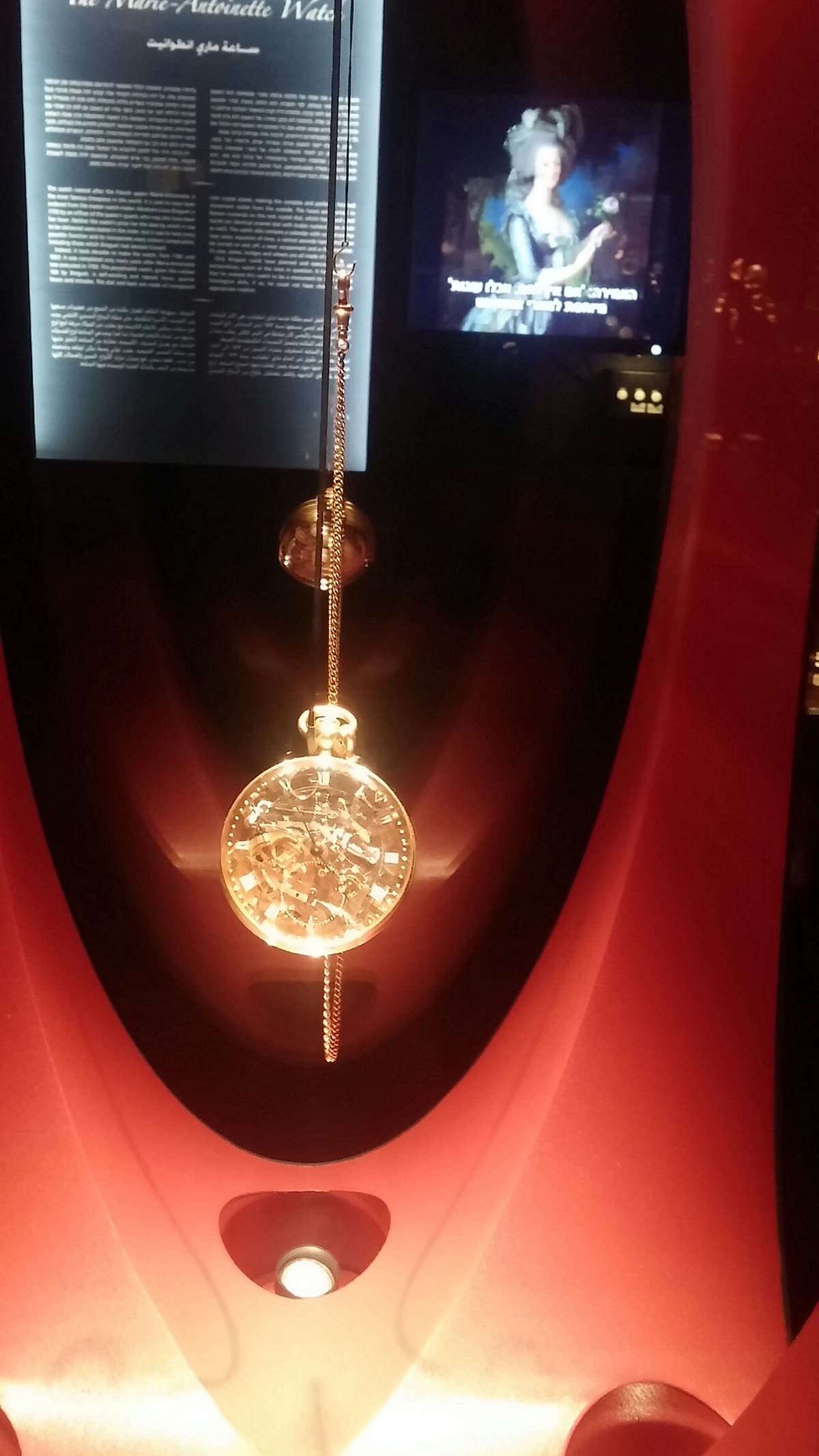
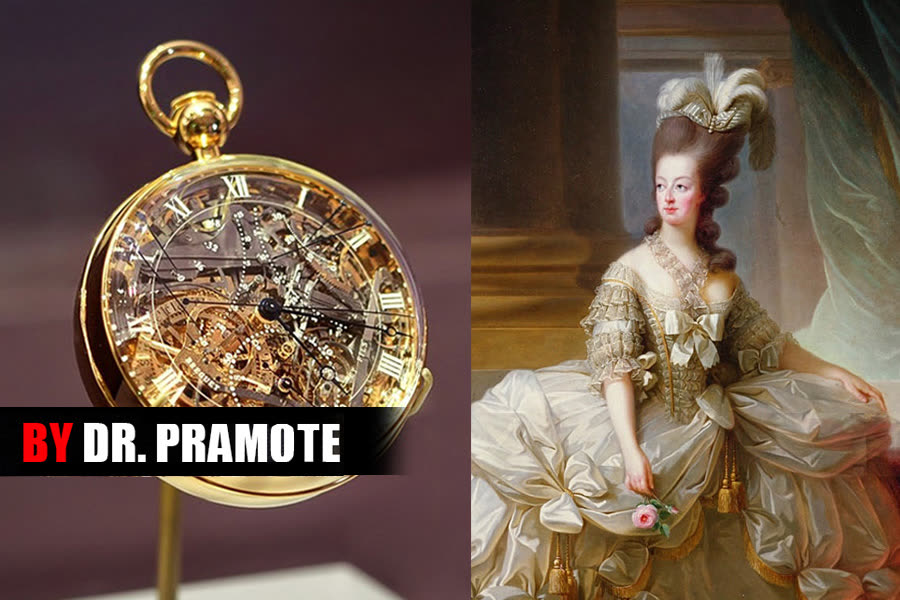
Photographs are illustrative examples of the type, not necessarily the exact object described. Verify details against the source file page.
Sources & references
- Marie Antoinette (watch), Wikipedia (English), retrieved 2026-10-28 (text CC BY-SA 4.0)
- L. A. Mayer Museum for Islamic Art, published provenance and theft/recovery history
- Breguet company, published historical materials (commissioning legend treated as company tradition, not independently documented)
Where sources disagree, the disagreement is stated rather than resolved silently.