
Museum · London, United Kingdom
The Clockmakers' Museum
Collection of the Worshipful Company of Clockmakers, strong in early English watches.
Overview
The Clockmakers' Museum is the collection of the Worshipful Company of Clockmakers and is displayed at the Science Museum in London. The collection and the host institution are distinct: a citation should identify the Clockmakers' collection when that is the provenance of the object, rather than assigning every exhibited piece to the Science Museum's own collection.
The exhibition follows the work of London clock and watch makers from early modern craftsmanship into later precision timekeeping. Its objects include watches and clocks as well as evidence of the makers who produced them. John Harrison's H5 belongs to this setting; it should not be confused with H1–H4 at Greenwich.
For research on an English maker, an exhibition object provides a comparison point for signatures, layout and finish. A company connection or a shared surname is not sufficient evidence that two works came from the same hand. Consult the collection information for each object and record the exact attribution, including any uncertainty.
Collection focus
- The Worshipful Company of Clockmakers' collection
- London clock and watch making
- John Harrison's H5 marine timekeeper
Catalogued timepieces and instruments
Exact collection records with credited photographs. Institutional holdings do not establish current display or public research access.
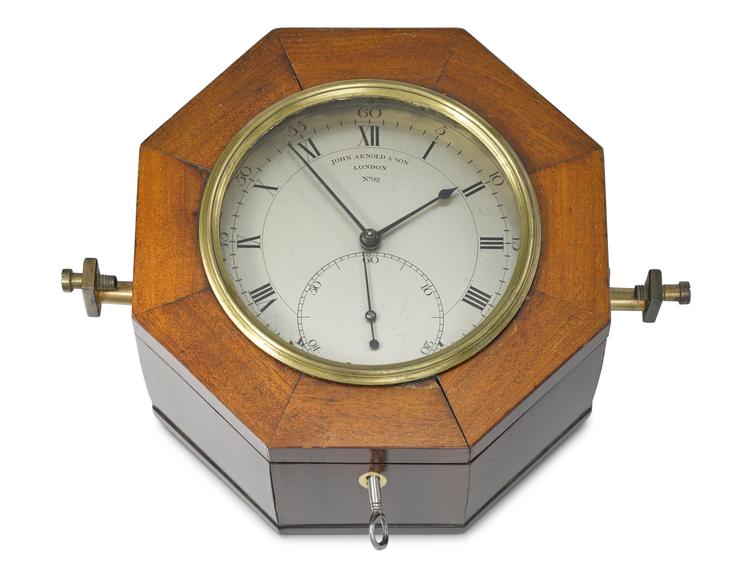 c. 1795John Arnold & Son marine chronometer No. 92The Clockmakers’ Museum record describes a spring-detent marine chronometer signed “John Arnold & Son, London No. 92 Invt. et Fect”. Its institutional identifier is L2015-3486; the historical museum number is 604.
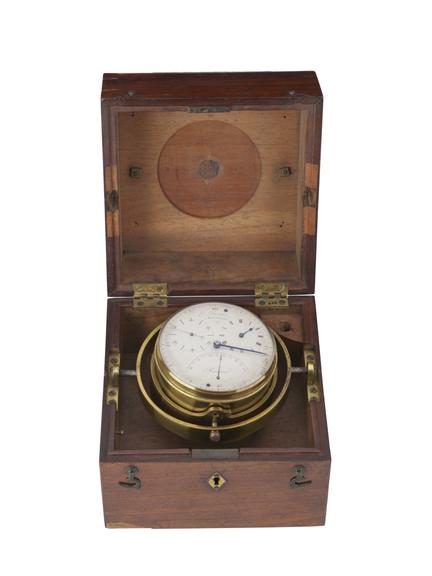 c. 1840E. Barthet marine chronometer No. 10Science Museum Group catalogues this chronometer as L2015-3496, historical Clockmakers’ Museum number 620. Its silvered dial has a central minute hand, subsidiary hours and seconds, and a thermometer marked for the Réaumur scale.
Using it for research
- Record both the collection name and its Science Museum display location.
- Distinguish Harrison's H5 here from H1–H4 at Greenwich.
- Check the stated maker attribution rather than relying on surname matching.
Before you visit
General visiting guidance; institution-specific arrangements have not been verified here.
- Confirm opening arrangements, temporary closures and photography rules directly with the institution before travelling — this encyclopedia does not record them.
- Working clocks and automata may be demonstrated only at set times.