
Component record · Dial & hands
Moonphase Disc
Partially verifiedA disc painted or printed with two moons, rotating behind a shaped aperture so that the visible moon waxes and wanes.
What it does
Displays the phase of the moon through the lunar month.
How it works
A lunar month (synodic month) lasts about 29.5 days. A disc with two moons and fifty-nine teeth, advanced one tooth a day, completes one turn in two lunations, so each moon crosses the aperture in about 29.5 days.
Because 29.5 days is only an approximation, the standard fifty-nine-tooth disc gains about a day on the moon in roughly two and a half years and needs occasional correction.
More precise trains, such as those with a 135-tooth moon wheel, reduce the error to about a day in more than a century.
Evolution
Moonphases became a popular decorative indication in twentieth-century wristwatches, and makers have competed on the precision of the lunar train.
Known variations
- Fifty-nine-tooth standard disc
- High-precision lunar trains
- Moon age scales printed around the aperture
Identification for collectors
- The shaped 'humps' of the aperture conceal the moon as it waxes and wanes
Common failure modes
- Worn teeth or jumper
- Disc set incorrectly after service
- Faded or damaged painting
Photographs
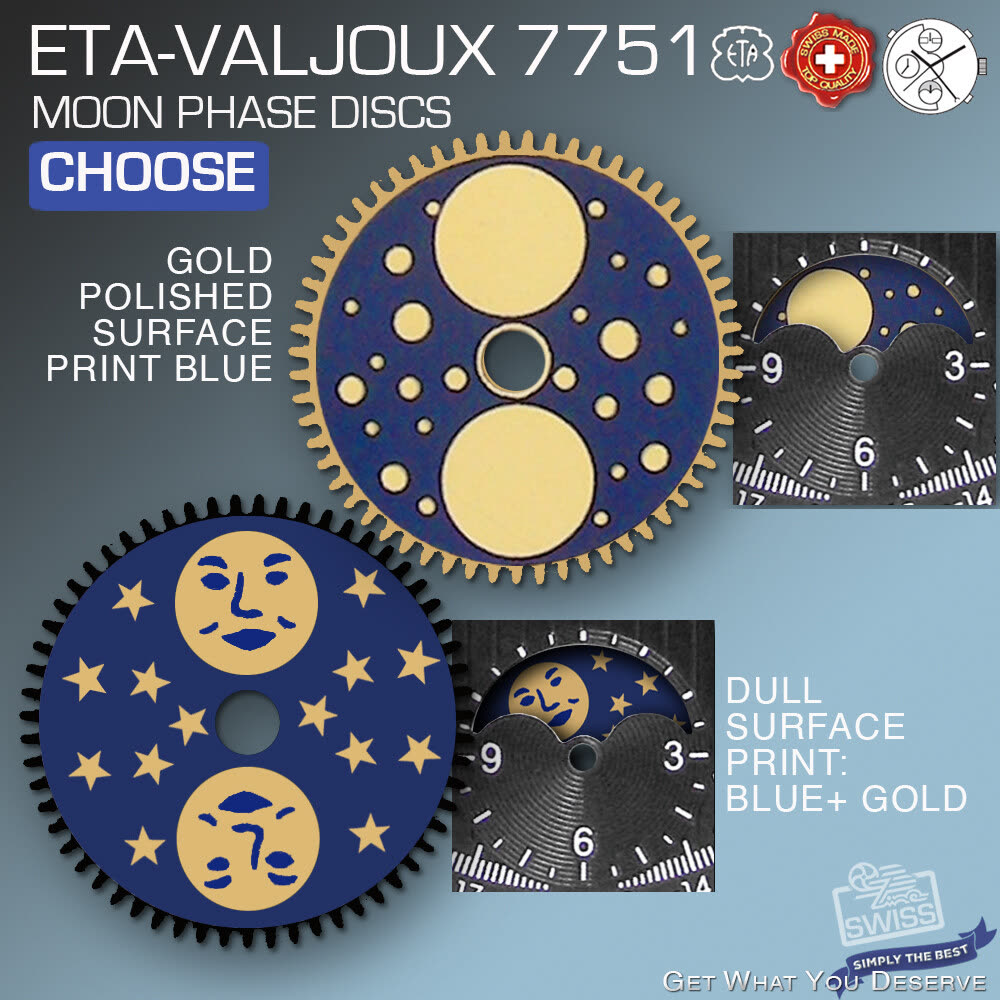
Photographs are illustrative examples of the type, not necessarily the exact object described. Verify details against the source file page.
Sources & references
- de Carle, D., Practical Watch Repairing
- de Carle, D., Watch and Clock Encyclopedia
- Fried, H. B., The Watch Repairer's Manual
- Daniels, G., Watchmaking
Where sources disagree, the disagreement is stated rather than resolved silently.