
Component record · Dial & hands
Date Ring
Partially verifiedThe toothed ring (or disc) under the dial printed with the numerals 1 to 31, shown one at a time in a dial aperture.
What it does
Displays the date, advanced one tooth per day by the calendar finger and held in place by the jumper.
How it works
A simple date ring has thirty-one teeth. It cannot know the length of the month, so in a simple calendar the wearer corrects it after months with fewer than thirty-one days.
Big-date displays use two discs, one for units and one for tens, read side by side through a larger aperture, to give legible numerals.
Printing style, colour and the position of numerals are calibre- and market-specific, and help judge whether a ring is original to a watch.
Evolution
Quick-set mechanisms spared wearers advancing the ring through the hands, and annual and perpetual calendars added programmes that allow for month length.
Known variations
- Standard thirty-one-tooth ring
- Two-disc big-date systems
- Rings with coloured or alternating numerals
Identification for collectors
- Font and colour can identify a service replacement ring
- Numerals off-centre in the aperture suggest a wrong ring or jumper problems
Common failure modes
- Chipped teeth
- Worn or flaking printing
- Ring rubbing on the dial
Photographs
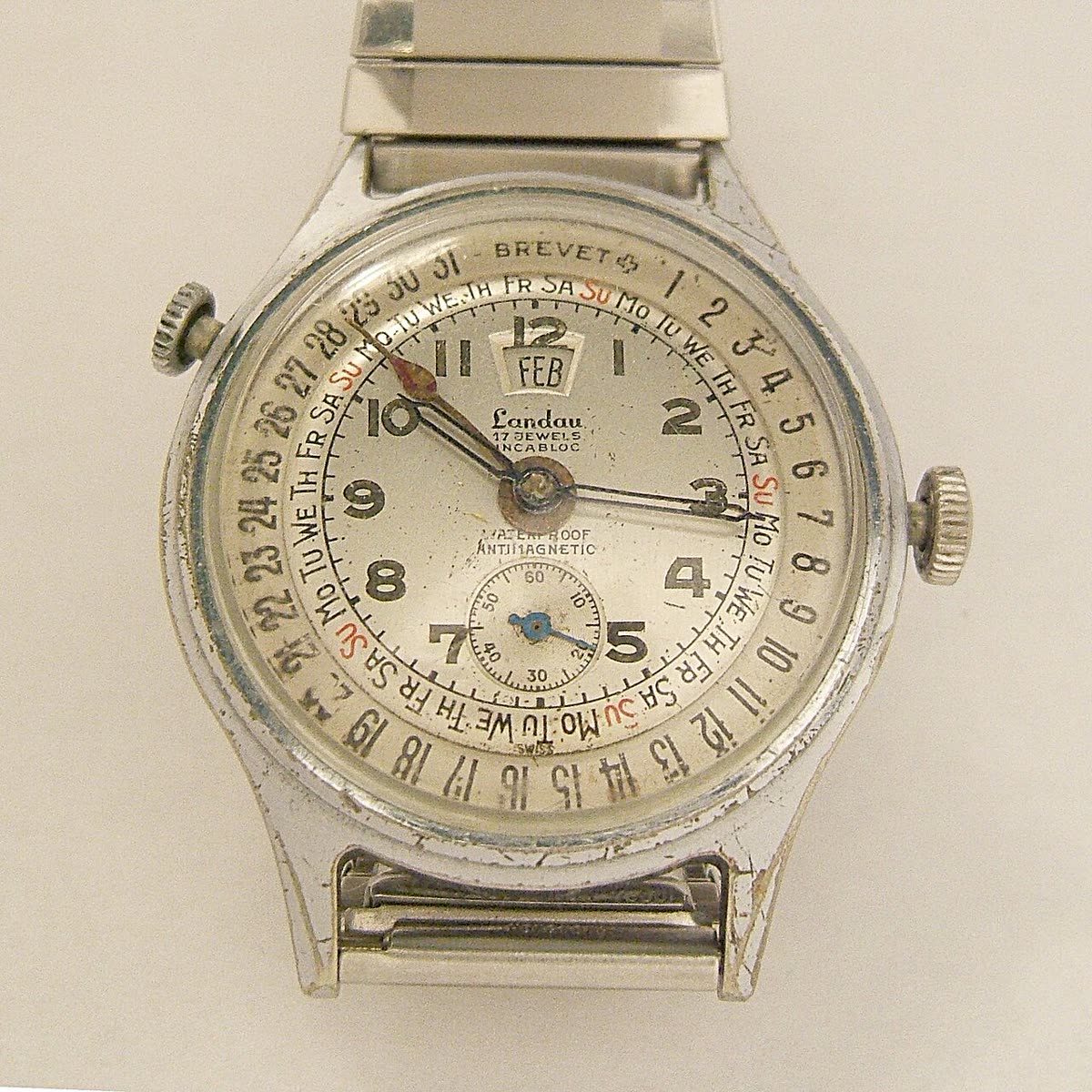
Photographs are illustrative examples of the type, not necessarily the exact object described. Verify details against the source file page.
Sources & references
- de Carle, D., Practical Watch Repairing
- de Carle, D., Watch and Clock Encyclopedia
- Fried, H. B., The Watch Repairer's Manual
- Daniels, G., Watchmaking
Where sources disagree, the disagreement is stated rather than resolved silently.