
Component record · Plates & finishing
Minute Wheel Bridge
Partially verifiedA small plate or cock on the dial side of the main plate that holds the minute wheel (and sometimes other motion-work or setting wheels) in place.
What it does
Keeps the motion-work wheels at the right height so that the hour wheel and cannon pinion mesh correctly and the hands do not tilt.
How it works
The minute wheel is driven by the cannon pinion and in turn drives the hour wheel through its pinion. A bridge over it prevents it from lifting and fouling the hour wheel or the dial.
In many calibres the same bridge also retains the setting wheels and forms part of the keyless cover plate.
When fitting it, the wheels must be free with slight end-shake; a bridge tightened onto a mis-seated wheel stops the hands.
Evolution
Combined bridges for motion and setting work became common as keyless work was standardised.
Known variations
- Separate minute-wheel bridge
- Combined keyless cover plate
Identification for collectors
- A small plate under the dial beside the cannon pinion, covering the minute wheel
Common failure modes
- Bent bridge causing hands to stop or bind
- Lost screws
Photographs
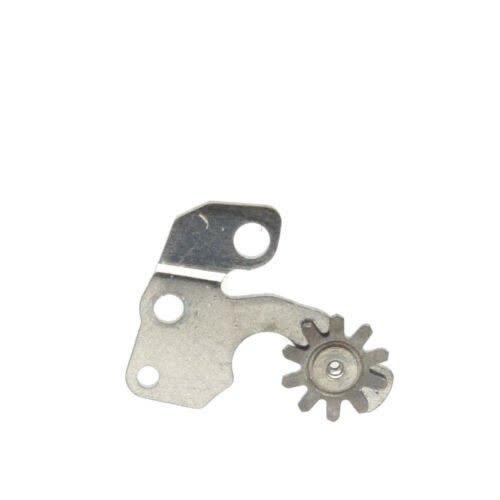
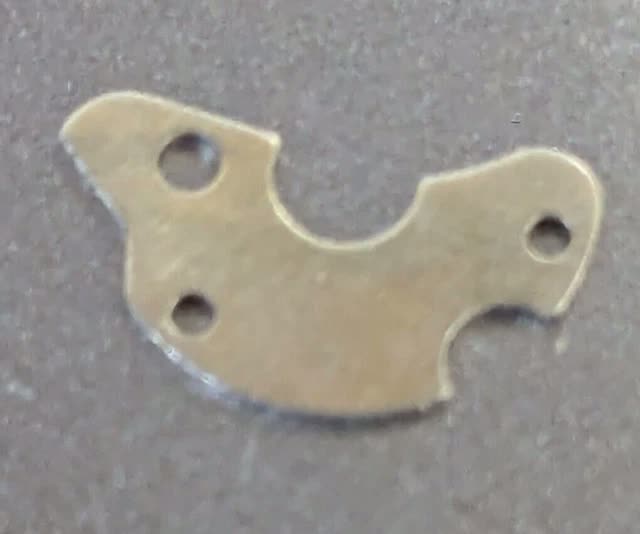
Photographs are illustrative examples of the type, not necessarily the exact object described. Verify details against the source file page.
Sources & references
- de Carle, D., Practical Watch Repairing
- de Carle, D., Watch and Clock Encyclopedia
- Fried, H. B., The Watch Repairer's Manual
- Daniels, G., Watchmaking
Where sources disagree, the disagreement is stated rather than resolved silently.