
Complication · Timing
1/1000th Second Chronograph
Partially verifiedA mechanical chronograph capable of 1/1000th second resolution.
Definition
A mechanical chronograph capable of 1/1000th second resolution.
Historical origin
The pinnacle of mechanical timing precision.
How it works
Uses an ultra-high-frequency oscillator or a complex differential system to divide the seconds further.
Often features multiple high-speed registers.
Pocket watch context
None.
Wristwatch context
Exceedingly rare; achieved by TAG Heuer (Mikrotimer/Mikrogirder).
Identification
- Multiple fast-spinning hands
- Frequency far beyond a typical heartbeat sound
Servicing notes
More of a technical demonstration than a practical tool; requires extreme maintenance.
General guidance only. Complicated mechanisms should be assessed and serviced by a qualified watchmaker or clockmaker specialist, not adjusted at home.
Background
The 1/1000th second chronograph was introduced by TAG Heuer in 2011 with the Mikrotimer Flying 1000, which the manufacturer describes as the world's first mechanical wrist chronograph to measure and display 1/1,000th of a second. According to TAG Heuer, the movement eliminates the traditional balance wheel, replacing it with a rigid balance spring that vibrates at a speed of 3,600,000 beats per hour. Engineers developed a system named the Launcher-Hub-Brake System, which is controlled by a column wheel and utilizes the rigidity of the balance spring to manage high-frequency operation.
Solid lubrication and specialized surface materials were employed to address the friction issues inherent at such high speeds. The watch features a dual-chain architecture, separating the timekeeping mechanism from the chronograph chain, each possessing its own energy source and regulating organ.
Written from the sources listed under Sources (makers, museums, auction houses and specialist publications are paraphrased, not reproduced); each statement was checked against the cited text, and claims a maker makes about its own work are attributed to it.
Construction and action
- The escapement uses mono-block pallets that rebound against the pallet wheel to generate a hyper-velocity impulse.
- The regulating organ for the chronograph achieves a frequency of 500 Hz.
- Components such as the central axis are constructed from a lightweight alloy of aluminum, titanium, and magnesium to minimize inertia.
Use and later history
- TAG Heuer went on to present the Mikrogirder, which it states measures time to 5/10,000ths of a second.
Photographs
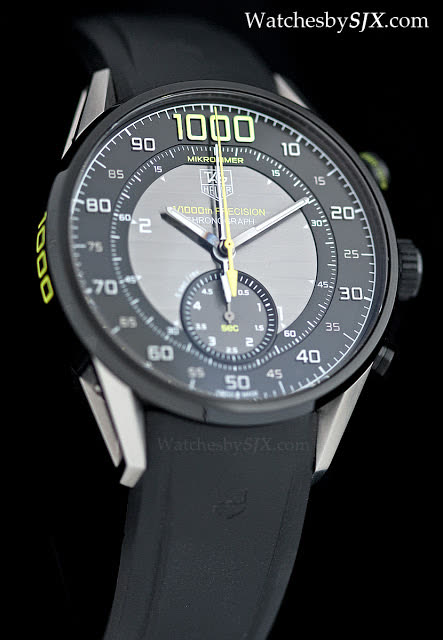
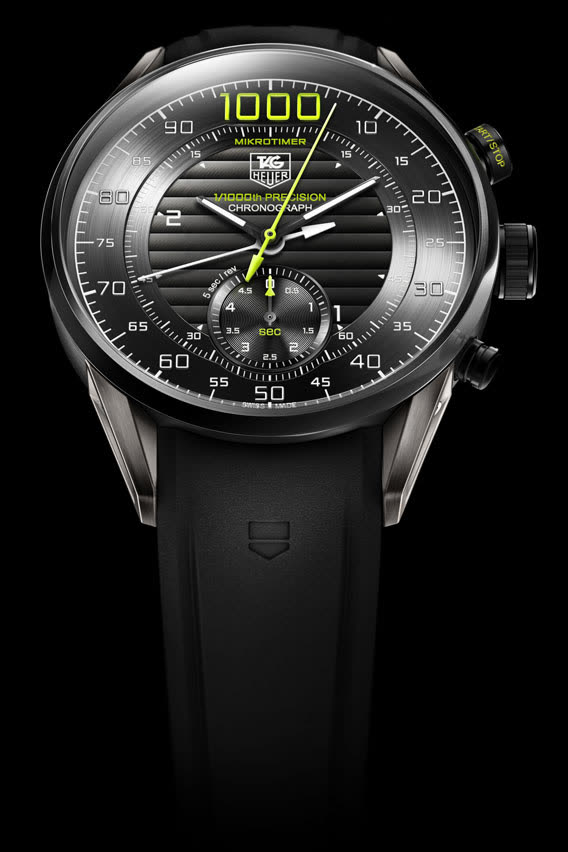

Photographs are illustrative examples of the type, not necessarily the exact object described. Verify details against the source file page.
Sources & references
- Mikrotimer Flying 1000, Worldtempus, retrieved 2026-10-30 (paraphrased; text © the publisher)
- TAG Heuer Mikrotimer Flying 1000 Concept Chronograph, Europa Star, retrieved 2026-10-30 (paraphrased; text © the publisher)
- Our haute horlogerie complications, TAG Heuer, retrieved 2026-10-30 (paraphrased; text © the publisher)
- de Carle, D., Watch and Clock Encyclopedia
- Britten, F. J., Old Clocks and Watches and Their Makers
- Horological Journal (British Horological Institute), technical articles
Where sources disagree, the disagreement is stated rather than resolved silently.