
Complication · Precision
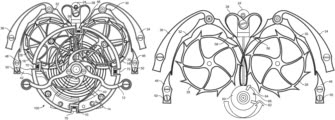
Double Escapement with Differential
Partially verifiedA movement using two separate balances and escapements linked by a differential gear.
Definition
A movement using two separate balances and escapements linked by a differential gear.
Historical origin
Averages the rates of two oscillators to improve overall accuracy.
How it works
A differential gear (similar to a car's) sits between the mainspring and the two escapements.
It distributes power to both and averages their output back to the hands.
Pocket watch context
Pioneered by Antide Janvier and later Ferdinand Berthoud.
Wristwatch context
Perfected in the modern era by Philippe Dufour (Duality) and Greubel Forsey.
Identification
- Two balance wheels beating simultaneously
- A differential gear visible in the centre
Servicing notes
Extremely difficult to regulate; both escapements must be closely matched.
General guidance only. Complicated mechanisms should be assessed and serviced by a qualified watchmaker or clockmaker specialist, not adjusted at home.
Background
A double regulator watch utilizes two independently operating balances connected by a differential mechanism to average their rates and improve overall accuracy. By adjusting one balance to run slightly fast and the other slightly slow, the rate variations across different positions tend to cancel each other out. The differential serves to link the two oscillators, distributing power from the gear train and outputting the average of the two frequencies to the hands.
Philippe Dufour, who created the Duality in 1996, describes the mechanism as requiring the differential to be shrunk to the size of a match head. If one balance stops, the remaining balance continues to operate, though the rate at which the seconds hand completes a revolution will change.
Written from the sources listed under Sources (makers, museums, auction houses and specialist publications are paraphrased, not reproduced); each statement was checked against the cited text, and claims a maker makes about its own work are attributed to it.
Construction and action
- Opposed pinning points on the balance springs can further assist in canceling positional errors in the vertical positions.
Use and later history
- Hodinkee reports that the Duality is based on double-balance pocket watches made at the Vallée de Joux watchmaking school in the 1930s, with a single gear train feeding two balances through a differential.
- Phillips notes the Philippe Dufour Duality was the first dual escapement wristwatch, introduced in 1996.
Photographs
Photographs are illustrative examples of the type, not necessarily the exact object described. Verify details against the source file page.
Sources & references
- How the Philippe Dufour Duality actually works, as explained by Philippe Dufour, Hodinkee, retrieved 2026-10-30 (paraphrased; text © the publisher)
- How watchmakers try to make two balances better than one, Hodinkee, retrieved 2026-10-30 (paraphrased; text © the publisher)
- What Makes Philippe Dufour's Duality So Important, Phillips, retrieved 2026-10-30 (paraphrased; text © the publisher)
- de Carle, D., Watch and Clock Encyclopedia
- Britten, F. J., Old Clocks and Watches and Their Makers
- Horological Journal (British Horological Institute), technical articles
Where sources disagree, the disagreement is stated rather than resolved silently.