
Clock type · Domestic
Bornholm Clocks
Partially verifiedA Danish tradition of longcase clocks made on the Baltic island of Bornholm, developed after English movements salvaged from a wrecked ship reputedly gave local smiths their first close model for domestic clockmaking, and continuing as a distinct regional case and movement style into the nineteenth century.
Background
According to the traditional account, the craft began after a Dutch ship carrying clocks was wrecked near Bornholm in 1744, giving the local craftsman Poul Ottesen Arboe the chance to study their mechanisms. These clocks are powered by weights and regulated by a pendulum.
The Arboe family, including Peter and Otto Arboe, became recognized as notable manufacturers of these timepieces. The movements were housed in locally made cases reflecting architectural styles such as Baroque and Empire.
Written from the sources listed below; each statement was checked against the cited text.
Recognising one
- Clocks with a straight top line are referred to as a 'hanbornholmer' or male.
- Clocks featuring ornate headpieces are known as 'frøkener' or 'koner' and take inspiration from the floral decorations on the traditional Bornholm female bonnet.
Condition and survival
- Production of Bornholm clocks continued at the Svendborg workshop in Rønne until 2015.
Where sources differ
- Period. This guide records: “c. 1745 – 1900s”. The documented production period on the island concluded in the early twenty-first century.
Movement & mechanism
- Weight-driven eight-day movements broadly following English longcase practice, with anchor escapement and rack or locking-plate striking
- Movement plates and wheel work made locally by Bornholm smiths and later a small organised local trade, rather than imported wholesale from England
- Seconds pendulum typical of the mature Bornholm longcase tradition, as in English practice
Identification
- Regional Danish case styling and painted decoration distinct from mainstream English or Dutch longcase cases
- Maker's names typically in Danish, sometimes with the specific Bornholm town of manufacture inscribed on the dial
- Movement construction generally follows English eight-day longcase conventions but executed by Danish makers
Terminology
- Bornholmerur — the Danish term for a Bornholm clock
Known variations
- Early Bornholm longcase clocks following closely English models
- Later nineteenth-century Bornholm production with distinct local case decoration
Collecting notes
Bornholm clocks form a well-recognised Danish regional collecting field distinct from, but influenced by, English longcase practice; because the founding narrative involving an English shipwreck is a widely repeated trade tradition rather than a fully documented historical event in every retelling, it should be treated as traditional attribution pending specific verification for any individual clock.
Photographs
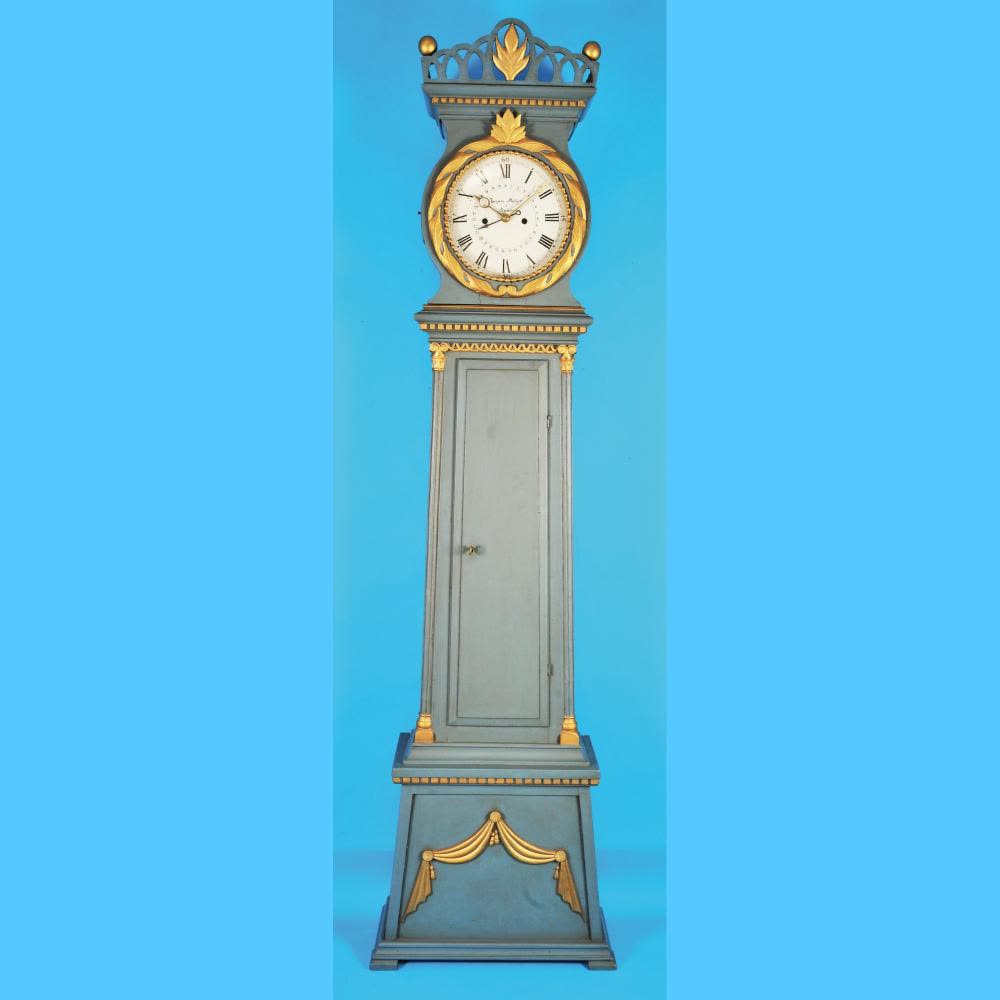
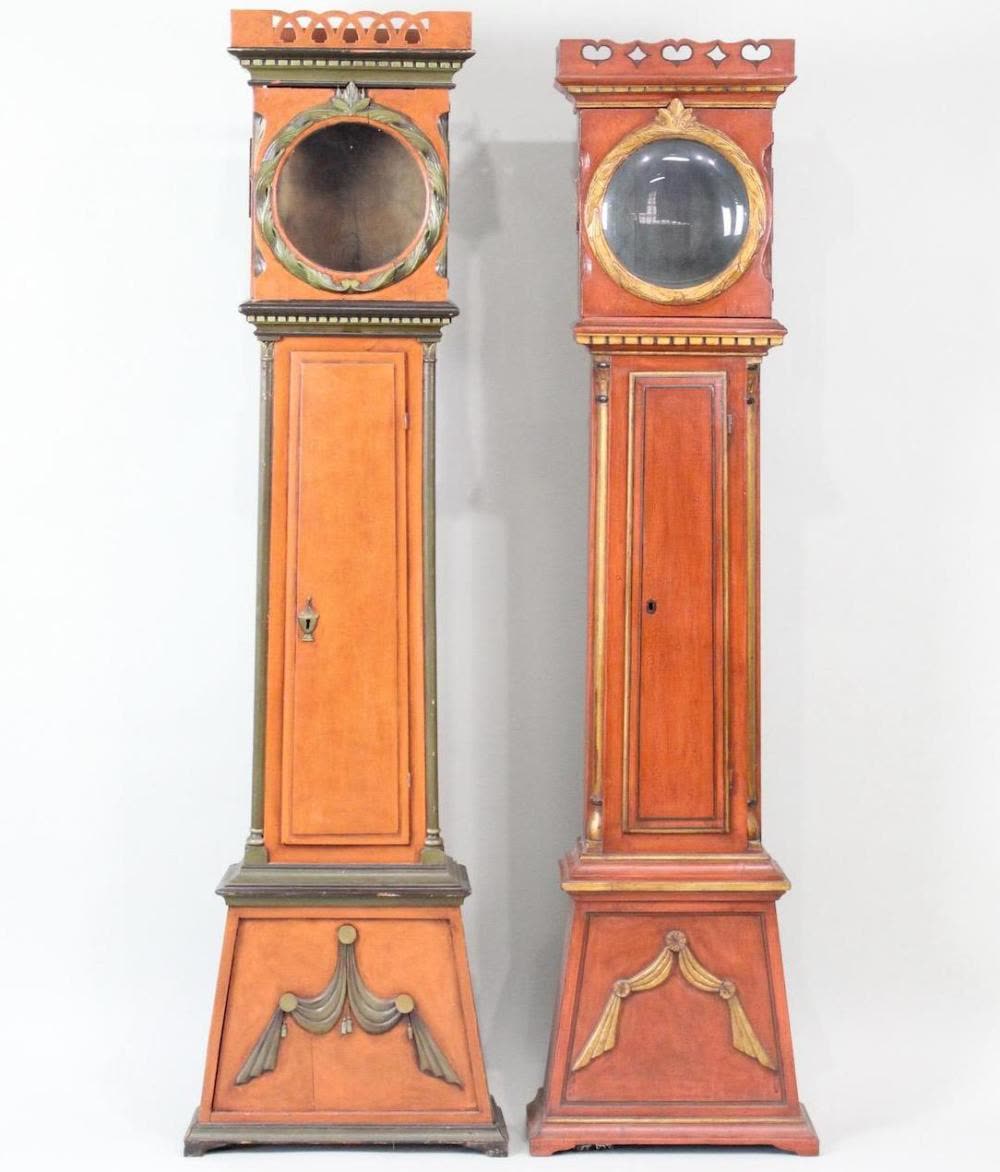
Photographs are illustrative examples of the type, not necessarily the exact object described. Verify details against the source file page.
Sources & references
- Bornholmerur, Wikipedia (Danish), retrieved 2026-10-28 (text CC BY-SA 4.0)
- Britten, F. J., Old Clocks and Watches and Their Makers
- The founding shipwreck narrative associated with the Bornholm clockmaking tradition is a widely repeated trade account whose precise historical details are not independently verified here.
Where sources disagree, the disagreement is stated rather than resolved silently.