
Skip to content
The Encyclopedia of Horology

Clock · World time clock

Willis world clock

Partially verified

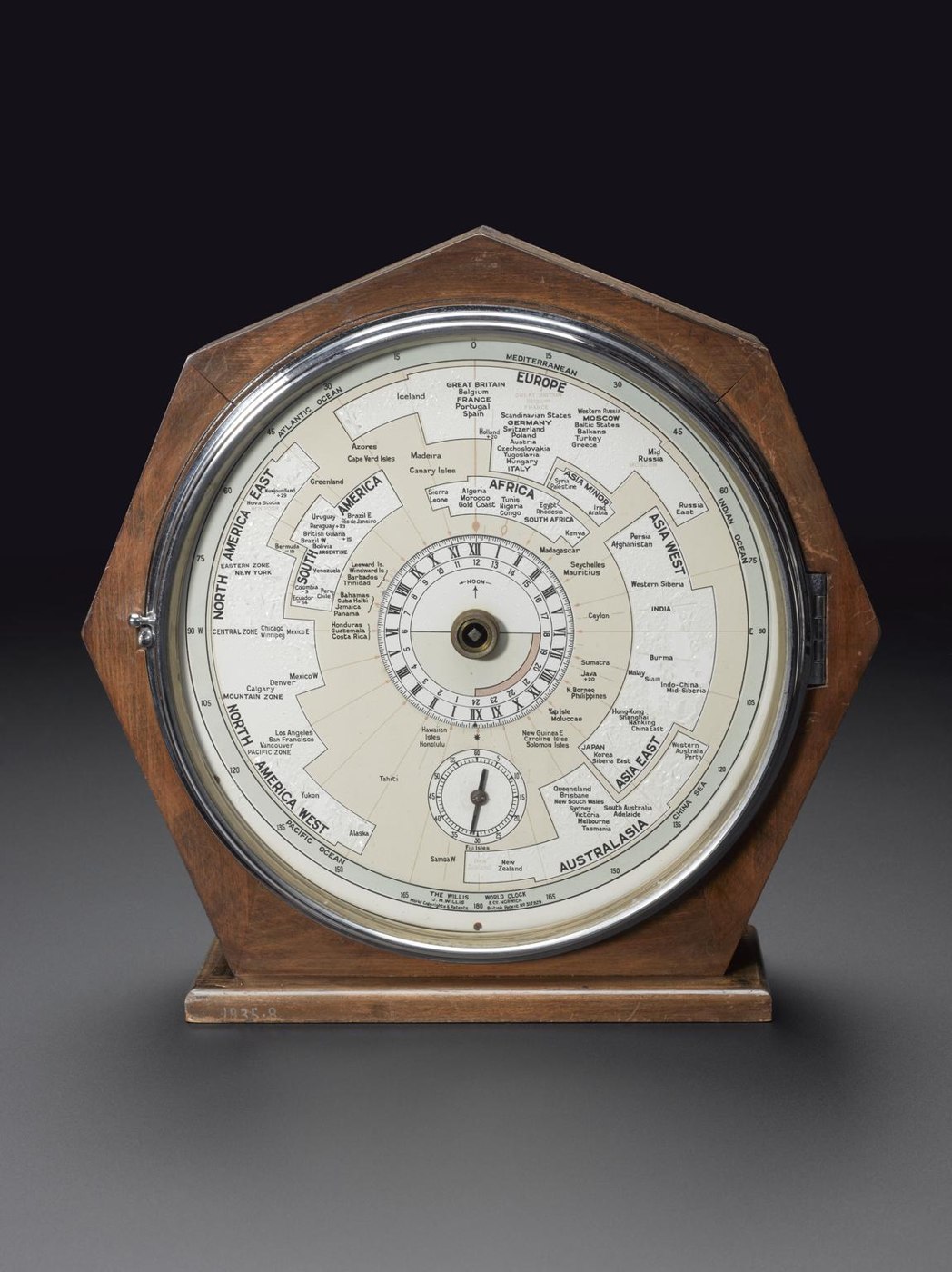
The Willis world clock is a horological instrument manufactured in Norwich, England, by J. H. Willis and Company between 1929 and 1935. Patented by John Henry Willis in 1929, the clock serves to indicate local time in various parts of the world. The mechanism features a central hour-indicating dial that rotates rather than employing traditional moving hands. Radial lines on the dial facilitate time tracking across international regions by connecting specific countries to an inner dial. A secondary, smaller subsidiary dial tracks minutes, which remain uniform across global time zones. Additional graphic indicators include names in red ink to denote regions observing summertime and asterisks to mark the beginning of a new day within a specific zone. The device is housed in a wooden casing and includes a dedicated winding key for operation.

Front view of the Willis world clock showing the dial with geographical time zones, the minute subsidiary dial, and the hexagonal wooden case.
Front view of the Willis world clock showing the dial with geographical time zones, the minute subsidiary dial, and the hexagonal wooden case. — Science Museum Group. Rights pending — permission not yet requested. Original source

Catalogue identity

Source
collection.sciencemuseumgroup.org.uk
Category
Clock · World time clock
Maker / attribution
J. H. Willis and Company
Reference
Not recorded
Catalogue / lot identifier
1935-8
Source-reported date
1929-1935
Source-reported place
England

Source-reported attribution and specifications are not independent authentication. A listing does not establish present ownership, current display, availability or permission to reproduce.

Object description

Design and Functionality

The Willis world clock is designed to display time across different global regions. The primary time-telling feature is a central, rotating dial that indicates the hour, dispensing with the conventional hand-and-dial arrangement. Surrounding this are radial lines that allow the user to correlate time between countries by tracing a line from a specific nation on the outer dial to the corresponding section on the inner dial.

Minutes are displayed on a separate, smaller subsidiary dial situated below the main clock face. This arrangement ensures that the minute indication remains consistent, as it is uniform regardless of the time zone. The clock includes specialized markers, such as asterisks for indicating the start of a new day and specific red-colored text to signify countries observing summertime adjustments.

Evidence for this section
  • “The central wheel was used to show the hour. Rather than a moving hand, the dial itself rotated.”
  • “The dial was also divided by radial lines, which could be used to track the hour in another country”
  • “Names in red were used to indicate those countries which changed their clocks for summertime.”

Construction and Specification

The object is contained within an approximately hexagonal wooden housing, measuring 320 mm by 330 mm by 90 mm. A hinged front cover fitted with a glass panel protects the clock face, providing access to the dial. The overall unit weighs 3.08 kg.

A dedicated metal winding key is included with the device to facilitate operation of the internal mechanism. The physical construction reflects its purpose as a functional desktop or stationary instrument for monitoring worldwide time.

Evidence for this section
  • “overall: 320 mm x 330 mm x 90 mm, 3.08kg”
  • “Example of the Willis world clock, with winding key”

Provenance and Documentation

The clock is identified by the accession number 1935-8 and is associated with the patent held by John Henry Willis, filed in 1929. The unit was produced in Norwich, England, by J. H. Willis and Company. The manufacture date range is documented as 1929 to 1935.

The device exists within the collection of the Science Museum Group, cited as an example of the Willis world clock patent.

Evidence for this section
  • “made by J. H. Willis and Company, Norwich, England, 1929-1935.”
  • “patented by John Henry Willis in 1929”

Open research questions

  • What is the specific internal gear configuration required to rotate the main dial vs the minute hand?
  • How many of these world clocks were manufactured by J. H. Willis and Company during this period?

Source evidence

Recorded claims and source quotations for Willis world clock
FieldSource-reported valueSource quotation
MakerJ. H. Willis and Company“made by J. H. Willis and Company”
PatenteeJohn Henry Willis“patented by John Henry Willis in 1929”
Place of originNorwich, England“Norwich, Norfolk, England, United Kingdom; Norwich”
Dimensions320 mm x 330 mm x 90 mm“overall: 320 mm x 330 mm x 90 mm”
Weight3.08kg“3.08kg”
Accession number1935-8“1935-8”
Summertime indicatorRed ink“Names in red were used to indicate those countries which changed their clocks for summertime.”

Visible details

  • Hexagonal wooden case with hinged front glass panel
  • Radial lines on the main dial for geographic time calculation
  • Central rotating hour dial
  • Subsidiary dial for minutes

Research qualifications

  • Exact production date within 1929-1935 range not specified for this unit
  • Mechanism internals not visible in photographs

Photograph identity and source facts were screened before import; rights clearance remains pending.

Consulted source

Willis world clock, 1929-1935

Reviewed 2026-10-26 · Record 7a45c37bd8

Terms in this record

Glossary explanations for terms named in this object’s record.