
Skip to content
The Encyclopedia of Horology

Pocket watch · English lever pocket watch

William Ehrhardt Silver Pocket Watch with Albert Chain, Vesta and Fob

Partially verified

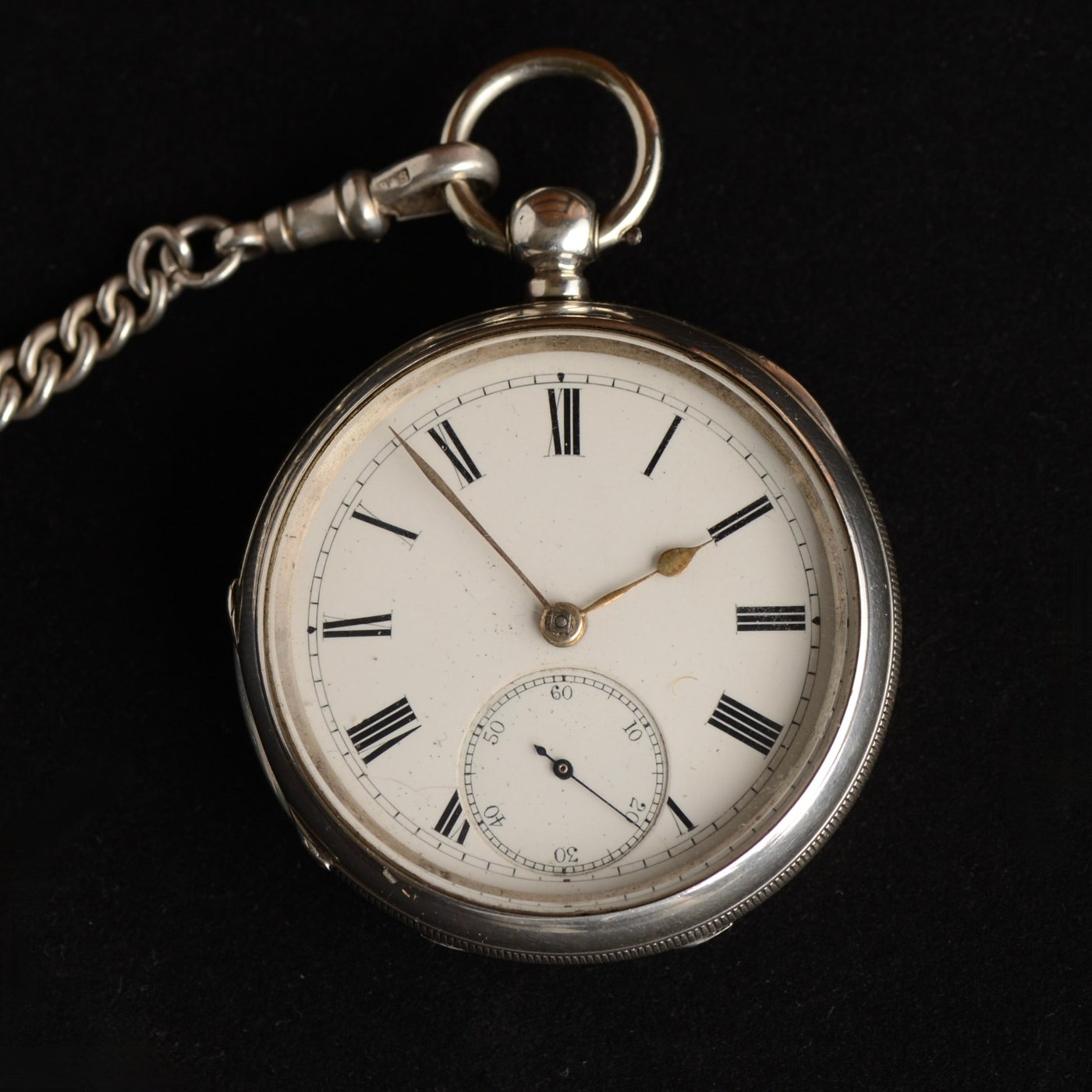
This Victorian-era pocket watch is signed by the Birmingham manufacturer William Ehrhardt and dates to 1896. The 52.5mm diameter silver case features coin-edging and a vacant cartouche on the reverse. The white enamel dial displays Roman numerals, gold-tone hands, and a subsidiary seconds register at the 6 o'clock position. Internally, the watch utilizes a traditional key-wound English lever movement. The timepiece is offered as an ensemble with a 1918 silver Double Albert chain, a silver Vesta match case hallmarked in 1910, and a silver fob hallmarked in 1921. A winding key is provided with the watch. The auction description reports that the movement is currently running. The various components, while assembled from different years, are presented as a matched set representative of traditional pocket watch accessories of the period.

Front view of the William Ehrhardt pocket watch, alongside the included Double Albert chain, silver Vesta case, and silver fob.
Front view of the William Ehrhardt pocket watch, alongside the included Double Albert chain, silver Vesta case, and silver fob. — Ashton-Blakey Vintage Watches. Rights pending — permission not yet requested. Original source

Catalogue identity

Source
ashton-blakey-antiques.com
Category
Pocket watch · English lever pocket watch
Maker / attribution
William Ehrhardt
Reference
Not recorded
Catalogue / lot identifier
Source URL identifies the listing
Source-reported date
1896
Source-reported place
England

Source-reported attribution and specifications are not independent authentication. A listing does not establish present ownership, current display, availability or permission to reproduce.

Object description

Watch Case and Dial

The pocket watch is housed in a 52.5mm diameter silver case, distinguished by a coin-edged decorative border. The reverse side of the case features a vacant cartouche, offering a plain surface without engraved monograms. The construction includes well-fitting hinges and a solid pendant bow for chain attachment.

The dial is finished in white enamel, featuring Roman numeral hour markers and a dedicated subsidiary seconds register positioned at the 6 o'clock mark. Gold-tone hands indicate the time. The dial surface is described as being preserved without significant cracks or chips.

Evidence for this section
  • “features a substantial 52.5mm silver case bearing full Birmingham hallmarks for 1896, with an attractive coin-edged surround and vacant cartouche to the reverse”
  • “classic white enamel dial with bold Roman numerals, elegant gold-tone hands and a subsidiary seconds register at 6 o'clock”
  • “The dial is beautifully preserved without major cracks or chips”

Movement and Functionality

The watch is powered by an English lever movement, which follows traditional key-wound construction. The auction description reports that the mechanism is currently in running order.

A winding key is included with the purchase to facilitate the operation of the movement.

Evidence for this section
  • “Inside is a traditional key-wound English lever movement, which appears clean and is currently running”
  • “A winding key is included”

Ensemble Components

The watch is accompanied by a collection of silver accessories. These include a Double Albert chain hallmarked for 1918, which is fitted with individually hallmarked links, a T-bar, and dog clips.

Complementing the chain is an engraved silver Vesta match case hallmarked in 1910 and a decorative silver fob featuring a gold-coloured centre, hallmarked in 1921. These pieces are presented as a matched ensemble.

Evidence for this section
  • “accompanying hallmarked silver Double Albert chain dating to 1918”
  • “ornate engraved silver Vesta match case hallmarked Birmingham 1910”
  • “attractive silver fob featuring a contrasting gold-coloured centre, hallmarked Birmingham 1921”

Open research questions

  • What specific hallmarks or assay marks are present on the case to confirm the 1896 Birmingham attribution?
  • Does the English lever movement contain identifying stamps or specific serial numbering associated with William Ehrhardt production?

Source evidence

Recorded claims and source quotations for William Ehrhardt Silver Pocket Watch with Albert Chain, Vesta and Fob
FieldSource-reported valueSource quotation
Date1896“dating to 1896”
MakerWilliam Ehrhardt“William Ehrhardt, Birmingham, England”
Case Diameter52.5mm“52.5mm silver case”
Movement TypeKey-wound English lever“traditional key-wound English lever movement”
Chain Date1918“Double Albert chain dating to 1918”
Vesta Case Date1910“silver Vesta match case hallmarked Birmingham 1910”
ConditionCurrently running“currently running”

Visible details

  • Coin-edged case surround
  • Vacant cartouche on the reverse
  • Subsidiary seconds dial at 6 o'clock
  • Ornate engraved silver Vesta case

Research qualifications

  • Historical accuracy of the 'matched ensemble' assembly is not independently verified
  • Functional longevity of the key-wound movement is not stated

Photograph identity and source facts were screened before import; rights clearance remains pending.

Terms in this record

Glossary explanations for terms named in this object’s record.